
Quick answer
Do not treat a product footprint, equipment mat, nearby outlet, transport wheel, safety key, or generic “home use” label as a complete safety check.
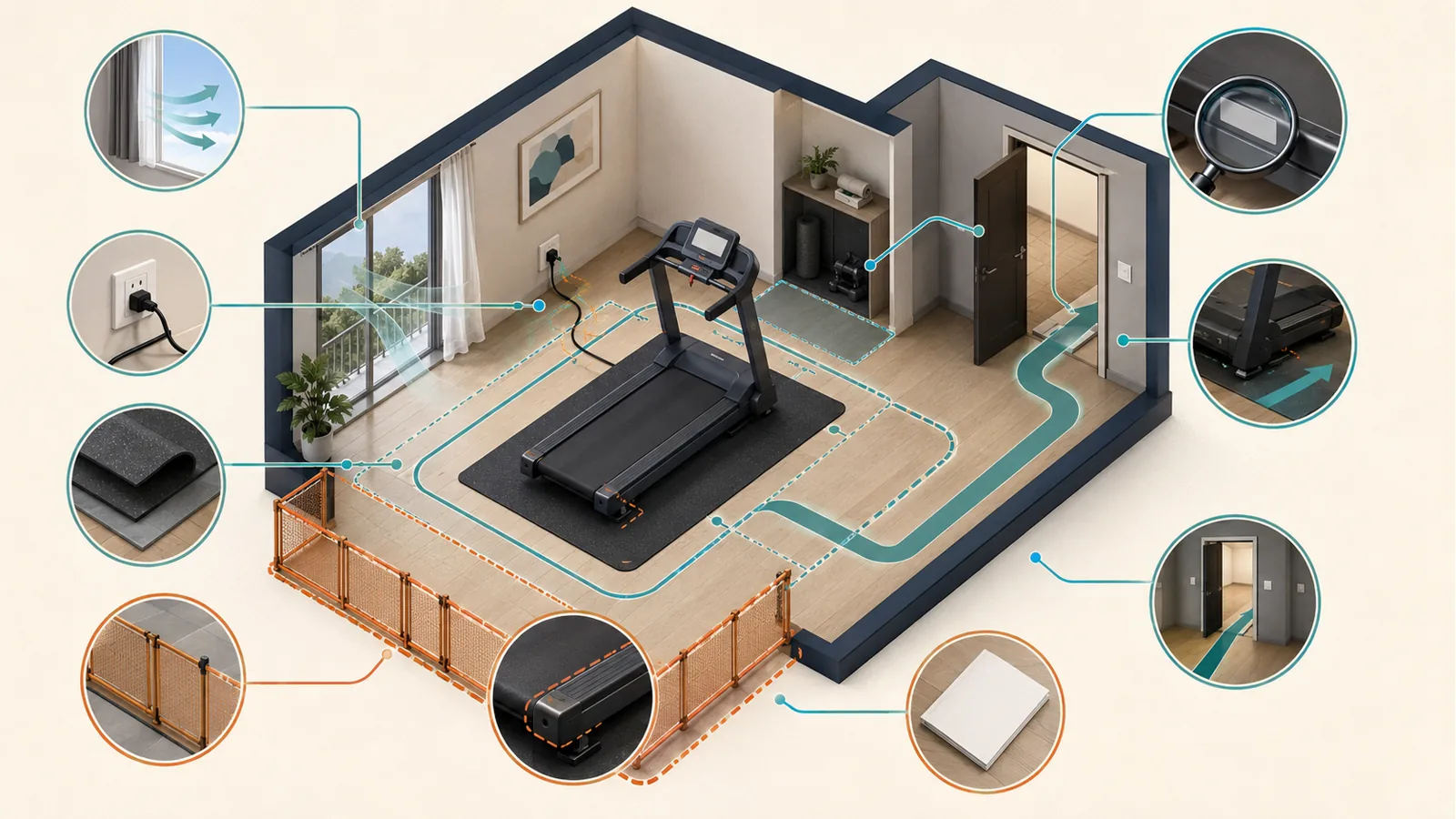
Before buying, create one exact record for the product and site, then verify: model and recall status; floor surface and finish; full equipment, tray, stand, accessory, and user loads; power, grounding, cord, and shutdown instructions; operating, access, maintenance, and escape paths; delivery, assembly, moving, and storage handling; child, pet, and unauthorized access; moving parts and loose components; moisture, ventilation, inspection, and maintenance conditions.
A documentation-complete record supports diligence only. It does not prove the installation is structurally sound, electrically suitable, legally compliant, accessible, medically appropriate, or safe for every user.
Define the exact product, room, and responsible person
Start with one dated record. Do not begin with a category label such as “treadmill,” “exercise bike,” “rower,” “adjustable dumbbell,” or “home gym.”
Record:
- exact brand, model, SKU, option, market, and checked date;
- serial or lot route when a recall, remedy, or service notice uses it;
- manufacturer manual, support page, warnings, installation instructions, and maintenance instructions;
- package, assembled, operating, access, folded, moved, stored, tray, stand, anchor, and accessory states that apply;
- room, doorway, turn, stair, elevator, floor surface, outlet, cord route, ceiling, vent, door, and escape-path facts;
- user-dependent limits and the intended operating mode;
- children, pets, visitors, roommates, caregivers, or unauthorized users who can reach the equipment;
- the person responsible for delivery, assembly, adjustment, movement, inspection, maintenance, emergency shutdown, and storage;
- every unresolved conflict or missing field.
If the product identity, room, power path, responsible person, or exact manual is unresolved, the screening outcome remains unknown pending evidence.
Use an authority ladder for every safety-adjacent question
Use the most specific applicable source.
| Question | First source | Escalate when |
|---|---|---|
| Product setup, limits, clearances, power, maintenance, and warnings | Exact current manufacturer manual or support record | Instructions are missing, contradictory, damaged, or outside the planned site |
| Recall, warning, remedy, and stop-use status | CPSC exact-model notice and current recall search | Identity, serial/lot scope, remedy, or seller status is unresolved |
| Outlet, circuit, grounding, cord, heat, moisture, or installation | Exact manufacturer requirement plus applicable qualified electrician | Site wiring, outlet type, circuit, code, damage, or compatibility is uncertain |
| Floor finish, mat, tray, stand, and surface condition | Exact equipment/accessory and flooring instructions | Finish compatibility, load, fastening, moisture, or warranty effect is unknown |
| Structural capacity, anchoring substrate, ceiling/wall support | Qualified building or structural professional | Any structural conclusion is material |
| Accessibility or route compliance | Applicable standards and U.S. Access Board technical assistance | Physical measurements are being used as a legal or compliance conclusion |
| Lease, building, HOA/condo, or local rule | Exact current governing document and qualified help when needed | Interpretation, permission, liability, or code scope is disputed |
The publication’s reviewed safety-source framework supports source routing and editorial boundaries. It does not certify the product, site, circuit, floor, anchor, or installation.
Check exact identity, recall, warning, and remedy status first
Search the exact model before comparing convenience features. Use the current CPSC recall route, the manufacturer recall route, and the product label.
Record:
- exact product name and model;
- serial or lot range when the notice uses one;
- hazard and affected configuration;
- notice date and checked date;
- required stop-use, repair, refund, replacement, disposal, or inspection action;
- whether the remedy is complete for the exact unit.
The current CPSC Sperax warning identifies specific walking-pad and treadmill models and instructs consumers to stop using them. The Johnson treadmill recall identifies specific Matrix and Vision models and serial scope related to a power-cord connection. The Peloton Tread+ recall identifies model TR01 and an entrapment hazard involving children, pets, adults, and objects. The BowFlex notice identifies exact 552 and 1090 models and serial ranges involving plates that can dislodge.
These are identity examples, not category rules. Do not transfer a recall to another product merely because it shares a brand or mechanism. Do not clear a product because a different model is the one named. No matching search result is not a safety certification.
Verify the floor surface and protection system without claiming structural safety
Separate four questions:
- Is the equipment allowed on the exact surface stated by the manufacturer?
- Does the surface remain level, stable, dry, clean, and unobstructed in the required operating state?
- Is a tray, stand, foot, cap, mat, underlayment, or protective layer required or optional?
- Can the actual floor finish and protection material coexist without staining, softening, trapping moisture, slipping, curling, or voiding a warranty?
Record the complete contact system:
Equipment or accessory → feet, frame, tray, stand, wheels, or anchor → mat or pad, if used → floor finish → subfloor or structural assembly.
Concept2 describes its RowErg mat as helping protect the floor and reduce slippage. That supports a source-stated accessory function for the named configuration. It does not prove compatibility with every floor finish, eliminate movement, reduce impact transmission to a neighbor, or establish structural capacity.
Do not use one product’s mat dimensions, material, or claim as a universal floor-protection specification.
Treat floor-load and structural questions as escalation triggers
A product weight or footprint does not determine whether a floor, platform, mezzanine, shelf, wall, ceiling, or anchor point is suitable.
The following can matter:
- equipment, stand, plates, accessories, and user load;
- static, moving, impact, concentrated, and repeated loads;
- foot, wheel, plate, anchor, or contact area;
- location relative to joists, supports, damaged areas, transitions, or openings;
- floor assembly, condition, finish, subfloor, and moisture;
- anchored versus freestanding configuration;
- local building conditions and permissions.
This page does not calculate structural load, allowable floor capacity, anchor capacity, fastener selection, or code compliance.
Require a qualified structural professional when a structural conclusion is material, when the manufacturer requires anchoring but the substrate is unknown, when the floor is damaged or visibly deflects, when the planned support differs from the manual, or when the responsible party cannot verify the building condition.
Verify electrical supply, grounding, cords, and shutdown
Create an exact power record:
- product voltage, frequency, current, plug, and power-supply requirements;
- dedicated-circuit requirement, when stated;
- grounding instructions;
- outlet type and location;
- cord length and route;
- extension-cord, power-strip, surge-protector, adapter, or GFCI instructions;
- moisture and indoor-environment limits;
- shutdown, unplugging, safety-key, and maintenance steps;
- damaged-cord, loose-plug, heat, odor, sparking, trip, and fault behavior;
- qualified-electrician escalation.
USFA electrical-fire guidance advises against overloaded outlets and damaged cords, and warns against routing cords where they can be pinched or damaged. The checked Horizon records state manufacturer-specific treadmill electrical requirements and power-up instructions. Those records are dated examples, not a current fetch or a generic rule, and may not be transferred to every product or used to interpret local electrical requirements.
If the exact manual and the actual site cannot be reconciled, stop. Do not modify a plug, defeat grounding, select an adapter, diagnose wiring, or decide circuit suitability from this article. A qualified electrician is required.
Keep operating, access, maintenance, and escape paths separate
Do not collapse all space needs into one footprint.
Record:
- product envelope;
- operating movement envelope;
- manufacturer clearance;
- entry and exit path;
- emergency dismount or stop path;
- maintenance and service access;
- ventilation openings;
- cord and controller path;
- folding or movement sweep;
- stored and retrieval states;
- doorway, window, circulation, and escape route.
The checked Horizon placement and clear-zone record illustrates why the exact manual matters; its values are not generic treadmill or home-fitness clearances.
USFA advises keeping doorways and windows clear for escape. This page may block a proposed placement that obstructs a known exit or required route. It does not determine code, egress width, accessibility, or legal compliance.
Plan delivery, assembly, folding, moving, and storage handling
A product that fits in the operating position may still fail its delivery, assembly, movement, or retrieval workflow.
Record:
- package count, size, weight, orientation, and handling warnings;
- doorway, stair, elevator, landing, turn, threshold, and floor protection;
- delivery-team and resident responsibilities;
- assembly area, tools, fasteners, torque, leveling, and inspection;
- number and capability of people required by the instructions;
- folded or moved state, latches, wheels, handles, supports, and pinch points;
- stored orientation, restraints, accessories, and retrieval path;
- return or service path if the unit is damaged or unsuitable.
The checked Horizon placement record warns that its treadmills are heavy and calls for care and additional help when needed. That does not provide a universal lifting limit or establish that a route is manageable.
Do not infer easy handling from transport wheels, a folding hinge, “compact” wording, or product weight alone.
Control child, pet, and unauthorized access
The control plan must cover use, idle time, cleaning, maintenance, storage, and power loss.
Record:
- who can access the room and equipment;
- whether the room can be secured;
- safety-key, lock, passcode, power, remote, selector, and accessory storage;
- exposed belts, rollers, chains, flywheels, fans, pulleys, hinges, pins, cables, plates, and anchors;
- under-equipment and behind-equipment access;
- loose weights, balls, benches, cords, remotes, and tools;
- supervision and emergency response.
Peloton’s Tread safety guidance tells users to keep children, pets, and objects away, remove and separately store the safety key, and unplug before cleaning or when not in use. That is product-family guidance, not a universal age threshold or complete household-safety rule.
Concept2’s RowErg return-mechanism cover is described as protecting the mechanism from dust and helping keep little fingers and pet tails away from moving parts. That exact accessory example shows why guards and covers must be identified, retained, and inspected.
If children or pets can reach a hazardous moving or stored state and the access plan cannot be controlled, rework the configuration, leave the equipment category, or do not purchase or defer the decision.
Check moving parts, pinch points, entrapment, and loose components
Inspect the exact instructions for:
- running belts, rear rollers, chains, flywheels, fans, pulleys, cables, arms, and linkages;
- folding hinges, latches, locks, selector pins, dials, plates, trays, screws, and stands;
- guards, covers, shrouds, keys, clips, and interlocks;
- engagement indicators and pre-use checks;
- damaged, missing, loose, misaligned, or recalled components;
- clothing, hair, jewelry, fingers, tails, toys, and objects entering the mechanism;
- emergency stop and power isolation.
The BowFlex recall demonstrates why exact model, serial, tray, handle, and plate identity can matter. The Peloton Tread+ recall demonstrates why under-belt and rear-roller access can matter. Neither notice authorizes a general verdict about another product.
Do not use appearance, a guard name, a lock icon, or an app feature as proof that the hazard is controlled.
Preserve ventilation, moisture, inspection, and maintenance conditions
Record the environmental and upkeep conditions named by the manufacturer:
- indoor or climate-controlled use;
- temperature and humidity limits;
- distance from water or moisture;
- ventilation and blocked-opening restrictions;
- dust, pet hair, debris, and cleaning access;
- inspection frequency;
- lubrication, alignment, fastener, belt, cable, plate, guard, and anchor checks;
- damaged-component and out-of-service rules;
- qualified service requirements.
A device that powers on is not automatically suitable to use. Heat, burning odor, repeated breaker trips, damaged cords, loose connections, unusual movement, missing guards, unstable support, or unresolved recall status are stop conditions—not troubleshooting invitations for an unqualified buyer.
Scenario: motorized treadmill or walking pad
Use one exact-model workflow:
- bind the product label, serial route, current manual, recall search, and remedy status;
- verify indoor environment, level and stable surface, floor-protection configuration, and full operating/access/escape paths;
- verify exact circuit, grounding, outlet, cord, and prohibited accessory instructions;
- keep ventilation openings and the cord route clear;
- bind safety key, emergency stop, lock/passcode, child/pet access, and object-control steps;
- inspect belt, rollers, guards, covers, latches, and power connection;
- define shutdown, unplugging, cleaning, maintenance, and out-of-service behavior.
A current Sperax warning or Johnson recall requires its exact stated action. A generic treadmill checklist cannot override a stop-use notice or remedy.
Scenario: bike, rower, flywheel, or fan equipment
Verify:
- leveling feet, stabilizers, contact points, mat or floor instructions;
- operating sweep of pedals, cranks, handles, seat, rail, chain, fan, or flywheel;
- mount and dismount route;
- user adjustment and locking points;
- child/pet access to moving parts;
- wall, ceiling, furniture, and circulation conflicts;
- power, adapter, cord, battery, display, and maintenance instructions where present;
- storage or separation steps when the product is designed for them.
A freestanding machine can still require a complete access and escape record. A mat can support floor protection or slippage control in a named configuration without proving structural, acoustic, or universal stability results.
Scenario: dumbbells, benches, and loose weights
Record the whole system:
- pair or single scope;
- dumbbells, plates, handles, trays, cradles, stand, bench, pins, screws, and accessories;
- selected-weight and stored dimensions;
- retrieval height and hand access;
- floor surface and drop/impact boundary;
- rolling, tipping, loose-part, pinch, and dislodgement risks;
- exact recall and serial/lot route;
- child/pet and unauthorized access;
- maintenance and replacement parts.
Do not infer that a tray, stand, selector, or non-round shape prevents every movement or impact. Do not treat a floor mat as permission to drop weights or as structural protection.
If exact recall identity, plate engagement, bench setup, load instructions, or storage control is unresolved, keep the result unknown or defer purchase.
For a separate exact-product record, see the BowFlex SelectTech 552 product analysis, which keeps generation, recall, pair/tray, handling, manual, and ownership unknowns explicit rather than treating specifications as a safety clearance.
Scenario: wall-mounted, anchored, or ceiling-dependent equipment
Before crediting a compact footprint, identify:
- exact mounting template and hardware;
- required wall, ceiling, floor, or structural substrate;
- fastener and anchor instructions;
- assembly, torque, leveling, and inspection requirements;
- cable, arm, door, body, and accessory sweep;
- maintenance and emergency access;
- landlord, owner, installer, or building permission;
- disassembly and repair obligations.
This article cannot select anchors, confirm a stud or substrate, approve a wall, calculate capacity, or certify installation. Require qualified structural, accessibility, or legal assistance when those determinations are material.
Evaluate mats, pads, and floor protectors cautiously
A mat or pad can have several separate proposed functions:
| Proposed function | Evidence needed | What it does not prove |
|---|---|---|
| Protect floor finish | Exact product/accessory and flooring compatibility | Structural capacity, no staining, or every finish |
| Reduce slipping | Exact contact surfaces and operating configuration | No movement under every user or intensity |
| Catch sweat or debris | Material, coverage, cleaning, and moisture plan | Electrical or mold safety |
| Reduce impact or vibration | Defined source, path, receiver, protocol, and result | Neighbor acceptance or structural safety |
| Level or stabilize | Manufacturer permission and exact setup | Permission to shim or modify the product |
Do not stack improvised materials, block vents, cover cords, hide damage, change leveling geometry, or use a mat to compensate for an unsuitable surface unless the exact instructions permit the configuration.
Synthetic safety-screening examples
The cases below are fictional test data. They do not describe a real product, residence, circuit, floor, child, pet, or installation.
Case A — motorized equipment with unresolved power
- Exact model and manual are known.
- The manual requires a grounded dedicated circuit.
- The buyer does not know which outlets share the circuit.
- An extension cord is the only proposed route.
Outcome: require a qualified electrician, or do not purchase or defer the decision. A nearby outlet is not enough evidence.
Case B — mat selected but floor and structure unresolved
- A manufacturer accessory says it helps protect the floor and reduce slippage.
- The buyer has a finished floor with unknown material compatibility.
- Structural condition and concentrated-load questions are material.
Outcome: unknown pending evidence, with a qualified structural professional required when the structural question controls the decision.
Case C — exact recall match
- Product label, model, and serial range match a current CPSC notice.
- The stated remedy is not complete.
Outcome: follow the action required by the exact recall. The product is not returned to the shortlist by a generic safety checklist.
Case D — child or pet access cannot be controlled
- The machine has exposed moving parts in use and stored states.
- The room cannot be secured.
- Keys, remotes, plates, or cords remain accessible.
Outcome: rework the configuration, leave the equipment category, or do not purchase or defer the decision.
Case E — proposed placement blocks the known escape route
- Product footprint fits.
- Operating or stored position narrows a doorway used for escape.
- No alternative placement preserves the route.
Outcome: rework the configuration, or do not purchase or defer the decision. No code-width conclusion is made.
Case F — wall-mounted system with unknown substrate
- Product instructions require anchoring.
- Wall construction and approved fastener system are unknown.
- The seller’s installer scope is unclear.
Outcome: a qualified structural professional is required. A marketing image is not installation evidence.
Stop and escalate when the evidence cannot answer the risk
Stop the purchase, setup, movement, or use decision when:
- an exact recall or warning action applies;
- identity, serial, lot, manual, or remedy status is unresolved;
- the product is damaged, unstable, missing a guard, or has a damaged cord or plug;
- power, grounding, circuit, outlet, moisture, or code questions remain material;
- the floor, wall, ceiling, anchor, platform, or support condition requires structural judgment;
- operating, maintenance, movement, or escape paths overlap;
- delivery or movement cannot follow the instructions;
- children or pets cannot be excluded from a material hazard;
- the planned mat, stand, shim, adapter, extension, anchor, or modification is not supported;
- accessibility, lease, installation, medical, or legal interpretation is required;
- sources conflict on a material limit or setup.
Use the outcome that matches the unresolved decision:
- Unknown pending evidence.
- Configuration rework required.
- Action required by the exact recall.
- Qualified electrician required.
- Qualified structural professional required.
- Qualified accessibility or legal assistance required.
- Leave the equipment category.
- Do not purchase or defer the decision.
Prohibited interpretations
This guide does not support any of the following:
- “The floor is strong enough.”
- “The mat makes the setup safe.”
- “This outlet or circuit is suitable.”
- “The installation meets code.”
- “The clearance is universally sufficient.”
- “The doorway or route is legally accessible.”
- “Transport wheels make it easy or safe to move.”
- “The safety key protects every child or pet scenario.”
- “No recall search result means the product is safe.”
- “A guard, cover, lock, app, or passcode eliminates the hazard.”
- “The product is safe for this person, condition, or exercise.”
- “The equipment can be used because it powered on.”
- “The landlord, insurer, building, or manufacturer will accept the setup.”
Safe fallback when uncertainty remains
Use the least assumptive outcome:
- preserve the current floor, exit, cord, and access path;
- do not modify plugs, guards, anchors, latches, or structural supports;
- choose equipment that does not require the unresolved condition;
- use manufacturer-authorized delivery, installation, service, or repair;
- obtain qualified electrical, structural, accessibility, legal, medical, or installation help when that conclusion controls the decision;
- keep the product out of service when a stop-use, damage, or unresolved remedy condition applies;
- defer purchase when the required evidence cannot be obtained.
A no-purchase result is a valid safety outcome.
Handle missing or conflicting information
Keep every record separate by exact product, model, serial/lot, market, state, source, version, checked date, room, surface, outlet, and user scenario.
Do not:
- average conflicting clearances, limits, weights, or electrical requirements;
- choose the smaller clearance to make a room pass;
- choose the larger load limit to retain a product;
- replace an unknown circuit or floor condition with a generic assumption;
- transfer a recall between products;
- infer a stored or anchored state from a marketing photo;
- treat a seller answer as a qualified electrical or structural assessment;
- hide an unresolved manufacturer-versus-site conflict;
- call missing evidence “not applicable” without a reason tied to the decision.
Name the missing field, the authority required to resolve it, and the exact decision it blocks.
Next step
Use the live FitFootprint room-measurement guide to create the room, delivery-route, operating, access, and storage record, then use Home Fitness Equipment Dimensions Explained to keep stated, operating, folded, stored, and access dimensions separate.
The documentation-only WalkingPad A1 Pro source-state analysis shows how exact-product identity, power, room, route, controls, ownership terms, source conflicts, and direct-evidence gaps can remain unresolved even when a product page lists specifications.
For a separate exact-product bike record, see the Schwinn IC4 small-space analysis; it keeps model, app, fit, safety, and recommendation limits explicit rather than treating specifications as a clearance finding.
The documentation-only Core Fitness Adjustable Dumbbells analysis is the current product-analysis destination for exact identity, cradles, dynamic footprint, current terms, and unresolved buyer inputs; it does not establish a safety, fit, or purchase result.
For a dedicated folding-bench storage and handling record, see the folding weight bench buyer guide for small home gyms; it keeps source-attributed states and unresolved handling, fit, and safety questions separate.
For a product-specific rower analysis that keeps room, storage, water, handling, and safety unknowns explicit, see WalkingPad WR20 Folding Rower: Space, Storage, Cost, and Limitations.
For a product-specific fan-bike analysis that keeps room, power, clearance, and safety unknowns explicit, see Schwinn AirDyne AD7 for home use: space, noise, cost, and limitations.
For delivery, assembly, and return planning, see Doorways, Stairs, Delivery, Assembly, and Returns: A Large-Equipment Checklist.
For product-and-site power questions, see Power, Outlets, Cords, and Placement for Motorized Home Fitness Equipment.
The documentation-only WalkingPad C2 source-state analysis applies the same safety-screening boundary to another exact-product record while preserving unresolved identity, source conflicts, buyer inputs, and the absence of direct evidence. For connected-fitness continuity and lock-in risk, see App Shutdown, Data, Subscription, and Device Lock-In Risks in Smart Fitness.
Methodology
This guide applies the publication’s reviewed safety-source framework to the retained regulator and manufacturer examples rechecked on August 22, 2026. It separates product identity, recall scope, floor finish, structural escalation, electrical requirements, operating/access/escape paths, handling, household access, moving parts, maintenance, and specialist conclusions.
No product, home, floor, outlet, circuit, route, anchor, child/pet scenario, or installation was inspected. The exact manufacturer and CPSC examples are not category rules. Apply each check to the exact product and scenario; a material source, identity, method, or claim change requires a fresh review.
Sources
- U.S. Consumer Product Safety Commission — Recalls & Product Safety Warnings — exact-product search route accessed August 22, 2026.
- U.S. Consumer Product Safety Commission — CPSC Warns Consumers to Stop Using Sperax Walking Pads and Treadmills Immediately — exact models and warning scope accessed August 22, 2026.
- U.S. Consumer Product Safety Commission — Johnson Health Tech Expands Recall to Include Matrix Retail and Vision Treadmills — exact model/serial and power-cord remedy scope accessed August 22, 2026.
- U.S. Consumer Product Safety Commission — Peloton Recalls Tread+ Treadmills — model TR01 and entrapment scope accessed August 22, 2026.
- U.S. Consumer Product Safety Commission — Johnson Health Tech Trading Recalls BowFlex Adjustable Dumbbells — exact 552/1090 model and serial scope accessed August 22, 2026.
- U.S. Fire Administration — Appliance and Electrical Fire Safety — outlet, cord, and power-strip diligence accessed August 22, 2026.
- U.S. Fire Administration — Hoarding and Fire Safety — clear doorway/window escape-path scope accessed August 22, 2026.
- U.S. Access Board — Technical Assistance — accessibility interpretation and escalation route accessed August 22, 2026.
- Horizon Fitness — Where To Put Your Treadmill — manufacturer-specific placement, grounding, clearance, and handling example accessed August 22, 2026.
- Horizon Fitness — Treadmill Electrical Requirements — recheck attempted August 22, 2026; the support route redirected to an unsafe HTTP URL in this environment, so no freshness or new claim was inferred.
- Horizon Fitness — How to Power Up Your Treadmill — manufacturer-specific safety-key, shutdown, and power example accessed August 22, 2026.
- Peloton — Safety Guidance — Tread child/pet/object, safety-key, unplugging, and maintenance scope accessed August 22, 2026.
- Concept2 — RowErg Floor Mat — exact accessory floor-protection/slippage claim accessed August 22, 2026.
- Concept2 — Return Mechanism Cover—RowErg — exact moving-part cover and little-finger/pet-tail scope accessed August 22, 2026.