
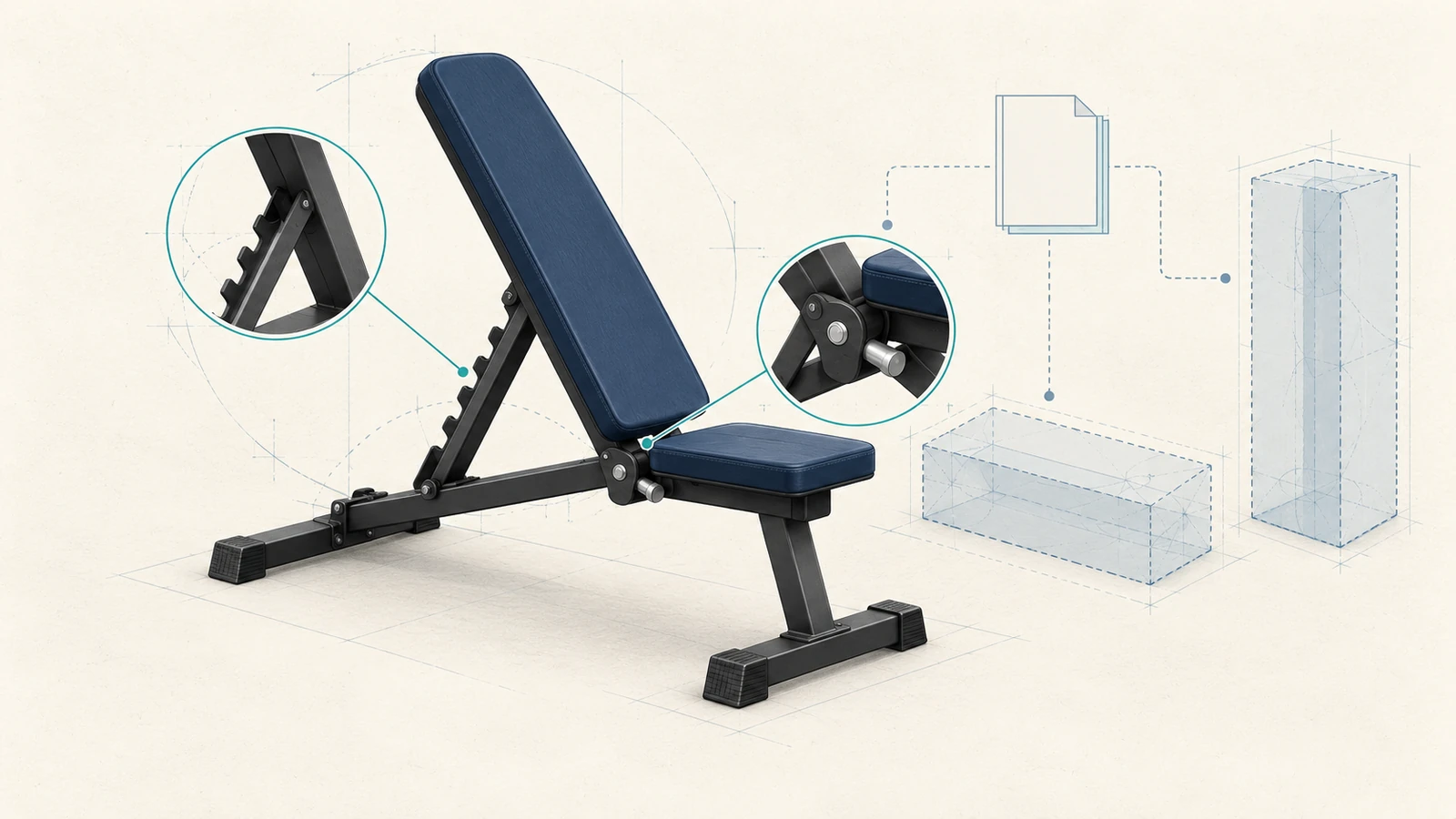
Quick answer
A folding bench can reduce its stored footprint only when the exact model has a verified folded or stowed state, a documented orientation, a resolvable lock or support mechanism, and a route that works in both directions. “Folds flat,” “stores upright,” and “can be stored vertically” describe different equipment states. None proves that a bench will fit under your bed, remain acceptable beside a wall, clear your rack, or be practical to move after every session.
Start with your exercise and load requirements, then measure the operating zone and the storage destination separately. Reject any candidate whose load statement, fold sequence, stored orientation, exact manual, or route remains material and unresolved. A no-purchase or defer outcome is valid.
Buyer problem and scope
The buyer problem is not simply finding the bench with the smallest product dimensions. A small-room bench has to satisfy a chain of constraints:
- the exact model and revision must be identifiable;
- the required back and seat positions must exist;
- the manufacturer’s load statement must cover the intended user-plus-load scenario;
- the bench must fit while operating, not only while folded;
- the folded or stowed object must fit the storage destination in the permitted orientation;
- the buyer must be able to reach, unlock, fold, move, retrieve, reopen, and inspect it;
- any rack, dumbbell, attachment, spotter, or escape-path requirement must still fit;
- return, warranty, replacement-part, and packaging burdens must be acceptable.
This guide focuses on free-standing benches sold for home strength training. Integrated Olympic benches, power-tower systems, commercial gym benches, and benches whose exact current identity cannot be verified are outside the primary example set.
Shortlist summary
| Buyer requirement | Evidence-safe routing |
|---|---|
| Low under-bed or closet height | Start with a true fold-flat model that publishes all three stored axes; still verify orientation, handle clearance, and the route. |
| Upright storage beside a wall | Use a model that explicitly publishes an upright stowed state; do not rotate a fold-flat bench into an undocumented orientation. |
| Frequent move-and-store routine | Compare product weight, actual handle location, wheel contact, thresholds, and turns; wheels alone do not prove one-person handling. |
| Barbell work inside a rack | Measure the bench, rack, bar path, plate path, safeties, spotter access, and bench adjustment path as one operating system. |
| Exact manual or locking state unresolved | Defer. A marketing image is not a fold, latch, or support instruction. |
| No folding candidate satisfies the scenario | Consider a vertically stored non-folding bench, a simpler flat bench, a permanent bench location, or no purchase. |
Current candidate universe
The current example set contains three currently reachable folding or stowable manufacturer records, one route-withdrawn earlier record, and one transport-limited adjacent vertical-storage benchmark:
- BowFlex 5.1S Adjustable Weight Bench — upright stowed state.
- FLYBIRD WP129 — the exact accepted route now returns HTTP 404 and is withdrawn from the current candidate set.
- HOIST HF-4145 — heavier fold-flat state with wheels and numeric stored dimensions.
- Inspire Folding Adjustable Bench — fold-flat claim, but no numeric folded envelope on the checked page.
- REP AB-4100 — non-folding vertical-storage alternative; exact current figures were not refreshed because the accepted route was DNS-transport-limited during this recheck.
Every retained record comes from an accepted official manufacturer or regulator route. The current set is bounded and non-exhaustive. A route withdrawal or transport limitation is not a product verdict, availability result, safety result, or recommendation.
Inclusion and exclusion rules
A product enters the primary folding set only when the current U.S.-facing official record provides:
- a stable model name or code;
- a clear folding or stowing claim;
- an assembled or operating envelope;
- at least one stored-state description;
- a load statement;
- adjustment-position information;
- a manual, support, warranty, or policy route that can be rechecked;
- no known exact-model stop-use instruction in the reviewed source set.
The set excludes marketplace-only listings, model-ambiguous benches, retired pages used as if current, integrated rack systems with a different buyer problem, and products selected because of affiliate availability. The REP AB-4100 is labelled as an adjacent alternative rather than a folding candidate.
Fold-flat, stow-upright, and vertical-storage are different
A fold-flat bench collapses into a lower-height object. The key fields are folded length, folded width, folded height, orientation, and what protrudes during folding.
A stow-upright bench reduces floor depth by standing in a manufacturer-documented state. Its height can increase. The BowFlex 5.1S, for example, is listed at 52.3 inches high in the stowed state, even though its stowed depth is 23.9 inches. The current BowFlex product record therefore cannot be treated as an under-bed candidate from the word “stowable” alone.
A vertical-storage bench may not fold at all. REP describes the AB-4100 as having a built-in upright storage post, but the checked REP bench guide does not turn it into a folding bench. These three states must remain separate in every room plan and product table.
Lock the exact model and current manual
Record the manufacturer, exact model code, market, seller, checked date, manual revision, and any serial or production-range information before relying on a fold or load instruction. Similar product names, revised pads, updated frames, and retailer bundles can change the applicable record.
For adjustable-dumbbell storage and small-space selection context, the live Adjustable Dumbbell Buyer Guide is a separate descriptive reference; it does not supply a folding-bench fit result.
The buyer should be able to answer:
- Which exact page and manual belong to this bench?
- Which pin, hinge, ladder, support bar, leg, or latch creates the operating state?
- Which parts move during folding?
- Which parts must be removed or repositioned?
- What state is required before lifting or rolling?
- Is the intended storage orientation documented?
If those questions cannot be answered from the exact model’s current documentation, the product remains a defer candidate.
Measure the operating envelope
The product’s assembled length and width are not the complete operating requirement. Add the buyer’s actual adjustment path, body position, dumbbell or bar path, rack footprint, safety hardware, spotter zone, and an unobstructed exit path.
Use the live FitFootprint space-measurement workflow to record the room, doorway, turns, operating location, storage location, and return path. For dimension definitions, use Home Fitness Equipment Dimensions Explained. Do not add a universal clearance number. The required space depends on the exact movement, equipment combination, and room.
Measure the folded or stowed envelope
A stored-state record needs all three axes and the orientation attached to them. “Saves 70%” or “fits under a bed” is not enough.
The currently reachable records illustrate why:
- the HOIST HF-4145 lists 48.25 by 17 by 9.25 inches when folded flat;
- the BowFlex 5.1S lists 23.9 by 28.1 by 52.3 inches when stowed upright;
- the Inspire page says the bench folds flat but does not publish a numeric folded envelope on the checked route.
The FLYBIRD WP129 stored dimensions from the earlier record are not carried forward as current because its exact accepted route returned HTTP 404. REP AB-4100 stored dimensions were not refreshed because the accepted route was transport-limited. These values cannot be mixed across products or rotated into a different orientation without manufacturer support.
Verify the storage orientation
For each candidate, record whether the documented state is:
- flat on the floor;
- upright on an integrated support;
- hanging from a compatible hook;
- under furniture;
- inside a closet;
- or unspecified.
Then check ceiling, shelf, baseboard, door, furniture, wall, moisture, child/pet, and retrieval constraints. A product photo or marketing phrase does not authorize leaning, hanging, stacking, or storing the bench on a side not identified by the manufacturer.
Verify the fold and lock sequence
The fold mechanism is part of the equipment, not just a convenience feature. Identify every support bar, pin, hinge, leg, ladder, seat, and back-pad state involved in moving between operating and storage modes.
The HOIST HF-4145 page links a model-specific manual, while the Inspire page links its warranty/manual area. The FLYBIRD WP129 route is withdrawn after the exact accepted URL returned HTTP 404, so its earlier manual reference is not current evidence. Do not transfer a sequence from one bench to another. If a required pin is missing, bent, difficult to seat, or not visibly engaged, stop and use the manufacturer’s support path.
Confirm the load statement operator
A capacity number is usable only when its operator is known. Possible source meanings include:
- user plus external load combined;
- external load only;
- user weight only;
- distributed static load;
- a product-page maximum with no visible operator.
The BowFlex 5.1S explicitly labels 600 pounds as maximum user plus load weight. Other pages may state only “maximum weight” or “weight capacity.” Do not silently convert those phrases into the BowFlex operator or apply an invented safety margin.
Separate user weight from external load
For a combined user-plus-load statement, the buyer scenario must include body mass plus the dumbbells, barbell, plates, and any other load applied to the bench. For a source that does not define the operator, mark the result unresolved and obtain exact documentation.
A capacity gate is only one screening condition. It does not prove weld quality, hinge engagement, floor suitability, stability, exercise technique, or the absence of a recall.
Back-pad positions and exact angles
Count labels are not enough. Record the exact angles and whether flat and decline are included.
Examples from the retained current pages:
- BowFlex lists decline at -20 degrees, flat, and four incline settings through 90 degrees.
- HOIST lists five exercise angles from -15 to 65 degrees.
- Inspire describes one decline, flat, and four incline positions.
- The former FLYBIRD count/value record is not current because the accepted WP129 route returned HTTP 404.
Do not use the withdrawn FLYBIRD count or values for a current fit or recommendation decision.
Seat-pad positions and pad gap
A back-angle list does not describe the whole bench. Record seat-angle positions, whether the seat moves with the back, the pad gap, and any foot-catch or leg-roller requirement.
The former FLYBIRD seat-angle record is not current because the accepted WP129 route returned HTTP 404. The BowFlex page says the seat adjusts but does not expose a complete seat-angle list on the checked product route. HOIST and Inspire require their own exact records. Missing values remain unknown rather than becoming flat or zero.
Pad length, width, and user-fit limits
Pad dimensions can affect support and rack placement, but a manufacturer height range or pad size is not a medical or ergonomic certification. The former FLYBIRD height-range statement is not carried forward as current because the accepted WP129 route returned HTTP 404. The REP AB-4100 exact figures are also not promoted as current while its accepted route remains transport-limited.
Measure the buyer and the required exercise positions, then compare with the documented pad length, width, and configuration. When head, shoulder, hip, foot, or accessibility requirements are uncertain, defer to the manufacturer or a qualified professional rather than extrapolating from height alone.
Rack, dumbbell, and attachment clearance
A folding bench may fit the room yet fail inside a rack or during adjustment. Record:
- rack interior width and depth;
- bench front/rear feet and wheel positions;
- bar and plate path;
- safeties and J-cup positions;
- spotter access;
- bench handle and adjustment access;
- decline foot-catch or attachment footprint;
- the path for rolling the bench into and out of the rack.
Do not use a bench’s product footprint as a substitute for the complete rack-based operating system.
Floor, feet, and movement path
Inspect the exact floor and the bench’s contact points, but do not make a structural, slip, or floor-protection conclusion from product photography. A narrow bench, a tripod front foot, and a wide rear crossbar create different contact patterns.
The buyer must verify the operating surface, route thresholds, rug edges, door tracks, floor transitions, and any mat interaction. A folded bench that fits the destination can still fail the route.
Product weight, handles, and wheels
The currently rechecked source-stated product weights are:
- Inspire Folding Adjustable Bench: 33 pounds;
- HOIST HF-4145: 53 pounds;
- BowFlex 5.1S: 60 pounds.
The former FLYBIRD 20.9-pound and REP AB-4100 85-pound figures remain in the earlier research history but are not promoted as current after the FLYBIRD route withdrawal and REP transport limitation. These numbers do not prove one-person handling. Wheels may work only after the bench is tipped to a specific angle and may not help with stairs, thresholds, carpet, tight turns, or lifting into storage. Record the actual handle, wheel contact, balance point, and route before accepting a move-after-every-session plan.
Assembly, fasteners, inspection, and maintenance
Treat assembly and inspection as model-specific. The HOIST product page says “no assembly required,” while its linked HF-4145 owner’s manual contains an assembly section and tool list. This conflict should be confirmed with the seller rather than resolved by assumption.
Inspire’s current equipment-safety guidance tells users to read the owner’s manual and warning labels, inspect items such as nuts and bolts, and address loose or damaged parts. The live home-fitness safety checklist provides a separate floor, power, clearance, handling, and household-diligence workflow; neither route is a claim that any candidate has passed inspection.
Shipping, packaging, returns, and warranty
A folding bench can create meaningful return and storage burdens even when product price is not the main decision.
- HOIST states a 30-day return period, customer-paid return shipping, and a 20% restocking fee except for stated seller/freight causes.
- Inspire’s current return policy states a 15-day window, customer-paid shipping/handling, possible 20% restocking, and a 30% repackaging fee when original packaging is absent.
- BowFlex’s current product route displays a dated promotional price and conditional free-shipping language; the product route also exposes an Add to Cart control. The BowFlex delivery page is a generic template and does not substitute for an exact checkout quote. No successful checkout was observed.
Keep packaging until the buyer understands the return requirements. Warranty duration does not prove free freight, successful service, parts availability, or a replacement timeline.
Current examples at a glance
| Exact current record | Storage architecture | Operating source state | Stored source state | Source-stated load | Product weight | Material unresolved point |
|---|---|---|---|---|---|---|
| BowFlex 5.1S | Upright stowable | 61.3 × 28.1 × 49.5 in | 23.9 × 28.1 × 52.3 in | 600 lb user + load | 60 lb | Dated promotion and conditional shipping are not a checkout quote. |
| FLYBIRD WP129 | Current route withdrawn | Not carried forward | Not carried forward | Not current | Not current | Exact accepted route returned HTTP 404 after redirect. |
| HOIST HF-4145 | Fold-flat | 52.5 × 17.25 × 44 in | 48.25 × 17 × 9.25 in | 500 lb maximum | 53 lb | Product page says no assembly; linked manual contains assembly content. |
| Inspire Folding Adjustable Bench | Fold-flat | 17 × 52 × max 41 in | Numeric folded dimensions not published on checked route | 500 lb | 33 lb | Sold out and Add to Cart both render. |
| REP AB-4100 | Vertical storage, not folding | Not promoted as current | Not locked | Not current | Not current | Accepted route was transport-limited during the recheck. |
BowFlex 5.1S: upright-stowable branch
The current BowFlex 5.1S page publishes a clear upright stowed envelope, six adjustment angles, a 600-pound user-plus-load operator, 60-pound product weight, and wheels. That makes it useful for a buyer whose storage destination is tall and whose route can accept the 28.1-inch width.
It is not an under-bed example. The current route displays the regular and promotional price fields, conditional free-shipping language, and an Add to Cart control. Those observations do not prove a completed checkout, address-specific shipping, or a recommendation.
FLYBIRD WP129: current-route withdrawal
The accepted FLYBIRD WP129 route returned HTTP 404 and redirected to a different domain during the 2026-09-12 recheck. The assembled dimensions, stored dimensions, weight, capacity, angles, price fields, manual reference, and seller wording from the earlier record are therefore withdrawn from the current candidate set.
This is a transport/identity boundary, not a conclusion about the product. Do not use the former WP129 figures for a current fit, load, availability, price, or recommendation decision without a fresh accepted-source review.
HOIST HF-4145: heavier fold-flat branch
The current HOIST HF-4145 page publishes a 9.25-inch folded height, 53-pound product weight, wheels, five angles, and a 500-pound maximum. It also provides a model-specific owner’s manual route.
This example illustrates a heavier low-profile folded object: low folded height does not mean short length, low move burden, or under-bed fit. It also illustrates why linked documentation must be reconciled when a product page says no assembly but the manual contains assembly instructions.
Inspire folding bench: sold-out and folded-dimension gap branch
The current Inspire product page states six positions, a 500-pound capacity, 33-pound product weight, no assembly, wheels, and a fold-flat storage claim. It does not publish a numeric folded envelope on the checked page.
The page also displays “Sold out” while an Add to Cart control remains present. This candidate can illustrate the architecture, but a buyer cannot complete the storage or purchase gate until current availability and folded dimensions are verified.
REP AB-4100: vertical-storage alternative
The accepted REP bench guide is retained as an adjacent vertical-storage route, not as a current numeric product record in this transaction. The direct transport check could not resolve the accepted host on 2026-09-12, so the earlier dimensions, weight, capacity, angle count, and storage-post wording are not promoted as current.
It is not a folding bench. A future recheck may determine whether the route can support the exact alternative record. Until then, keep it separate from the folding candidates and do not use its historical figures for a fit, load, price, or recommendation conclusion.
Material source conflicts and unknowns
The current accepted-route recheck contains material conflicts or missing fields:
- BowFlex: current price and conditional shipping fields are dated/conditional; no checkout quote was observed.
- FLYBIRD WP129: the accepted route returned HTTP 404 after redirect; former current claims are withdrawn.
- HOIST: no-assembly product-page wording conflicts with assembly content in the linked manual.
- Inspire: sold-out label conflicts with an Add to Cart control.
- Inspire: fold-flat claim has no numeric folded dimensions on the checked route.
- REP AB-4100: the accepted route was DNS-transport-limited; exact current figures remain unrefreshed.
- several capacity statements do not expose the same operator.
Do not average, normalize, or choose the favorable side of a conflict. Recheck the exact seller record and manual at purchase time, and document a fresh source review if a withdrawn or transport-limited record is needed.
Scenario: under-bed storage
Assume a buyer records a storage cavity that accepts no more than 13 inches of height, 49 inches of length, and 18 inches of width, with a route that has been measured separately.
- The HOIST HF-4145’s stated 48.25-by-17-by-9.25-inch folded object may pass that numeric cavity gate.
- BowFlex 5.1S does not pass because its documented storage state is upright and 52.3 inches high.
- Inspire remains unknown because numeric folded dimensions are absent.
- FLYBIRD and REP are not evaluated as current candidates in this scenario because their exact current records were not available in the accepted recheck.
This synthetic result is not a recommendation. Orientation, projections, handles, floor friction, retrieval, lock state, and the exact cavity still require verification.
Scenario: upright wall-side storage
Assume a buyer has a 25-by-29-inch floor area and 54 inches of unobstructed height beside a wall. BowFlex’s 23.9-by-28.1-by-52.3-inch stowed envelope may pass the numeric box gate.
The buyer must still verify that the stowed state is self-supported as documented, the wall and floor are not being used in an unauthorized way, the route is clear, and children or pets cannot interact with the bench. A dimension pass is not a storage-safety result.
Scenario: rack-based barbell work
A buyer wants incline and flat pressing inside a rack. None of the candidate tables alone proves fit. The buyer must combine the exact bench feet, wheel position, back-pad adjustment arc, rack depth, safeties, J-cups, bar/plate path, and spotter access.
If the bench cannot be adjusted or removed while the rack remains usable, the folding feature may not solve the real room problem. Record the complete operating system before shortlisting.
Scenario: frequent move-and-store routine
A buyer intends to fold and move the bench after every session. Current rechecked product weights range from 33 to 60 pounds across the retained Inspire, HOIST, and BowFlex records; withdrawn or transport-limited records are not silently included in that range.
The buyer should rehearse the route without carrying a live load, identify the documented handle and wheel state, and stop if stairs, lifting, tight turns, or balance remain unresolved. “Wheels” and “lightweight” are seller descriptors, not one-person handling approval.
Scenario: unresolved lock or manual
If the exact manual cannot be bound to the product, or the buyer cannot determine how the pin, hinge, support bar, leg, or ladder must engage, the result is no purchase or defer.
Do not use another model’s instructions, a retailer video, a copied manual, or a product image as a substitute.
When no current candidate fits
The folding set may be exhausted for a buyer whose scenario requires all of the following at once:
- a very low stored height;
- a short stored length;
- a high combined-load operator;
- exact incline and decline angles;
- low product weight;
- simple one-person movement;
- rack compatibility;
- a confirmed current purchase path;
- and acceptable return exposure.
Exhausting this bounded example set does not prove the market has no solution. It means the buyer should expand the current candidate universe deliberately or leave the category for now.
No-purchase or defer outcome
Defer when any material gate remains unresolved:
- exact model or manual;
- load operator;
- fold/lock sequence;
- stored orientation;
- folded dimensions;
- operating or rack clearance;
- route and handling;
- product condition;
- current recall or stop-use status;
- return/packaging burden;
- or buyer-specific support needs.
A smaller purchase that cannot be used or stored as intended is not a successful small-space outcome.
Alternatives to a folding bench
The alternatives are architectural, not ranked products:
- a non-folding bench with manufacturer-documented vertical storage;
- a compact flat bench when incline/decline is unnecessary;
- a permanent bench location that avoids repeated folding and moving;
- floor-based or standing strength work that does not require a bench;
- a delayed purchase until the room, rack, load, or manual requirement is resolved.
Use the space-measurement workflow again after changing format, because the operating and storage states will change.
Next step
Create a one-page bench record with:
- exact model and manual revision;
- current seller and checked date;
- required exercises and angles;
- user and external-load scenario;
- operating envelope;
- adjustment path;
- folded or stowed envelope and orientation;
- fold/lock sequence;
- product weight, handle, and wheels;
- rack/attachment requirements;
- storage and retrieval route;
- packaging, return, warranty, and service conditions;
- unresolved conflicts and a stop/defer decision.
Then validate the room and route with FitFootprint’s measurement guide.
For a one-corner strength workflow, see the compact strength setup guide; it separates storage, retrieval, movement, set-down, inspection, and preserved-route zones while leaving room-specific unknowns explicit.
Methodology
This guide used the twelve accepted official manufacturer, policy, manual, safety, regulator, and internal measurement routes, rechecked on 2026-09-12, for a bounded U.S. example set. Fields were normalized by object state: operating, adjusting, folding, moved, stored, retrieved, and reopened. Manufacturer-stated values remain attributed. Conflicting values remain separate. Missing values remain unknown.
Historical CPSC records were used only to demonstrate exact-model diligence. The Spectrum NG-14 N recall concerned a hinge that could break and shift the bench; the Cybex records concerned specific decline-bench models whose frames could collapse. These exact records do not establish that any current candidate has the same defect. (Spectrum recall, Cybex recall)
The candidate universe is non-exhaustive, no affiliate or merchant link was used, no physical test was performed, and no recommendation is issued.
Sources
- BowFlex 5.1S Adjustable Weight Bench
- BowFlex shipping and delivery information
- FLYBIRD WP129 Adjustable Weight Bench
- HOIST HF-4145 Folding Multi Bench
- HOIST HF-4145 owner’s manual
- Inspire Folding Adjustable Bench
- Inspire Exercise and Equipment Safety Guidelines
- Inspire Return and Cancellation Policy
- REP Bench Guide
- CPSC Spectrum Fitness NG-14 N weight-bench recall
- CPSC Cybex decline-bench recall
- FitFootprint space-measurement guide