
Published:
Quick answer
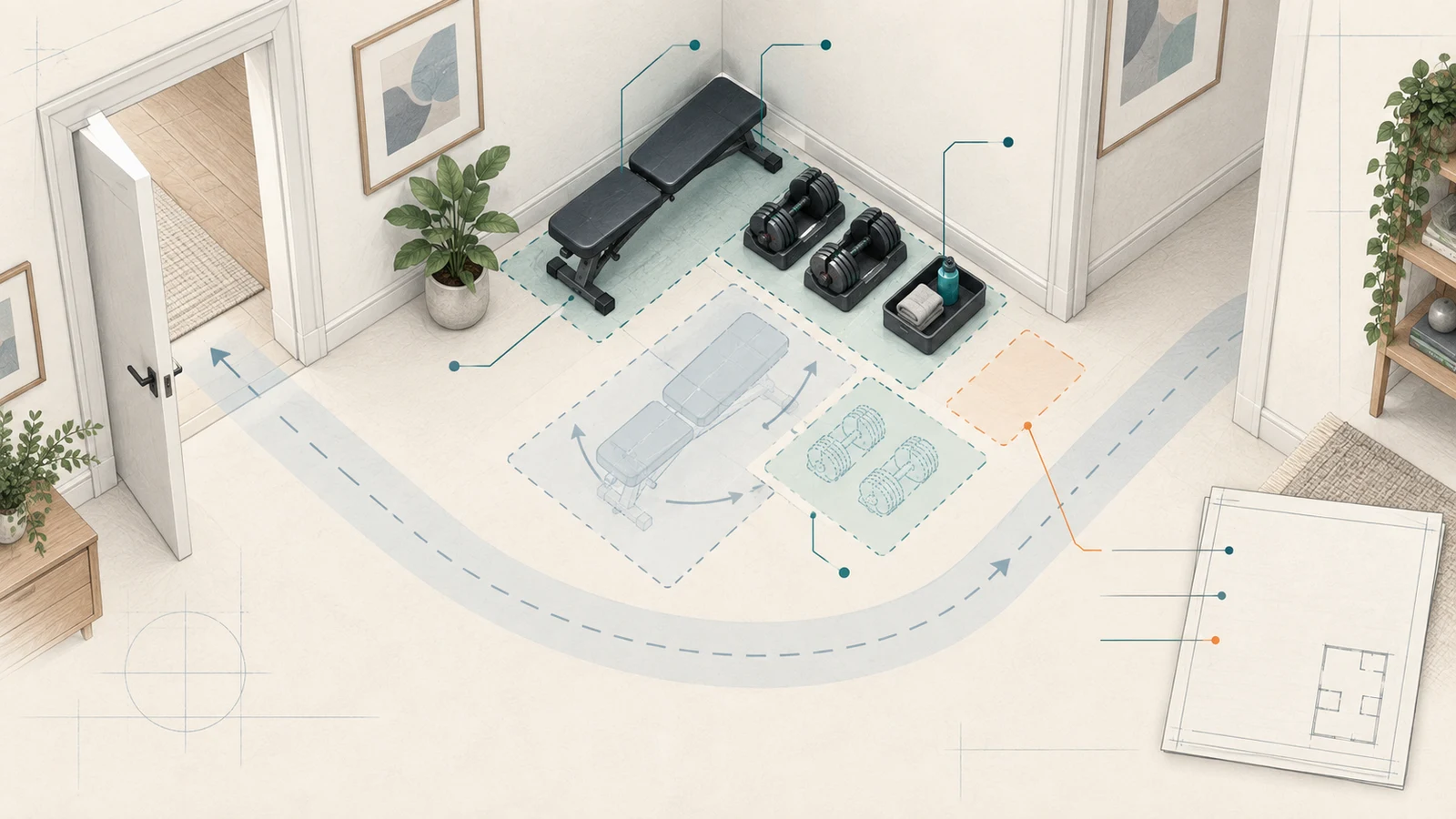
A compact strength setup is not defined by how neatly the equipment looks while stored. It works only when one documented corner can support the full cycle: retrieve the equipment, configure it, use it for the intended movements, set it down between tasks, inspect and reset it, and return every object to an allowed stored state without blocking a doorway, window, control, or preserved exit route.
Build a dated one-corner setup record before buying or moving equipment. Separate the storage zone from the active movement envelope, and separate each object state: package, assembled, stored, retrieved, adjusted, in use, reset, serviced, and packed for return. Record unknowns rather than converting them into zero space or an assumed pass.
The valid result may be a layout ready for a floor-tape rehearsal, a layout with named conditions, a blocked setup, or no setup at all. It is not automatically “safe,” “apartment-friendly,” or recommended.
The record you are building
Use one record for one room, one corner, one exact equipment set, and one intended activity list. Give it a date and a stable name so a later model, furniture, floor, household, or source change does not silently overwrite the original decision.
| Record section | What to capture | What it prevents |
|---|---|---|
| Scenario | Room, corner, users, intended movements, equipment set, date | A generic layout detached from the real task |
| Room and route | Usable dimensions, door/window swings, controls, obstructions, delivery and retrieval path | Treating the empty rectangle as the whole problem |
| Object inventory | Bench, dumbbells, cradles, stand, mat, loose parts, accessories, packaging | Missing objects that still consume space or need control |
| Product states | Delivered, assembled, stored, retrieved, configured, active, reset, service, return | Treating one favorable size as every state |
| Zones | Storage, retrieval, setup, active movement, temporary set-down, inspection/service, preserved route | Overlapping incompatible uses of the same floor area |
| Evidence | Exact model, source, revision, market, original values, checked date, conflicts | Unsourced or stale dimensions and instructions |
| Outcome | Completeness, conditions, blockers, unknowns, next action | A false binary “fits/does not fit” answer |
A complete record can still conclude that the setup should be deferred. Completeness means the applicable questions were handled; it does not guarantee that the proposed corner is suitable.
Use the equipment-dimensions methodology, adjustable dumbbell buyer guide, home-fitness safety checklist, and folding weight bench buyer guide when those records are part of the set. These links provide separate diligence paths; they do not certify the corner or the equipment.
Scope and evidence limits
This guide covers a low-footprint strength setup built from portable or stowable equipment such as adjustable dumbbells, fixed dumbbells, kettlebells, a bench, cradles, and optional storage furniture. It does not authorize wall-mounted racks, ceiling anchors, structural alterations, electrical work, or a particular exercise program.
Current manufacturer records can support exact dimensions, object counts, stated storage architecture, adjustment states, and warranty or return facts. They do not establish a reader’s floor capacity, wall suitability, lifting ability, movement technique, comfort, or safe clearance.
The current example objects are deliberately bounded:
- a REP QuickDraw 30 lb adjustable-dumbbell pair and its two cradles;
- a REP AB-4100 bench as an upright-storage example;
- the earlier FLYBIRD WP129 record only as a withdrawn fold-flat/stowed-envelope example; its accepted route is no longer a current input.
These are workflow examples, not recommendations or a market census.
Inputs to lock before drawing the corner
Gather the following before deciding where anything goes:
- the current exact product page and current instructions for every equipment item;
- the exact variant, quantity, and included parts;
- the intended exercise list and whether each movement uses one or two implements;
- every relevant room, doorway, swing, ceiling, and route measurement;
- the floor surface and any unresolved structural or lease question;
- the proposed storage orientation and the manufacturer record that permits it;
- the household access plan for children, pets, guests, or shared-room users;
- a place to retain packaging when return terms make it material;
- the current recall or warning check for each exact model and identifying scope.
Use the live FitFootprint room-measurement workflow for the underlying room, route, object-state, and conflict record. Do not invent a generic buffer when the exact product instructions do not provide one.
Step 1: define the exact room and corner
Start with the usable corner, not the room’s gross floor area. Record:
- the two wall segments that bound the corner;
- the usable floor rectangle after fixed furniture and controls are excluded;
- the lowest relevant ceiling or sloped-ceiling point;
- doors, windows, closet panels, drawers, radiators, vents, outlets, and switches;
- the route from the room entrance to the corner;
- the route from storage position to exercise position;
- any path that must remain open during setup, use, and reset.
A corner that accepts a stored bench may still fail when the bench is rotated, opened, adjusted, or moved around the user. A corner that works while the room is empty may fail when a door, bed drawer, desk chair, or closet is used normally.
Step 2: inventory every object and object state
Create one row per physical object. Do not use a single line called “weights” or “bench.”
| Object | Minimum states to record |
|---|---|
| Adjustable dumbbell | In cradle, selected load, removed from cradle, set down, inspected, packed |
| Dumbbell cradle | Empty, occupied, fixed on stand or floor, service/cleaning access |
| Bench | Operating flat, operating angled, adjustment transition, stored, retrieved, inspected |
| Stand or cart | Empty, loaded, moved if permitted, parked, caster/leveler state |
| Mat or floor layer | Rolled/package state, installed state, edge/door conflict, cleaning state |
| Loose accessories | Attached, removed, temporarily set down, stored |
| Packaging | Stored for return, discarded, or unavailable |
The QuickDraw product page lists separate cradle and dumbbell dimensions. That is useful evidence that the system contains multiple objects; it is not proof of the complete pair layout or the hand space needed to operate both cradles.
Step 3: separate the six working zones
Draw six zones even when some overlap at different times.
Storage zone
The allowed parked position for all equipment and loose parts. It must preserve the documented orientation, support points, and access needed to retrieve the equipment again.
Retrieval and set-down zone
The place where hands and feet can approach the equipment and where a dumbbell or accessory may be placed between tasks. Do not assume that the storage rectangle also provides retrieval access.
Setup and transition zone
The floor swept by a bench, ladder, hinge, handle, wheel, cradle, or user while changing from stored to active configuration.
Active movement envelope
The space occupied by the equipment and the intended movement, including the user’s body and the implement path. A product footprint is not this envelope.
Inspection and service zone
The access needed to see selectors, pins, hinges, fasteners, pads, feet, labels, and damaged parts before use or before returning the setup to storage.
Preserved route zone
The doorway, window, normal room path, and exit route that remains unavailable to storage or temporary set-down. The U.S. Fire Administration states that doorways and windows should remain clear for escape; this workflow uses a route conflict as a stop rule, not as a code-compliance finding. (USFA source)
Step 4: preserve doors, windows, controls, and exit routes
Mark every door and window swing on the drawing. Then mark controls that must remain reachable, such as a thermostat, outlet, breaker access, radiator valve, or window latch.
Do not count a route as “usually clear” when the workout requires placing a bench, dumbbell, mat, or packaging across it. Test the worst planned state: bench fully deployed, dumbbells out of their cradles, accessories set down, and the user in the active zone.
If the setup obstructs the preserved route at any required stage, change the layout or stop. Do not solve the conflict by assuming that equipment can always be moved quickly in an emergency.
Step 5: map the floor and unresolved structural questions
Record the floor finish, subfloor information when known, transitions, slopes, damage, moisture, and any landlord or building restriction. Keep three questions separate:
- surface protection;
- equipment stability on the actual surface;
- structural adequacy of the floor or building element.
A manufacturer floor mat can be an exact product option, but its existence does not prove that a mat is required or sufficient for another product or floor. REP’s 4-by-6-foot mat, for example, is itself an 88 lb object with stated dimensions and tolerance. Adding it changes delivery, floor height, door interaction, cleaning, and stored-object planning.
Do not certify a floor, wall, shelf, or anchor. When the plan depends on structural judgment, record the question and seek appropriate qualified help.
Step 6: lock exact equipment identity and instructions
Record the brand, exact model, variant, quantity, market, identifying label location when available, and current instruction source. Similar-looking adjustable dumbbells or benches can have different selectors, trays, hinges, load wording, and recall scope.
Before use, check current CPSC records by exact model and identifying range. The 2026 FitRx SmartBell recall, for example, applies to specified model and serial ranges and addresses plates that can dislodge from the handle. It is evidence for exact-identity diligence, not a conclusion about every adjustable dumbbell. (CPSC FitRx recall)
Likewise, a historical Spectrum bench recall involved model NG-14 N and a hinge hazard. It does not transfer to current bench examples, but it illustrates why hinge, model, and recall checks cannot be replaced by a category label. (CPSC Spectrum recall)
Step 7: map the dumbbell system
For adjustable dumbbells, map the entire selector system rather than the handle alone.
The current QuickDraw 30 lb example lists:
- 12.2-inch dumbbell length at the selected 30 lb maximum;
- 20.6-inch cradle length;
- 8.45-inch cradle width;
- 7.9-inch height with the dumbbell in the cradle;
- 4.64 lb for each empty cradle;
- two micro-adjustment plates per dumbbell in the current product description.
Those values do not define the complete pair footprint. The setup record still needs:
- the chosen orientation of both cradles;
- distance between them;
- hand access to the switches and handle;
- a place for removed micro weights;
- a temporary set-down location;
- the route from cradle to exercise position;
- the inspection and reset sequence.
If the buyer uses a stand or cart, create a new object state. Do not place stand dimensions into the base dumbbell row.
Step 8: map the bench in every required state
For a bench, record at least:
- delivered/package state when available;
- assembled state;
- every back and seat position actually required;
- adjustment transition;
- fully active exercise state;
- documented stored state and orientation;
- retrieval/reopening sequence;
- inspection state;
- service and return state.
The current REP bench guide lists the AB-4100 at 51.3 by 20.3 by 17 inches, 85 lb, with seven back-pad and three seat-pad positions, plus an upright storage post. These are seller-stated states. They do not establish the full movement envelope or prove that the user can control an 85 lb bench along the planned route. (REP bench guide)
Step 9: record accessories, loose parts, and packaging
A compact setup often fails because the plan omits small items:
- micro plates;
- selector pins or removable parts;
- bench attachments;
- bands and handles;
- collars;
- cleaning supplies;
- tools required for inspection or adjustment;
- manuals and proof of purchase;
- packaging needed for a return.
Give each item a defined home. “On the floor beside the bench” is not a durable storage plan when that floor is also the retrieval or exit route.
Current REP warranty language notes that coverage can be affected by negligent use, maintenance, storage, or handling, and that coverage varies by component. Preserve the exact purchase and warranty records rather than treating a headline term as complete protection. (REP warranty information)
Step 10: draw the retrieval and setup sequence
Write the sequence as actions, not just arrows.
Example:
- enter the corner without crossing the preserved route;
- inspect the storage area and equipment condition;
- move or unfold the bench only as documented;
- place the bench in its exact exercise position;
- set the required back and seat positions;
- confirm the dumbbell cradles remain accessible;
- select the first load while the dumbbell is in the required selector state;
- move the dumbbell to the exercise zone;
- keep the temporary set-down zone clear;
- begin only after the full configuration is visible and unobstructed.
If a sequence requires an undocumented lift, rotation, wall contact, leaning state, or helper assumption, mark it unresolved.
Step 11: draw the exercise movement envelope
Use the exact intended movement list. A standing curl, floor press, bench press, split squat, overhead press, row, and kettlebell swing create different paths.
For each movement, record:
- implement count;
- start and finish position;
- body position;
- overhead, lateral, forward, or rearward travel;
- bench angle when used;
- floor or mat state;
- temporary set-down position;
- whether another person or spotter is required by the buyer’s plan;
- any technique or medical question outside this guide.
Do not infer movement clearance from the product’s outside dimensions. When the intended movement or technique has not been defined, the active zone remains unknown.
Step 12: draw the reset and storage sequence
The setup is not complete until the reverse path works.
Record:
- how each implement returns to its cradle or storage point;
- how selectors or loose plates are checked and reset;
- where the bench is placed before folding or rotating;
- the exact permitted storage orientation;
- how the bench or stand reaches the storage zone;
- how the floor and equipment can be inspected;
- how the route becomes clear again;
- what remains accessible for the next retrieval.
A stored object that blocks inspection or forces the user to reach behind unstable equipment is an unresolved setup, even when the storage rectangle itself fits.
Floor-tape layout rehearsal
Before moving heavy equipment, reproduce the measured object envelopes and routes with painter’s tape, cardboard, or another low-risk visual marker. Mark stored, active, set-down, and preserved-route zones separately.
This rehearsal can reveal overlap between a bench, door, cradle, bed drawer, or path. It cannot prove that the actual equipment can be lifted, rolled, controlled, adjusted, used, or stored as planned.
Use the result only as one of these states:
- Layout record ready for review: every applicable zone is drawn and sourced;
- Layout ready with named conditions: the drawing works only if stated assumptions are later verified;
- Layout blocked: a required zone or route overlaps an immovable constraint;
- No setup or defer: the evidence or room does not support proceeding.
Actual-equipment observation remains a separate event
A tape diagram is not hands-on evidence. Actual equipment introduces mass, balance, caster or foot behavior, hinge travel, selector operation, noise, flex, and user interaction.
A later observed-layout upgrade requires:
- exact access relationship and disclosure;
- a safe, documented protocol;
- the real room and exact equipment;
- dated observations and measurements;
- limitations and stopped tests;
- accountable review before any tested language is used.
This documentation-only article does not claim that such an event occurred.
Branch: standing-only dumbbell setup
A bench may be unnecessary when the buyer’s exact movement list is standing-only. Removing the bench can reduce object count, transition steps, and stored-state complexity.
However, the setup still needs dumbbell cradles or storage, selector access, temporary set-down space, overhead or lateral movement zones, and a clear route. Do not replace a bench with an undocumented chair, bed, desk, or unstable surface.
Branch: floor-work setup without a bench
A floor-work plan may use a mat or clear floor area rather than a bench. Record the full body envelope, entry and exit, implement set-down positions, and the mat as a separate object.
A floor-only plan is not automatically smaller when the user requires a large mat, wide arm position, two dumbbells, or a path to stand up while controlling equipment.
Branch: bench-based setup
A bench-based plan requires both the bench’s outside envelope and the user’s movement envelope. The bench also needs adjustment access, a retrieval path, and a stored-state plan.
If a rack, barbell, or spotter platform is part of the scenario, this one-corner dumbbell-and-bench workflow is insufficient. Open a separate exact system record rather than attaching rack clearances to a bench row by assumption.
Branch: fold-flat bench
The earlier FLYBIRD WP129 record reported an assembled/flat envelope of 42.3 by 15.1 by 16.5 inches and a stated stowed envelope of 31.5 by 12.6 by 11.8 inches. During the 2026-09-20 source-status recheck, the accepted route returned HTTP 404 after redirect, so those figures are withdrawn from current fit, storage, or purchase decisions. The earlier record also used inconsistent position wording: it labelled eight back-pad angles while listing seven values. Preserve that historical conflict rather than fabricating an eighth value. (FLYBIRD WP129)
A numeric stowed envelope supports only a preliminary geometry screen. The buyer must still verify the exact fold sequence, lock state, allowed orientation, route, under-furniture obstructions, retrieval space, and current instructions.
Branch: upright-stowed or vertical-storage bench
An upright-storage post is an architecture, not a universal permission to lean any bench against a wall. The AB-4100 is specifically described as designed for vertical storage; another bench without that documentation must remain in its exact permitted state.
Record the vertically stored floor rectangle, total height, wall or furniture interaction, ceiling and shelf conflicts, retrieval grip, movement route, and the space needed to lower the bench into its operating position.
Branch: stand-based dumbbell storage
A stand can improve access but creates another heavy object. Record its width, depth, adjustable height, wheel or leveling-foot state, loaded weight, tray orientation, and whether its planned position blocks the bench transition.
Do not assume that casters prove easy or controlled movement. A stand parked on wheels and a stand installed on leveling feet are different states and may require different tool, route, and floor records.
Branch: shared room with children or pets
Record who can enter the room, whether the corner is continuously supervised, and how access is controlled when equipment is stored. Avoid unsupported universal age or lock rules.
The setup is blocked when the plan depends on loose weights, exposed selector parts, an unverified fold/hinge state, or equipment in a route that cannot be controlled under the actual household conditions. The correct next action may be a different storage architecture or no setup.
Missing and conflicting inputs
Use explicit states:
| Condition | Required handling |
|---|---|
| Exact model or revision missing | Stop model-specific dimensions and instructions |
| Product and manual conflict | Preserve both; block the affected tight-fit conclusion |
| Stored orientation not documented | Do not call the proposed storage state allowed |
| Bench transition envelope missing | Mark setup/retrieval result unknown |
| Dumbbell pair layout missing | Do not double one cradle dimension and call it complete |
| Floor or wall judgment required | Record the question and seek qualified help |
| Household access plan unresolved | Block the stored-state outcome |
| Recall identity unresolved | Stop use or purchase conclusion until exact scope is checked |
| Movement list incomplete | Active envelope remains unknown |
Unknown is not zero space, a pass, a failure, safe, compatible, accessible, or storable.
Synthetic case A: vertical-storage bench and adjustable dumbbells
A fictional corner provides 66 inches along one wall and 42 inches along the other. The buyer models a QuickDraw 30 lb pair on floor cradles and an AB-4100 bench stored upright.
The one-dumbbell and bench dimensions can be drawn, but the record lacks:
- the exact two-cradle arrangement;
- grip and selector access;
- the bench’s complete vertically stored envelope and lowering path;
- the user’s intended movement envelope;
- floor and handling review.
Correct result:
layout_ready_with_named_conditions
actual_setup_not_verified
recommendation_withheld
Synthetic case B: fold-flat bench under furniture
A fictional under-furniture cavity measures 34 by 14 by 12.5 inches. The WP129 stated stowed envelope is 31.5 by 12.6 by 11.8 inches.
The numeric rectangle passes the fictional screen, but the result remains conditional because the record has not verified:
- the exact current fold and lock instructions;
- protrusions or soft-surface compression;
- the insertion and retrieval path;
- household access;
- the official position-count conflict;
- the active exercise zone after retrieval.
Correct result:
preliminary_storage_geometry_pass
complete_setup_unknown
Synthetic case C: no viable one-corner setup
A fictional corner is large enough for stored objects but requires the deployed bench to cross the only preserved doorway route. Moving the bench after each set would not solve the conflict because the route is needed throughout normal use.
Correct result:
layout_blocked
no_setup_or_defer
The workflow must allow this outcome rather than forcing a smaller product or an improvised storage orientation.
Stop and escalation conditions
Stop the affected setup when:
- the exact model, current instructions, or recall scope is unresolved;
- the stored orientation is inferred rather than documented;
- a bench pin, hinge, ladder, weld, foot, selector, cradle, or attachment appears damaged or its state cannot be verified;
- the proposed corner blocks a doorway, window, control, or preserved route;
- the setup requires a wall, floor, shelf, electrical, accessibility, legal, or structural conclusion outside the available evidence;
- the user cannot document the retrieval, setup, reset, and storage path;
- the household access plan cannot control the stored equipment and loose parts;
- the exact movement list does not fit the modeled active zone;
- the plan depends on an undocumented lifting, dragging, leaning, or helper assumption.
Escalate the exact question to the manufacturer, landlord, building professional, qualified installer, accessibility specialist, medical professional, or other appropriate expert. Do not ask one professional to answer a different professional domain.
Save the setup record
The saved record should include:
- room and route drawing;
- object inventory;
- exact product and source IDs;
- stored, transition, active, set-down, inspection, and preserved-route zones;
- measurements with original units and checked dates;
- assumptions and conflicts;
- current recall-check result and scope;
- blocked conclusions;
- named professional questions;
- floor-tape rehearsal result;
- next action and review date.
Save photos only when you have a privacy-safe reason and permission. A photo does not replace measurements or exact product documentation.
When to choose a different format
A one-corner bench-and-dumbbell system may be the wrong format when:
- the exercise list does not require a bench;
- a fold or vertical-storage transition cannot be completed without blocking the room;
- the equipment must be moved more often than the user can document and control;
- exact loads require too many separate objects;
- a stand, mat, packaging, and access zone erase the apparent storage advantage;
- children, pets, or shared-room access cannot be resolved;
- the floor, wall, lease, or building question remains open;
- the only viable result depends on an improvised chair, bed, wall, shelf, or storage orientation.
The correct alternative may be floor work, resistance bands, fewer fixed weights, a different bench architecture, another room, supervised external facilities, or no purchase. This guide does not rank those alternatives.
Next step
Create the room and route record first with the FitFootprint measurement guide. Then bind the record to exact equipment and current instructions, draw all six zones, and run the floor-tape rehearsal.
Do not buy, move, mount, or load equipment merely because the stored rectangles fit. Continue only after the missing model, transition, movement, floor, household, and recall questions have named answers or named stop conditions.
Methodology
This workflow applies the current FitFootprint dimension, room-fit, and safety source boundaries to a one-corner strength scenario. It uses official manufacturer records as exact source-state examples and government sources for narrowly scoped escape-route, recall, and technical-assistance boundaries.
The workflow separates:
- room geometry from product geometry;
- stored state from operating state;
- object footprint from active movement envelope;
- documentation from observation;
- exact recall scope from category inference;
- record completeness from a setup conclusion.
No product was acquired or tested. The candidate examples are non-exhaustive; this is a qualified documentation-only guide, not a direct-use, structural, safety, fit, accessibility, compliance, or recommendation result.
For delivery, assembly, route, and return diligence, see Doorways, Stairs, Delivery, Assembly, and Returns.
Sources
- FitFootprint — How to Measure Your Space for Home Fitness Equipment
- REP Fitness — QuickDraw Adjustable Dumbbell (LB)
- REP Fitness — Bench Guide and AB-4100 dimensions
- FLYBIRD — Adjustable Weight Bench with Lumbar Support WP129 — earlier record retained only as withdrawn context; accepted route returned HTTP 404 after redirect during the 2026-09-20 recheck.
- REP Fitness — 4-by-6-foot floor mats
- REP Fitness — Warranty information
- REP Fitness — Terms, returns, and cancellations
- U.S. Fire Administration — Hoarding and Fire Safety
- U.S. Access Board — Technical Assistance
- CPSC — Recalls and Product Safety Warnings
- CPSC — FitRx SmartBell Quick-Select adjustable-dumbbell recall
- CPSC — Spectrum Fitness NG-14 N weight-bench recall