
Written by fitfootprint.com. Evidence reviewed July 25, 2026.
Quick answer
A useful equipment dimension is more than a number. Before you compare or reuse it, identify:
- what object and count it describes;
- the product state and configuration;
- the axes, orientation, or geometry;
- the original value and unit;
- the exact model, variant, market, source, and date;
- any accessory, user input, rounding, missing field, or conflict; and
- the conclusion the value may—and may not—support.
“Footprint,” “folded size,” “clearance,” and “shipping dimensions” answer different questions. If the object, state, axes, or exact source cannot be resolved, keep the value as unknown for the affected decision. Do not turn it into a generic room requirement or a fit result.
Scope and limitations
This page explains how to classify and interpret home fitness equipment dimensions. It does not teach the step-by-step process for measuring a room or delivery route, rank products, publish category averages, or determine whether equipment fits a particular home.
It also does not establish:
- a universal equipment footprint, room size, or clearance;
- that a folded product may be stored in a proposed orientation;
- delivery maneuverability or safe handling;
- structural, electrical, accessibility, medical, legal, code, installation, or safety suitability;
- product availability, price, warranty, service, or commercial value; or
- practical comfort, stability, quietness, durability, or ease of movement.
The method supports a bounded data interpretation. It is not a product verdict.
Purpose and method version
This article presents FitFootprint’s dimension-interpretation-v01 method. Its output is a structured dimension record plus a statement of what that record can support.
The controlling question is:
The method is designed for buyers reading manufacturer pages, manuals, support documents, packaging records, retailer listings, or later first-party measurements. It keeps source-stated values separate from measurements and prevents one product state from being silently substituted for another.
Build a complete dimension record
Use the following fields before treating a value as reusable.
| Field | Record | Why it matters |
|---|---|---|
| Record ID | A stable local identifier | Keeps claims, corrections, and downstream uses tied to the exact value |
| Object | Package, whole product, component, one dumbbell, pair, stand, opening, route segment, room, or storage space | Stops a component or one unit from becoming a whole-system value |
| Count | One package, two boxes, one dumbbell, pair, or set | Prevents single-unit dimensions from becoming pair or shipment dimensions |
| State | Shipping, assembled, operational, access/clearance, folded, moved, stored, delivery-path, or room-envelope | Different states answer different decisions |
| Configuration | Leg height, screen position, folded mode, accessory, orientation, or another exact setup | Prevents facts from drifting between configurations |
| Axis or geometry | Length/depth, width, height, diameter, projected footprint, irregular envelope, or formula | Makes orientation and comparison explicit |
| Source value and unit | Exact published or measured value in its original unit | Preserves provenance and avoids replacing the source with a rounded conversion |
| Source class | Official page/manual, official support record, seller page, first-party measurement, or another named class | Separates a published statement from a measurement or editorial conclusion |
| Exact scope | Model, variant, SKU, market, page/revision, and seller when material | Prevents facts from moving across similar names or regions |
| Date | Publication/revision date when available plus checked or measured date | Makes freshness and corrections possible |
| Limitation | Rounding, extraction, orientation, accessory, user input, missing field, or conflict | Stops a conditional value from appearing unconditional |
| Allowed use | The exact question the value may help answer | Keeps downstream use bounded |
| Prohibited inference | What the record does not establish | Prevents a number from becoming an unsupported fit or safety claim |
Takeaway: If a material field is missing, the number may still be a useful research lead, but it is not yet a complete decision record.
Keep dimension states separate
One product can have several valid dimension records at the same time.
| State or object | What it describes | What it does not establish |
|---|---|---|
| Shipping or package | The outside size of one identified package in a stated configuration | Assembled size, route passage, allowed orientation, handling, or return feasibility |
| Assembled | The outside envelope of one assembled configuration | Movement during use, access, adjustment, maintenance, or the complete room requirement |
| Operational | The product envelope in a stated use configuration | User access, service space, or additional documented clearance |
| Access or clearance | Space documented for a named purpose such as use, entry/exit, adjustment, service, ventilation, or separation | A category-wide clearance rule |
| Folded | The envelope in one identified folded configuration | Approved storage orientation, support, movement path, or retrieval clearance |
| Moved | A configuration documented for relocation | Maneuverability or safe handling |
| Stored | An explicitly permitted stored state with its orientation and prerequisites | Suitability of the proposed wall, floor, route, or handling method |
| Delivery path | The clear opening or movement envelope along one named route segment | A nominal door size or a delivery guarantee |
| Room envelope | The usable room boundary after fixed obstacles and reserved routes are recorded | Fit from gross floor area alone |
| Component | A sub-object such as a walking area, deck, tray, stand, or one dumbbell | The whole product, pair, complete shipment, or workout zone |
| User-dependent | A source-defined formula combined with a named user or scenario input | A fixed product dimension or a rule for every product in the category |
Takeaway: Like-for-like comparison requires the same object, count, state, configuration, axes, scope, and material prerequisites. A package length cannot replace an assembled length, and a folded envelope cannot replace an approved stored state.
What “footprint” should mean
The word footprint is too ambiguous to reuse on its own. For this method, a footprint record must identify:
- the object;
- the state and configuration;
- the horizontal axes or projected geometry;
- whether height is excluded; and
- which operating, access, movement, storage, or clearance space is not included.
One source may use footprint for an assembled floor projection. Another may use it for a stored position or total planning zone. Preserve the source’s wording, but normalize it only after its exact meaning is clear.
Interpret a dimension step by step
Use this sequence to decide whether a dimension record is ready for a like-for-like comparison. The detailed steps below explain each check.
| Sequence step | Check before proceeding | If unresolved |
|---|---|---|
| 1. Object and count | Identify the exact object and quantity described. | Preserve the source wording; keep object or count unknown and stop the dependent comparison. |
| 2. State and configuration | Identify the product state and exact setup. | Keep the normalized state unknown; do not compare it with a different state. |
| 3. Axes and orientation | Define each axis and the stated orientation. | Keep values unnormalized; do not assume L × W × H. |
| 4. Exact scope | Bind the model, variant, market, source, revision, and checked date. | Do not merge variants, markets, or source records into one product-specific conclusion. |
| 5. Original value and unit | Preserve the exact source-stated or measured value and unit. | Do not reconstruct or substitute a rounded conversion for the source record. |
| 6. Precision and extraction | Record how the value was stated, read, calculated, rounded, or measured. | Do not add unsupported precision, tolerance, or certainty. |
| 7. Like-for-like eligibility | Match material object, count, state, configuration, axes, scope, and prerequisites. | Mark the comparison ineligible; do not choose a smaller value or generic default. |
| 8. Local inputs | Add room, route, user, or storage inputs only after source meaning is stable. | Defer the downstream result; this methodology page does not produce a local fit result. |
| 9. Missing data and conflicts | Name each missing or conflicting field and the conclusion it affects. | Preserve source records separately; do not average or fill an unknown with a default. |
| 10. Bounded interpretation | State what the record supports and what remains incomplete, conflicted, or unsupported. | Withhold the dependent conclusion; do not turn a dimension record into a fit verdict. |
Takeaway: A record is eligible for comparison only after its material fields match. An unresolved field blocks only the conclusion that depends on it and never supports a generic fit result.
1. Identify the object and count
Determine whether the value describes one box, several boxes, the complete product, one component, one dumbbell, a pair, a stand, a route opening, a room, or a storage space. Stop the comparison if object or count remains unknown.
2. Identify the state and configuration
Classify the record as shipping, assembled, operational, access/clearance, folded, moved, stored, delivery-path, or room-envelope. Retain details such as leg height, screen position, accessory, or permitted orientation.
If the source does not name a state, keep its original label and mark the normalized state as unknown.
3. Define the axes and orientation
Use L × W × H only after defining what each axis means in the stated orientation. A bare three-number string does not prove the axis order or even the product state.
For a floor-plane projection, say which dimension is omitted and what space is excluded.
4. Bind the exact scope
Record the model, variant, SKU when available, market, source URL or document, revision/date, and checked date. Seller-specific facts stay seller-specific. Do not merge values merely because two products share a retail name or look similar.
5. Preserve the original value and unit
Store the value exactly as published or measured. A converted value is a separate derived field; it does not replace the source record.
6. Record precision and extraction
Note whether the value was stated in text, read from a diagram, calculated from another field, rounded by the source, measured under a documented procedure, or affected by orientation and configuration.
Do not add decimal places, tolerances, or certainty the source does not support.
7. Compare only like with like
A comparison is eligible only when the material record fields match. Examples of ineligible comparisons include:
- package length versus assembled length;
- walking-area width versus whole-product width;
- one dumbbell versus a pair on a stand;
- folded size versus stored-with-anchor size;
- fixed product height versus a user-dependent ceiling formula; and
- an older or global source versus a current United States variant without reconciliation.
8. Add local inputs only after the source meaning is stable
After the source record is resolved, a separate workflow may combine it with room and route measurements, a user-height input, documented clearance, a storage accessory, or another local configuration. This methodology page does not produce that local result.
9. Preserve missing data and conflicts
Name the missing or conflicting field and the exact conclusion it blocks. Keep source records separate. Do not average conflicting values, select the smaller value, or fill a missing clearance from a generic guide.
10. State the bounded interpretation
A valid output might say:
- the state is identified and source-bound;
- the record is eligible for a like-for-like comparison;
- a labeled display conversion is available;
- the record is incomplete because object, state, axes, or scope is unknown;
- the record is conflicted pending exact-source resolution; or
- the value cannot support the proposed downstream conclusion.
What current source examples demonstrate
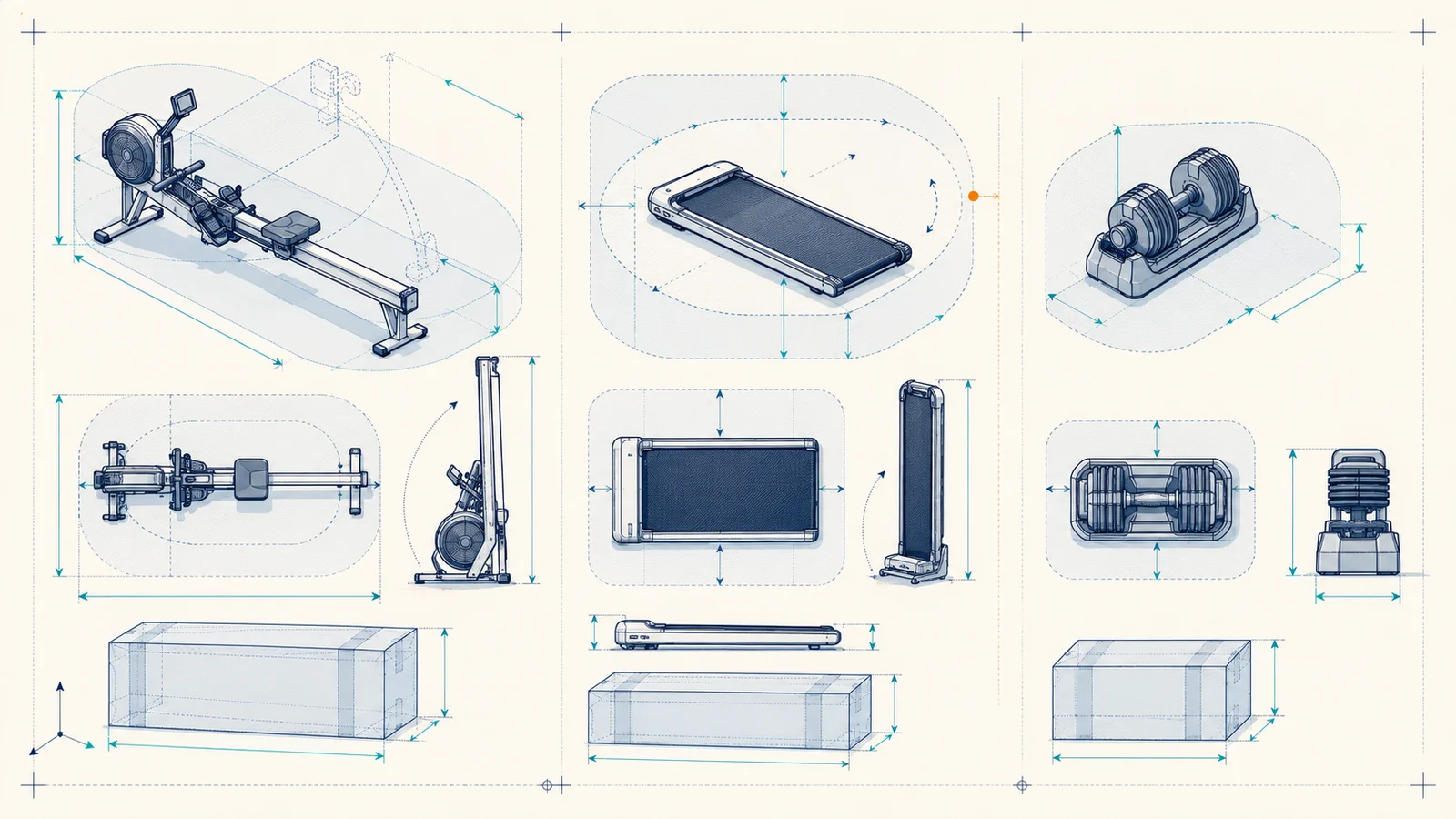
These examples validate classification behavior only. They are not product recommendations and their numbers must not be transferred to another model.
| Official example | States or scope shown | Method lesson |
|---|---|---|
| Concept2 RowErg | Assembled space, clearance for use, storage, and one- or two-box shipping configurations | State, configuration, and package count must remain separate |
| Hydrow FAQs | Hydrow Wave assembled footprint, boxed dimensions, and upright stored dimensions with the Vertical Anchor | A storage accessory and orientation can be part of the dimension record |
| Schwinn IC4 | Fixed product dimensions plus a minimum-ceiling input defined as user height plus 20 inches | Some planning dimensions are formulas that require a local input |
| WalkingPad A1 Pro | Walking area, unfolded size, folded size, and package size | A component, whole-product states, and package state are not interchangeable |
| BowFlex Results Series 552 | Dimensions for a single dumbbell | Object and count must be explicit before the value is reused |
Takeaway: The examples show why the method needs distinct records. They do not establish a typical rower, bike, walking pad, or dumbbell dimension.
Convert units without adding precision
The NIST Appendix B.8 conversion table lists:
- 1 inch = 2.54 centimeters; and
- 1 inch = 0.0254 meters.
The broader NIST Appendix B guidance also explains conversion-factor use and rounding converted values.
Use these rules:
- Preserve the original source value and unit.
- Store the unrounded calculation separately.
- Round only the public display to precision supported by the source.
- Label the secondary value as a conversion.
- Do not infer measurement uncertainty from displayed decimals alone.
- Preserve both published unit systems when they disagree.
- Never convert an unknown value to zero.
The WalkingPad A1 Pro page is a useful conflict example. It publishes 56.5 inches and 1432 millimeters for the same unfolded axis. Exact conversion of 56.5 inches is 1435.1 millimeters. The method preserves both source-published values and flags the discrepancy; it does not invent a cause or select one for a tight-fit decision.
Validation cases
The following synthetic/editorial cases test the method, not product performance.
| Case | Correct handling | Shortcut the method rejects |
|---|---|---|
| One source lists assembled, clearance-for-use, storage, and shipping values | Create separate state records | Merge them into one “dimensions” row |
| A source lists walking area and whole-product unfolded size | Record component and whole-product state separately | Treat walking area as product footprint |
| A folded size is listed without an approved storage orientation | Keep folded; mark stored state unknown | Claim vertical or under-furniture storage |
| Stored dimensions require an anchor or kit | Record the prerequisite and orientation | Publish the stored dimensions without the condition |
Ceiling input is user height + 20 in |
Store the formula, input, exact source/model, and result | Store 20 inches as the ceiling height |
| Dimensions are stated per dumbbell | Count one dumbbell; keep pair/stand/zone separate | Treat the value as the pair footprint |
| A configuration ships in two boxes | Create two package records | Invent one combined box |
| A source lists 56.5 in and 1432 mm for one axis | Preserve both and flag the conflict | Replace or average them |
A source says only 70 × 30 × 10 |
Keep axes and state unknown | Assume L × W × H and package state |
| Retailer and manufacturer values disagree | Preserve source class and scope separately | Choose the smaller or newer-looking value |
| A first-party measurement differs from a published value | Keep stated and measured records separate | Overwrite the source record |
| A material value or prerequisite is missing | Mark the dependent conclusion incomplete | Use zero, false, or a generic default |
Takeaway: A case passes when the method preserves provenance and blocks only the conclusion that depends on the missing or conflicting field.
Missing and conflicting inputs
| Missing or conflicting field | Allowed response | Blocked conclusion |
|---|---|---|
| Object or count | Retain the raw wording and mark normalized object unknown | Whole-product, pair/set, or package comparison |
| State or configuration | Retain the raw record and obtain exact official context | Like-for-like state comparison |
| Axis or orientation | Keep values unnormalized | L × W × H or route comparison |
| Exact model, market, or revision | Do not merge or reuse it as current exact-product data | Product-specific conclusion |
| Original value or unit | Do not reconstruct it from a rounded secondary display without qualification | Precision-sensitive comparison |
| Storage prerequisite | Keep stored state unknown or conditional | Storage permission or suitability |
| User input | Preserve the formula and name the required input | Calculated ceiling or space requirement |
| Source conflict | Preserve both records and the conflict class | Tight-fit or normalized single value |
| Only generic clearance is available | Treat it as a research lead | Exact-product clearance or placement conclusion |
Takeaway: Missing data does not erase valid source records. It also does not become a universal pass or fail.
Prohibited interpretations
Do not use dimensions alone to claim that equipment:
- fits a particular room;
- is safe, apartment-friendly, compact for a buyer, or easy to move;
- can be delivered through a route;
- may be stored in a proposed orientation;
- suits a floor, outlet, wall, user, or installation; or
- meets a structural, electrical, accessibility, medical, legal, code, or regulatory requirement.
Those decisions require their own exact product, source, local scenario, access, and—when applicable—qualified evidence.
Downstream uses
A reviewed dimension record can support:
- room and delivery-path worksheets;
- exact-product dossiers;
- like-for-like comparisons;
- bounded calculator inputs;
- a sourced dimension database; and
- logistics, folding/storage, cost, and risk research.
Each downstream consumer must bind the method version and still verify its own model, market, source, date, scenario, and specialist boundaries.
Corrections and version changes
The method must be reassessed when a source page or manual changes, an example model or prerequisite changes, a conflict is resolved, a parent method is superseded, the unit policy changes, or a downstream tool exposes an interpretation gap.
A material change to definitions, protocol, validation cases, or conclusions requires a new reviewed version. Earlier evidence and its limitations must remain distinguishable from later revisions.
Version history: dimension-interpretation-v01 is the initial method version; its seven accepted public URLs were rechecked on July 25, 2026 before the v01 record was frozen.
When a dimension record is ready to interpret, use the space-calculation workflow guide to trace the inputs, formulas, state branches, and unresolved checks; it does not turn a dimension into a fit verdict.
Next step
If you are planning a real room, first save the product-side record with its source and limitations. Then use FitFootprint’s room and delivery-path measurement workflow to collect the local inputs. Do not combine the two records until their states, axes, units, and prerequisites match.
If a material source field remains missing or conflicted, obtain the exact current official document or stop the affected conclusion.
When a sourced product record is available, use the Compact Home Fitness Equipment Footprint Database to inspect its exact object, state, axes, and limitations before interpreting a calculation. It does not provide a room-fit verdict.
Methodology
This article uses the reviewed first version of FitFootprint’s equipment dimension methodology, dimension-interpretation-v01. Its evidence is research-based and documentation-only; the examples illustrate how to interpret source records, not measured product performance.
The method inherits only the reviewed terminology, record/fit distinction, source routing, and specialist exclusions from the frozen shared dimension, room-fit, and safety-source methods. No physical product or private room was used.
Sources
- NIST — Guide to the SI, Appendix B: Conversion Factors — conversion and rounding method — checked July 25, 2026.
- NIST — Appendix B.8, Factors for Units Listed Alphabetically — inch conversion factors — checked July 25, 2026.
- Concept2 — RowErg — current United States product page; state and package-count example — checked July 25, 2026.
- Hydrow — FAQs — Hydrow Wave assembled, stored-with-anchor, and packaged states — checked July 25, 2026.
- Schwinn Fitness — IC4 Indoor Cycling Bike — current United States product page; user-dependent ceiling example — checked July 25, 2026.
- WalkingPad — A1 Pro Foldable Treadmill — current United States product page; component, state, and unit-conflict example — checked July 25, 2026.
- BowFlex — Results Series 552 SelectTech Dumbbells — current United States product page; per-dumbbell object/count example — checked July 25, 2026.