
Quick answer
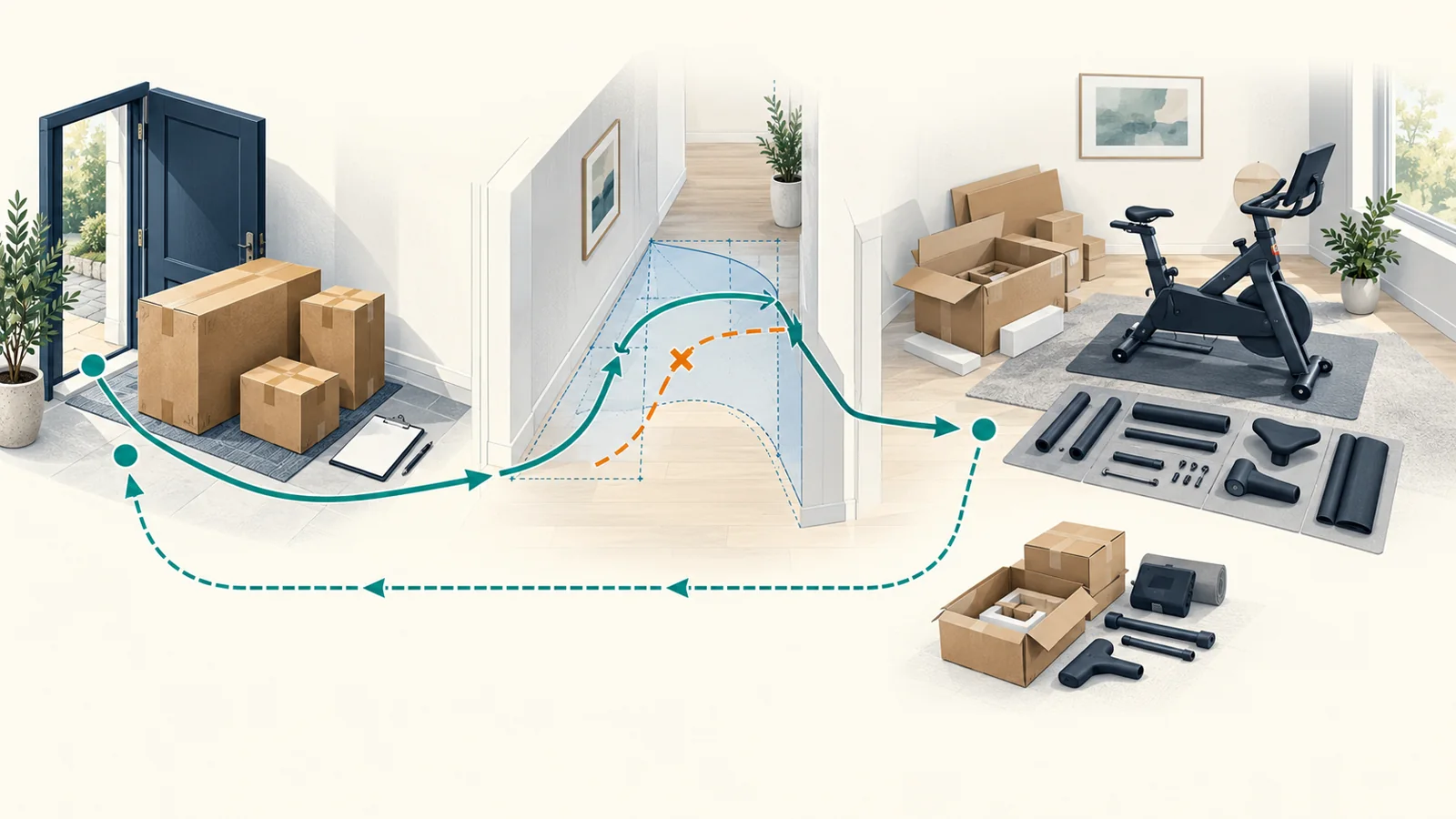
Before ordering large home-fitness equipment, build one dated delivery-to-return record. It should follow the exact purchase from the seller’s receiving point to the final room, through unpacking and assembly, and back out again if the product is damaged, rejected, or returned.
At minimum, the record should answer:
- what exact product, option, package count, and seller are involved;
- whether the service ends at the curb, threshold, room of choice, or completed installation;
- whether every doorway, turn, stair, elevator, threshold, and final approach has been measured as a clear opening;
- where unpacking and assembly will happen;
- which tools, helpers, installers, building permissions, and site prerequisites are required;
- how visible damage, missing packages, and delivery refusal must be documented;
- whether packaging must be retained;
- how the item would be disassembled, repacked, moved beyond a threshold, collected, and charged on return.
Do not force a pass when package data, allowed orientation, delivery scope, building access, assembly instructions, or return logistics are missing. A no-purchase or defer result is valid.
Use The Total Cost of Home Fitness Equipment: Beyond the Purchase Price for the broader cost fields and Floor Protection, Power, Clearance, and Safety Checks for Home Fitness Equipment for separate site and safety diligence. Neither replaces exact delivery and return evidence.
The delivery-to-return record you are building
Use one worksheet for one exact product option, seller, destination, delivery service, and return scenario. The room-measurement record in FitFootprint’s space-measurement workflow can supply room and route observations, while the dimension methodology keeps package, assembled, operational, moved, and stored states separate.
| Record block | Required fields | Decision it supports |
|---|---|---|
| Purchase identity | Exact model, SKU or variant, count, seller, market, order path, date | Stops facts from drifting across similar products or sellers |
| Shipment | Package count, dimensions, weights, labels, allowed orientation, pallet state | Determines what must reach the receiving point and route |
| Service scope | Parcel, curbside, threshold, room of choice, assembly, installation, packaging removal | Defines where the carrier’s or installer’s obligation ends |
| Route | Exterior approach, openings, halls, turns, stairs, elevators, thresholds, final approach | Screens whether the package or approved move state can reach the destination |
| Building access | Loading dock, reservation, elevator protection, Certificate of insurance, hours, parking, permits | Identifies access conditions outside the product dimensions |
| Assembly or installation | Location, sequence, tools, helpers, site prerequisites, installer responsibility | Prevents delivery from being mistaken for completed setup |
| Acceptance | Package count, visible damage, delivery receipt, photos, missing parts, refusal rules | Preserves evidence before the carrier departs |
| Return | Authorization, window, condition, packaging, disassembly, pickup point, freight, restocking, nonrefundable services | Tests whether the purchase can realistically leave the home |
| Outcome | Ready, conditional, professional review needed, blocked, or defer | States the bounded next action without implying certification |
A complete record can still produce a blocked result. Completeness means the applicable fields are present and sourced, not that the purchase should proceed.
Scope and evidence limits
This article owns the workflow between shortlist and completed delivery or return. It does not replace:
- the exact product manual, package labels, delivery agreement, order confirmation, or return authorization;
- a carrier’s site assessment or an installer’s final approval;
- a building manager’s access rules;
- a qualified structural, electrical, accessibility, or code review;
- a professional moving or rigging plan;
- a warranty diagnosis, recall remedy, consumer-rights opinion, or legal conclusion.
Manufacturer and seller examples below show how service scopes differ. They are not recommendations, category averages, or promises that another order will use the same terms.
Lock the exact purchase path before measuring
Record the exact product and transaction before reusing any logistics field. A product family name is not enough when package count, included accessories, seller, delivery tier, installer, or return policy changes by option.
Capture:
- exact product name, model, SKU, color or capacity option;
- seller and checkout route;
- market, destination ZIP code, and currency;
- quantity and bundled accessories;
- whether the unit is new, refurbished, used, rented, financed, or sold through a partner;
- delivery tier selected or displayed;
- installation or assembly provider;
- current return and warranty routes;
- checked date and saved evidence.
If the seller, manufacturer, carrier, and installer are different organizations, keep four separate responsibility records.
Capture package count, dimensions, weights, and allowed orientations
Package data must remain attached to the exact package count and configuration. The Concept2 RowErg page, for example, distinguishes a one-box standard-leg shipment from a two-box tall-leg shipment. That record illustrates why one package cannot stand in for the complete order.
For every package or pallet, record:
- package number and total expected count;
- outside length, width, and height with axis order;
- gross weight;
- pallet, crate, straps, protrusions, handles, wheels, or loose boxes;
- labels showing top, fragile, team lift, or orientation limits;
- whether the package may be tilted, rotated, separated, or opened before the final room;
- whether unpacking before the route is allowed by the seller, carrier, manual, or return policy.
Package dimensions are not assembled dimensions. Package weight does not prove that a person or team can control the load. An unlabeled orientation must remain unknown.
Separate curbside, threshold, room-of-choice, and assembly service
Delivery names are not interchangeable. The service record should quote or paraphrase the exact current scope and exclusions.
| Service label | Typical endpoint to verify | Questions that remain |
|---|---|---|
| Parcel | Door, lobby, mailroom, or carrier-selected point | Signature, package count, stairs, damage, theft, indoor movement |
| Curbside freight | Curb, driveway entrance, or carrier-reachable exterior point | Pallet movement, indoor handling, weather, street access, appointment |
| Threshold | First dry threshold or named ground-level point | Stairs, interior turns, room placement, unpacking, packaging removal |
| Room of choice | Named interior room under stated stair/access limits | Assembly, final position, accessories, debris removal, site approval |
| Delivery with assembly | Named room plus stated assembly tasks | Site prerequisites, accessory assembly, calibration, account setup, wall or floor approval |
| Professional installation | Delivery and installation under exact site requirements | Final on-site approval, wall/outlet/network/building conditions, relocation and removal |
REP currently describes freight as appointment-based and curbside, with driveway or garage placement left to driver discretion in limited circumstances. That is not room-of-choice delivery. See the current REP freight FAQ.
The dated Schwinn delivery record documents separate room-of-choice and delivery-with-assembly tiers, including stated stair limits and different service tasks. The accepted route was unavailable/transport-limited in the 2026-09-20 recheck, so treat these as dated examples rather than a current service confirmation. See Schwinn Shipping & Delivery. A delivery tier name must therefore remain attached to its exact order and date.
Measure the receiving point before the room
Start where the carrier is expected to stop—not at the final room. The receiving point may be:
- a curb or street edge;
- driveway entrance;
- garage;
- building loading dock;
- lobby or mailroom;
- first threshold;
- elevator lobby;
- room of choice;
- installer-approved wall or floor location.
Record who is responsible for every segment after that point. Curbside delivery is not indoor placement. A delivery appointment is not room-of-choice delivery.
Map the exterior approach and vehicle access
Document the approach from the public road or carrier access point to the receiving location:
- truck access, turning, parking, and loading restrictions;
- driveway slope, width, surface, and overhead obstruction;
- curb, gate, steps, snow, ice, mud, or construction;
- loading-dock reservation and vehicle-height limits;
- distance from curb to entrance;
- weather exposure for a pallet or carton;
- who supplies a pallet jack, dolly, lift gate, ramp, or protective covering;
- building delivery hours and contact method.
The dated Schwinn delivery record says the driver may stop at the street or closest safely reachable point when site conditions prevent the named delivery. The accepted route was unavailable/transport-limited in the 2026-09-20 recheck; the source-specific condition is retained as a dated example, not a current service promise. See Schwinn Shipping & Delivery.
Measure each clear doorway opening
Use the smallest clear opening available in the planned state, not the nominal door size. Record:
- clear width with the door open to the planned angle;
- clear height below closer, trim, threshold, or hardware;
- handle, hinge, latch, security bar, screen, storm door, or shoe molding intrusion;
- door swing and available approach;
- whether removal of a door or hardware is permitted, planned, and reversible;
- whether the package can use the required orientation through the opening.
The FitFootprint measurement guide explains why a rectangular screen is only a screen. It does not prove three-dimensional maneuverability or controlled handling.
Record hallway and turning geometry
For each turn, capture both legs of the route, the turn bay, and the vertical envelope. A single hallway width cannot approve a right-angle turn.
Record:
- inbound clear width and height;
- outbound clear width and height;
- length available before and after the turn;
- inside and outside corner obstacles;
- wall fixtures, railings, radiators, lights, sprinkler heads, and ceiling changes;
- package or product orientation allowed through the turn;
- any point where the load would have to be set down, regripped, tilted, or rotated.
Do not use a favorable diagonal calculation as proof when the package, center of mass, grips, or allowed orientation is unresolved.
Record stairs, landings, railings, and ceiling restrictions
A stair route needs more than stair width. Record:
- number of flights and steps;
- tread, riser, nosing, and narrowest width where relevant;
- railings and posts;
- landing length, width, and turn direction;
- ceiling, soffit, light, sprinkler, or beam height;
- door at the top or bottom of the flight;
- whether the delivery service includes that flight;
- whether the exact package or approved move state may use the necessary orientation;
- who is responsible for the move and what happens if the crew declines it.
Do not invent a universal person count or lifting limit. Transport wheels do not prove that one person can control the load.
Record elevator door, car, and booking requirements
For an elevator route, capture:
- clear door width and height;
- inside car length, width, and height;
- handrails, control panels, door returns, and protective pads;
- rated capacity only as a building record—not as a handling plan;
- loading-dock connection and corridor turns;
- reservation time, service-elevator requirement, keys, and staff contact;
- certificate-of-insurance or vendor-registration requirement;
- contingency if the elevator is unavailable or the crew misses the window.
A car rectangle does not prove the package can turn into the elevator or exit at the destination floor.
Record thresholds, floor transitions, and surface limits
Document every transition:
- curb and exterior step;
- door threshold;
- elevator gap;
- carpet edge;
- tile, wood, vinyl, concrete, or protective covering;
- slope or level change;
- maximum surface condition allowed by the carrier or installer;
- floor protection and who supplies it;
- point where pallet-jack, dolly, or wheel use stops.
Do not treat a mat, blanket, cardboard sheet, or wheel as proof that the floor can carry, protect, or guide the load. Site-specific floor or structural questions remain outside this workflow.
Preserve doors, controls, and escape routes
The route plan must preserve normal access and the household’s escape plan. The U.S. Fire Administration advises keeping doors and windows unblocked and knowing exit stairs in high-rise or condominium buildings. See Home Fire Escape Plans.
A proposed staging area that blocks a required doorway, exit path, alarm, extinguisher, electrical panel, building control, or accessible route is treated as blocked in this workflow. This is a practical stop condition, not a code-compliance determination.
Decide where unpacking and assembly will happen
Choose an assembly location only after considering both delivery and return. Possible locations include:
- outside or garage;
- lobby or loading area;
- final room;
- nearby larger room;
- installer-selected location.
Record:
- whether the package must stay closed until the destination;
- whether opening it changes return eligibility;
- whether components can travel separately;
- assembly floor area;
- tool and fastener staging;
- protection for floors and walls;
- ability to retain packaging;
- route from assembly location to final operating location;
- reverse path for disassembly and return.
Unpacking early can reduce one dimension while creating loose, heavy, fragile, or undocumented components. Do not assume early unpacking is allowed or easier.
Verify tools, helpers, installers, and assembly sequence
Use the current exact manual or seller service description to record:
- required tools and included tools;
- assembly steps and prerequisites;
- parts that must remain supported during assembly;
- manufacturer-stated helper or technician requirements;
- fastener checks;
- calibration, leveling, anchoring, or software steps;
- prohibited substitutions;
- packaging that must be retained;
- who is permitted to perform installation or service.
A generic video, older manual, or similar model cannot replace the exact current instructions.
Keep delivery, assembly, and installation as separate services
Delivery moves an order to a named endpoint. Assembly joins or configures components. Installation may add wall, floor, power, network, calibration, or site-approval requirements.
REP’s current third-party assembly service asks the buyer to confirm the complete order has arrived before the appointment and describes package movement and optional packaging removal as part of that separate service. That is evidence that delivery completion and assembly completion can be different events.
A seller offering assembly does not prove that every accessory, wall attachment, floor anchor, app, account, or final adjustment is included.
Verify wall, floor, outlet, network, and building prerequisites
Site-dependent products can fail after the route passes. Tonal currently requires a final on-site assessment and specific wall, space, outlet, and network conditions. Its installation requirements and supported wall materials show that a preferred location can be rejected even after planning.
Record only the exact current requirements. Do not certify a wall, stud, floor, outlet, network, or building condition. A professional installation option does not prove that the proposed site will pass the on-site assessment.
Record building management, insurance, reservations, and access windows
Apartment, condominium, and managed-building workflows may require:
- delivery reservation;
- loading-dock or service-elevator booking;
- certificate of insurance;
- vendor registration;
- proof of installer insurance;
- protective floor or wall covering;
- restricted hours;
- parking permit;
- security escort;
- landlord or owner permission for wall penetration;
- move-in or move-out deposit.
Tonal currently provides a process for a building-requested certificate of insurance and separately describes renter installation and relocation conditions in Tonal for Renters. These examples do not establish the requirements of another building.
Prepare for delivery day
Before the appointment or carrier arrival:
- confirm package count and tracking numbers;
- confirm delivery tier, endpoint, stair allowance, and assembly scope;
- confirm access window, contact numbers, parking, dock, elevator, and building approvals;
- clear only the planned route while preserving household access and exits;
- protect private documents, valuables, children, and pets from the work zone;
- prepare the final room and backup location when the installer requires one;
- have order confirmation, seller policy, product identity, and damage instructions available;
- decide who is authorized to sign, refuse, or note damage;
- preserve a place for packages and packaging;
- recheck the return window start trigger.
Do not assume the carrier will call, wait, move a pallet indoors, remove packaging, or reschedule without cost unless the exact service states it.
Inspect package count and visible damage before acceptance
Compare the delivered count with the order and shipment record. Inspect the outside of each package or pallet before the carrier leaves when the service and circumstances allow.
Record:
- package number and label;
- crushed, torn, wet, punctured, shifted, or missing packaging;
- broken bands or pallet damage;
- visible product exposure;
- delivery receipt notation;
- carrier instructions for refusal or acceptance;
- time, date, and contact name;
- seller case or claim number.
The dated Schwinn delivery record distinguishes visible package damage and says damage should be noted on the delivery receipt in its stated workflow. The accepted route was unavailable/transport-limited in the 2026-09-20 recheck; the exact order terms control. See Schwinn Shipping & Delivery.
Photograph and record damage without creating privacy issues
When documentation is allowed and useful:
- capture the package label and damage together;
- take overview and close-up images;
- avoid faces, neighboring homes, access codes, personal documents, and unrelated interiors;
- keep original files and timestamps;
- record who took the images and why;
- save correspondence and claim numbers;
- do not post publicly while a claim is unresolved unless there is a separate reason and privacy review.
Photographs document an observed condition. They do not determine carrier liability, internal damage, refund eligibility, or repairability.
Do not discard packaging before the return decision
Packaging can become a material return input. The dated Schwinn return-policy record requires original packaging in stated return cases and recommends retaining it through the initial period. It also describes disassembly and threshold placement for pickup. The accepted route was unavailable/transport-limited in the 2026-09-20 recheck, so these are dated policy examples rather than a current promise. See the Schwinn Return Policy.
Record:
- which boxes, inserts, straps, bolts, bags, labels, and pallets must be retained;
- storage space required;
- whether packaging can be flattened without losing return function;
- condition requirements;
- retention period;
- replacement-packaging availability and cost;
- who repacks the product.
Original packaging discarded is not a minor detail when the policy requires it.
Verify the route again before moving a package indoors
Delivery conditions can change between ordering and arrival. Recheck:
- parked vehicles, construction, weather, and surface condition;
- door hardware and furniture;
- elevator availability;
- route protection;
- final room readiness;
- package dimensions and actual package count from labels;
- whether the package arrived on a different pallet or configuration;
- whether the carrier or installer accepts the planned route.
A route record created from seller data does not override the actual package label or crew decision.
Use only a limited route rehearsal
A paper plan, taped outline, empty carton template, or lightweight mock-up can reveal an obvious turn or staging conflict. It cannot reproduce:
- actual mass and center of gravity;
- grip and team position;
- package flex or rigidity;
- stair control;
- surface loading;
- carrier policy;
- installer approval;
- internal component movement.
A route rehearsal is not proof of maneuverability. Do not rehearse with the actual load unless the responsible instructions and handling plan support that event.
Branch: parcel or small-box delivery
For parcel delivery, verify:
- package count and tracking;
- signature or unattended-delivery behavior;
- lobby, mailroom, locker, or doorstep limits;
- theft and weather exposure;
- whether accessories ship separately;
- damage and missing-package process;
- route from receiving point to the final room;
- packaging retention.
Small parcel does not mean the assembled system or complete order is small.
Branch: curbside or freight pallet
For freight, record the appointment, carrier contact, lift-gate status, pallet count, curbside endpoint, exterior surface, and indoor-movement plan.
REP currently states that freight is curbside and that driveway or garage movement is discretionary. See the REP freight FAQ. Its general shipping policy also keeps shipping costs and refund treatment separate.
A curbside pallet with no documented indoor path is a blocked delivery-to-room workflow, even when the product fits the final room.
Branch: threshold delivery
Confirm the exact threshold:
- street-side building entrance;
- garage threshold;
- first dry area;
- apartment threshold;
- another named point.
Record whether steps, elevator, long driveway, narrow gate, or weather change the endpoint. Threshold delivery is not room placement, unpacking, assembly, or packaging removal.
Branch: room-of-choice delivery
Confirm:
- eligible rooms;
- stair or floor limit;
- whether the service includes elevator access;
- package or assembled state;
- route protection;
- unboxing;
- debris removal;
- final placement;
- accessories and add-ons;
- failed-access and rescheduling treatment.
Peloton’s current U.S. 30-day home trial describes room-of-choice delivery for eligible equipment and separate return pickup with product-specific return fees. That is a seller-specific current path, not a universal definition.
Branch: delivery with assembly or professional installation
Record the exact service boundary:
- product assembly;
- accessory assembly;
- anchoring or mounting;
- leveling or calibration;
- power and network setup;
- account setup;
- packaging removal;
- user walkthrough;
- failed-site assessment;
- second location or rescheduling;
- warranty effect of third-party work.
A crew completing assembly does not establish that the product fits the buyer, meets every site rule, or can later be returned through the same route.
Branch: stairs or no elevator
If stairs are unavoidable:
- confirm the service includes the number and type of flights;
- record every landing, turn, ceiling restriction, railing, and door;
- verify whether the package or approved move state can use the required orientation;
- confirm who controls the move;
- define the stop point if the crew refuses the route;
- price an authorized alternative only when the exact service exists.
Do not improvise by removing railings, doors, product parts, or packaging without permission and a documented restoration plan.
Branch: elevator or scheduled loading dock
Confirm the reservation, arrival window, package count, dock access, truck limits, service elevator, protective pads, staff contact, certificate of insurance, and contingency for missed access.
A booked elevator does not guarantee the carrier will arrive within the reservation or that the package will turn into the car.
Branch: wall-mounted or site-dependent equipment
For a wall-mounted or installer-dependent system, separate route pass from installation-site pass.
Tonal’s current support materials say installers perform a final assessment and may require a backup location. They also document wall and renter constraints. See Tonal Home Gym Installation Requirements and Tonal for Renters.
If the product cannot be delivered without completing installation, a failed site assessment can block both events. Record the seller’s cancellation, rescheduling, storage, and return consequences rather than assuming a free second attempt.
Branch: damaged, missing, or wrong shipment
When the shipment is damaged, incomplete, or incorrect:
- preserve package labels and the delivery receipt;
- follow the exact refusal or acceptance instructions;
- contact the seller or manufacturer through the official route;
- record case numbers and promised next action;
- keep all components and packaging unless instructed otherwise;
- do not assemble a product the manufacturer or seller tells you not to assemble;
- keep carrier, seller, installer, and manufacturer decisions separate.
Record order, payment, shipping, return-policy, and communication details from the exact transaction. Keep the seller’s stated terms and your own delivery record separate.
Branch: the product fits only after unapproved disassembly
If the route works only after removing a factory-assembled part, screen, rail, motor cover, cable, bracket, or safety component, stop unless the exact manual or responsible manufacturer authorizes the state and provides the process.
An online video or mover’s suggestion does not create manufacturer permission. Unapproved disassembly can affect handling, damage, warranty, assembly, and return eligibility.
Branch: the assembled product fits but the return route does not
A product can reach the room as several packages and become too large or complex to leave assembled. Before purchase, record:
- disassembly instructions;
- required tools and technician;
- component weights and move states when documented;
- original packaging requirement;
- pickup endpoint;
- ability to move the packed components beyond the threshold;
- return window and authorization timing;
- freight, restocking, assembly, and nonrefundable service exposure.
An assembled product that fits the room is not automatically returnable through the same route.
Build the return path before the return window starts
The return plan should exist before delivery. Before purchase, record who pays return shipping, the return period, restocking, and nonrefundable charges from the exact policy.
Build a reverse sequence:
final location
→ disassembly or deinstallation
→ repackaging
→ interior route
→ threshold or pickup point
→ carrier collection
→ warehouse receipt
→ inspection
→ refund or alternate resolution
Record the event that starts the return window: order date, ship date, delivery date, installation date, or another exact term.
Record authorization, return window, condition, and included items
Capture:
- authorization or return-merchandise number;
- deadline and time zone;
- eligible reason and excluded products;
- new, unused, like-new, or working-condition requirement;
- original packaging and labels;
- all accessories, manuals, hardware, tools, keys, straps, and gifts;
- photos or serial verification;
- refund destination and timing;
- replacement, repair, store credit, or refund alternatives;
- whether sale, refurbished, partner, financed, or installed orders use different terms.
A return window does not prove free return freight.
Record disassembly, repackaging, pickup, freight, and restocking exposure
Return costs and tasks should stay as separate fields:
- technician or disassembly charge;
- wall repair or deinstallation;
- packaging replacement;
- indoor movement to threshold;
- palletizing or crating;
- pickup appointment;
- return freight;
- original outbound freight that is not refunded;
- restocking, handling, storage, or missed-appointment charge;
- nonrefundable assembly or installation;
- damage deduction;
- financing interest or fee treatment.
Unknown amounts remain unknown. Do not enter zero because the public policy omits a quote.
Separate seller, carrier, installer, and manufacturer responsibilities
| Party | Typical records to verify | Do not assume |
|---|---|---|
| Seller | Order, price, delivery tier, cancellation, return authorization, refund | Seller controls carrier or installer action in every event |
| Carrier | Appointment, endpoint, damage receipt, lift gate, pickup | Carrier will move indoors, assemble, wait, or accept an unapproved package |
| Installer | Site assessment, assembly or installation scope, failed-site process | Installer approves the building, wall, floor, outlet, or product use beyond its scope |
| Manufacturer | Product identity, manual, warnings, approved states, warranty, recall remedy | Manufacturer pays voluntary-return freight or building costs |
| Building | Dock, elevator, insurance, hours, access, wall permission | Seller or carrier can waive building rules |
When records conflict, preserve each source and ask the responsible party. Do not silently choose the instruction that makes delivery easier.
Keep warranty service separate from a voluntary return
A voluntary return, shipping-damage claim, warranty service, recall remedy, and credit-card dispute are different paths.
The dated Schwinn return-policy record distinguishes buyer-remorse or size-limitation returns from visible shipment damage and technical-support resolutions. The accepted route was unavailable/transport-limited in the 2026-09-20 recheck, so do not treat this record as a current transaction result. See the Schwinn Return Policy.
A warranty can cover a repair or replacement under its terms without covering return freight, routine assembly, moving, packaging, downtime, wall repair, or a full refund. Record the exact path rather than treating warranty as a zero-cost return.
Check exact-model recalls and stop-use remedies
Before installation, assembly, resale, or return, search the exact model, serial range, and remedy on the CPSC exercise-equipment recall route and the manufacturer’s current recall page.
The CPSC’s exact AMP MP2 recall illustrates why model, remedy, and authorized on-site repair must remain exact. It does not apply to every smart gym or wall-mounted product.
A recall search with no matching result is not a safety certificate. If the exact unit is recalled, follow the remedy and stop-use instructions rather than substituting this workflow.
Missing and conflicting inputs
Use one of three states for every required input:
| State | Meaning | Workflow treatment |
|---|---|---|
| Present | Exact current source or local measurement is recorded | Continue within its scope |
| Missing | The field applies but no reliable value or instruction is available | Mark the affected conclusion unknown or blocked |
| Conflicted | Exact sources or parties disagree | Preserve both and stop the affected decision until reconciled |
Material missing fields include package count, gross weight, allowed orientation, delivery endpoint, stair allowance, installer prerequisites, package-retention rule, return pickup point, and return freight.
Unknown is not a pass, zero, deliverable, returnable, or professionally approved.
Synthetic case A: curbside pallet and third-floor stairs
A fictional order arrives as one 74 × 42 × 38-inch pallet weighing 420 pounds. Freight service ends at the curb. The apartment is on the third floor, the building has no elevator, and no authorized indoor mover is booked.
The final room is large enough for the assembled product, but the delivery-to-room workflow is blocked. The correct next action is to obtain an authorized delivery or moving path, choose another seller or product, or defer. The room rectangle does not override the service endpoint or stairs.
Synthetic case B: room-of-choice service with missing package data
A seller lists room-of-choice delivery including one flight of stairs, but the exact package count, package dimensions, gross weights, and allowed orientation are not published. The buyer has measured a narrow turn before the staircase.
The service label alone cannot prove the route. The result is conditional pending the seller’s exact shipment record and carrier acceptance. No route pass should be reported.
Synthetic case C: wall-mounted installation blocked on site
A wall-mounted system passes the delivery route. On installation day, the installer determines that the primary and backup walls do not meet the vendor’s current requirements. The product cannot be delivered without completed installation.
The installation is blocked. The record must capture rescheduling, storage, cancellation, return, refund, wall-work, and second-visit consequences from the exact seller terms. A route pass is not an installation-site pass.
Synthetic case D: return blocked by discarded packaging
An assembled machine fits the room. Ten days later, the buyer requests a voluntary return. The policy requires original packaging and threshold pickup, but the boxes and inserts were discarded and the machine cannot leave assembled.
The return path is blocked pending seller authorization, replacement packaging, disassembly, indoor movement, and freight terms. The initial delivery success does not prove return feasibility.
Stop and escalation conditions
Stop or escalate when:
- exact product, package count, or shipment configuration is unresolved;
- a material route segment is unmeasured;
- package dimensions or weight conflict;
- allowed orientation is unknown for a tight route;
- the delivery endpoint or stair allowance is unclear;
- building approval, elevator booking, certificate of insurance, or wall permission is missing;
- the route blocks an exit or required control;
- the carrier, installer, or building rejects the route or site;
- the plan depends on unapproved product disassembly;
- site-specific wall, floor, structural, electrical, accessibility, or code judgment is required;
- packaging cannot be retained despite a material return requirement;
- return authorization, disassembly, pickup, freight, or restocking exposure could change the decision;
- exact-model recall or stop-use instructions apply;
- the household cannot keep children, pets, or bystanders outside the work zone;
- no responsible party accepts the next segment of the route.
The correct escalation may be the seller, carrier, installer, manufacturer, building manager, professional mover, qualified contractor, electrician, or another specialist. This article does not choose or certify that professional.
When to choose another product or seller
Consider another product, option, seller, or delivery tier when:
- the exact shipment cannot pass the route;
- curbside delivery creates an unresolved indoor move;
- the unit requires disassembly that is not authorized;
- the building will not permit the delivery or installation;
- the product fits only by blocking normal access or an escape route;
- return packaging or reverse-route requirements are impractical;
- the likely return or relocation exposure is unacceptable but cannot be resolved;
- the seller cannot provide the package or service fields needed for the decision;
- the exact-model recall remedy or support state changes the purchase path.
A no-purchase or defer result is valid.
Save the delivery-to-return record
Save:
- exact product and seller identity;
- source URLs and checked dates;
- order and delivery tier;
- package inventory;
- route segment table and measurements;
- building requirements;
- assembly or installation plan;
- delivery-day acceptance record;
- damage and missing-package evidence;
- packaging-retention plan;
- return authorization, reverse route, freight, and exposure fields;
- conflicts, unknowns, stop conditions, and responsible contacts;
- final disposition and next action.
Keep the record even if the buyer does not order. It can explain why a larger product or different seller was rejected and what evidence a future candidate must supply.
Next step
Use the live space-measurement guide to collect room and route inputs, then use the live dimension methodology to classify package, assembled, operating, moved, and stored values. Recheck all seller, carrier, installation, return, and recall facts immediately before purchase.
For a dated policy-matrix snapshot, see Compact Fitness Equipment Warranty, Return, Service, and Repairability Matrix. For used-equipment diligence before treating a private-sale or refurbished listing as a purchase, see Buying used compact fitness equipment. The total-cost and safety pages remain separate decision paths from this delivery-to-return checklist.
Methodology
This canonical v01 workflow combines the approved FitFootprint dimension, room-fit, and safety-source boundaries with the accepted current official seller, installation, return, fire-escape, and recall records. It keeps product identity, package state, delivery service, route segments, assembly, site prerequisites, acceptance, return, warranty, and recall paths separate.
The accepted routes were rechecked on September 13, 2026. The 2026-09-20 source-status recheck found the accepted Schwinn delivery and return routes unavailable/transport-limited, so those earlier fields remain dated examples rather than current service confirmations. The records validate fields and branches, not product quality or delivery success. FitFootprint did not perform a delivery, installation, damage inspection, assembly, return, or recall transaction.
Sources
- FitFootprint — How to Measure Your Space for Home Fitness Equipment — live route, room, package, assembly, and product-state workflow — checked September 13, 2026.
- FitFootprint — Home Fitness Equipment Dimensions Explained — object, count, state, configuration, and delivery-path interpretation — checked September 13, 2026.
- REP Fitness — FAQ — freight appointment and curbside-delivery scope — checked September 13, 2026.
- REP Fitness — Assembly Services — separate assembly scheduling and package-arrival dependency — checked September 13, 2026.
- REP Fitness — Shipping Policy — shipping-cost and refund-treatment boundary — checked September 13, 2026.
- Schwinn Fitness — Shipping & Delivery — delivery tiers, stairs, damage checklist, and site restrictions — checked September 13, 2026.
- Schwinn Fitness — Return Policy — authorization, packaging, disassembly, threshold pickup, freight, and restocking exposure — checked September 13, 2026.
- Tonal — Home Gym Installation Requirements — final site assessment and installation prerequisites — checked September 13, 2026.
- Tonal — Supported Wall Materials — wall-material and installer-approval boundaries — checked September 13, 2026.
- Tonal — Certificate of Insurance — managed-building insurance-document workflow — checked September 13, 2026.
- Tonal — Tonal for Renters — renter permission and relocation-service boundary — checked September 13, 2026.
- Peloton — 30-Day Home Trial — room-of-choice delivery, return pickup, and current equipment-specific return fees — checked September 13, 2026.
- U.S. Consumer Product Safety Commission — Exercise Equipment Recalls — exact-product recall and remedy route — checked September 13, 2026.
- U.S. Consumer Product Safety Commission — AMP MP2 Recall — exact-model, stop-use, and authorized on-site repair example — checked September 13, 2026.
- U.S. Fire Administration — Home Fire Escape Plans — keep doors and windows unblocked and know exit stairs — checked September 13, 2026.
- Concept2 — RowErg — one-box and two-box shipping configurations and included assembly materials — checked September 13, 2026.
What changed — September 25, 2026: The September 20 status recheck found the accepted Schwinn delivery and return routes unavailable/transport-limited. Their previously reviewed policy details remain dated examples, not current service confirmations. No delivery, return, or service outcome was observed.