
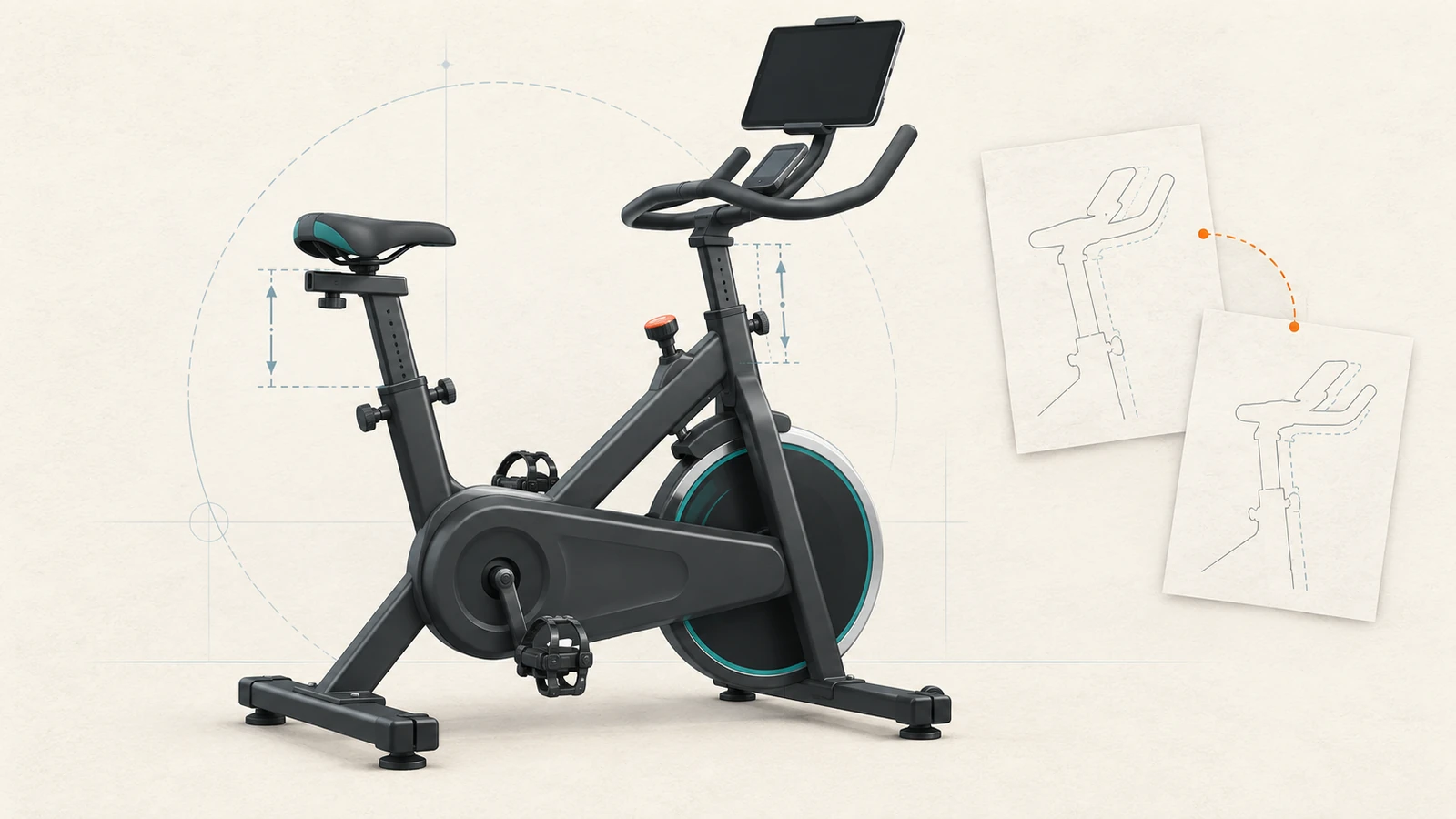
Quick verdict
The current Schwinn IC4 can remain on a small-room shortlist when a buyer wants a fixed indoor-cycling bike with magnetic resistance, a console that works without a paid app, and documentary connection paths for Peloton, Zwift, and JRNY. It should not be treated as a compact or universally compatible choice from its product dimensions alone.
The product page gives a 54.6-by-30.7-by-51.8-inch assembled envelope and a 113.6-pound assembled mass. That rectangle is only the bike. A real setup also needs an entry and exit path, pedal and knee movement, seat and handlebar adjustment access, a device position, a power-cord route, ventilation and maintenance access, and enough room to move or service the bike. Use the live FitFootprint space-measurement workflow before accepting the seller footprint.
The largest current blockers are not a missing feature count. They are the conflict between two official rider-range records, the difference between broad app marketing and exact data/control directions, a current console-description conflict, price volatility, return-freight exposure, and the absence of direct pairing, fit, noise, stability, and service evidence.
Key facts from current official records
| Field | Current official record | Evidence limit |
|---|---|---|
| U.S. product identity | Schwinn IC4 Indoor Cycling Bike | Exact label, serial, and hardware revision were not inspected |
| Current direct listing | $799 with a $999 crossed-out reference field | Dated listing input; the displayed promotion expires September 12, 2026 and is not final checkout or an evergreen normal price |
| Product envelope | 54.6 × 30.7 × 51.8 in | Does not include user, access, device, cord, or maintenance zones |
| Assembled mass | 113.6 lb | Does not prove one-person movement or floor suitability |
| Maximum user weight | 330 lb | Seller-stated limit, not an independent fit or safety finding |
| Product-page rider range | 5 ft 1 in–6 ft 4 in; inseam 29–39 in | Conflicts with current FAQ |
| FAQ rider range | 4 ft 6 in–6 ft 6 in; inseam 30–39 in | Conflict requires seller clarification or direct fit evidence |
| Resistance | 100 magnetic levels | Level numbering is not cross-platform intensity equivalence |
| Included training accessories | Pair of 3 lb dumbbells and BLE heart-rate armband | Inclusion does not establish accuracy, fit, or replacement cost |
| Power | 110–120V wall connection; cord included | Outlet, circuit, cord placement, and code suitability not assessed |
| Warranty headline | Frame 10 years; mechanical 3; electronics 3; labor 1 | Coverage, exclusions, proof, freight, and remedy remain controlling |
Best for and avoid if
Potential fit for further diligence: a buyer who has a measured permanent bike zone, accepts a 113.6-pound fixed bike, wants a console-based ride without mandatory paid software, and is willing to verify app behavior, rider fit, delivery, power, and return terms before checkout.
Avoid or defer: a buyer who needs a folding or easily hidden bike, requires exact automatic resistance control from an app, cannot preserve the power and household route, needs a guaranteed rider fit from the published height range, cannot retain return packaging, or cannot manage the delivery, assembly, and possible return-extraction process.
This section is not a recommendation. It routes a buyer to the remaining checks.
For the platform-function comparison, see JRNY vs Peloton App vs Zwift for Compatible Home Equipment; that comparison does not establish that the IC4 will pair or control an app.
Exact product identity and market
The checked direct product is the U.S. Schwinn IC4 Indoor Cycling Bike. The accepted Schwinn global comparison route now redirects to a global indoor-cycling collection that does not independently bind the current U.S. IC4 to an 800IC transaction. Region, voltage, included accessories, warranty, seller, and support path therefore remain attached to the exact transaction; no IC4/800IC equivalence is inferred here. (Official regional model comparison route)
The current U.S. product page links its manual and replacement-parts controls to a parts-catalog record titled “SCH IC4 (800ICi) BIKE | 2019.” That record is useful for parts identity and historical model binding, but record number 91096 is not treated here as a retail SKU, serial number, or proof that every current unit has the same hardware revision. (Official IC4 parts catalog)
A used listing that says only “IC4,” “800IC,” or “800ICi” is not sufficiently identified for this analysis. Exact label, voltage, seller market, serial or production information, included accessories, ownership history, app state, and support eligibility remain purchase-specific.
Buyer scenario
The five synthetic scenarios below distinguish a measured permanent-bike zone with no paid app, cadence-only Peloton use, a requirement for automatic app resistance or full FTMS, a rider at a published range boundary, and a need to hide or move the bike after each session. They are evidence-screening examples, not observed customers or direct-use results. Their dispositions are summarized later, after the conflicts and unknowns review.
Product envelope and complete room fit
The seller-stated product rectangle is about 11.64 square feet when 54.6 by 30.7 inches is converted to a plan area. That arithmetic is not the operating area. It excludes:
- the rider’s entry and exit side;
- knee, foot, elbow, and upper-body movement;
- seat and handlebar adjustment travel and hand access;
- pedal clipping or toe-cage access;
- tablet or phone placement and viewing distance;
- dual bottle holders and included dumbbell access;
- wall-adapter and cord routing;
- transport-wheel tilt and turning path;
- cleaning, inspection, and parts-service access.
Measure the room and delivery route with the FitFootprint measurement guide, and use the live equipment-dimensions methodology to keep seller dimensions separate from missing operating-space inputs. Do not infer apartment fit, doorway fit, ceiling fit, or safe circulation from the bike rectangle.
Delivery path and assembled mass
The assembled product weight is 113.6 pounds. The product also includes a pair of 3-pound dumbbells, so a simple bike-plus-dumbbell inventory is 119.6 pounds before packaging, mat, device, bottles, shoes, tools, or accessories. This sum is an inventory value, not a lifting, floor-loading, or structural conclusion.
Transport wheels are documented, but wheels do not prove that one person can control the bike through a turn, threshold, carpet edge, sloped route, stair, or narrow room. Record package dimensions, assembled dimensions, hand positions, tilt state, helper need, temporary set-down, and the route in both directions. The checked public product record did not close all those fields.
Rider range conflict
The current product page gives a recommended height range of 5 feet 1 inch to 6 feet 4 inches and an inseam range of 29 to 39 inches. The current IC4 FAQ instead gives 4 feet 6 inches to 6 feet 6 inches and an inseam range of 30 to 39 inches. (IC4 product specifications) (IC4 FAQ)
These records cannot be averaged or combined into a wider range. A buyer at or near any boundary should obtain current seller clarification and verify the exact bike adjustment with the intended shoes and riding position. Height or inseam within a seller range does not guarantee reach, comfort, joint position, accessibility, or medical suitability.
The product page also gives a minimum ceiling formula of user height plus 20 inches. That is seller guidance for the named bike, not a universal bike-clearance rule. The buyer still needs a measured ceiling, mounting path, room obstructions, and any platform or mat height.
Seat, handlebar, and pedal adjustment
The product page describes fore-aft and vertical seat adjustment, four-way handlebar adjustment, and dual-sided pedals with SPD clips and toe cages. The FAQ states that the crank arm is 170 millimeters and non-adjustable, and that replacement pedals use a 9/16-inch interface. (IC4 FAQ)
Those records define adjustability, not a rider-specific setup. This article does not prescribe seat height, fore-aft position, handlebar position, cleat setup, footwear, cadence, or training load. A buyer who cannot verify reach and mounting/dismounting should defer or use qualified bike-fit or medical guidance as appropriate.
Intended use and manufacturer limits
The current FAQ gives a maximum user weight of 330 pounds and describes the bike as a consumer fitness product. A seller-stated maximum is a documented constraint, not a recommendation to operate at the boundary and not an independent safety margin.
General Schwinn support material says consumer equipment is not intended for commercial or institutional use and that such use can affect warranty coverage. A buyer planning shared, rental, studio, clinic, employer, or other non-home use should confirm the exact use class before purchase.
Resistance, flywheel, and console
Current official records describe 100 levels of magnetic resistance and a 40-pound flywheel. The console shows time, calories, speed, distance, cadence, resistance level, and pulse/heart rate. (IC4 FAQ)
A resistance number is not a standardized workload across Peloton, Zwift, other bikes, or different IC4 units. The checked documentation does not establish calibration parity, power-meter accuracy, automatic resistance control, or a one-to-one conversion to another platform’s scale.
Likewise, displayed calories, speed, distance, and power-related app values should not be treated as independently validated measurements without an accepted protocol and direct evidence.
Display conflict
The product page calls the console a backlit LCD metric console. The current official bike-comparison page labels the IC4 display Full Color LCD. (Current product page) (Official bike comparison)
The package preserves both descriptions. It does not choose the more favorable label. A buyer for whom color, backlighting, readability, language, metric layout, or accessibility is material should verify the current console on the exact unit or obtain current written clarification.
Included accessories
The current U.S. record lists a pair of 3-pound dumbbells, easy-reach cradles, a Bluetooth Low Energy heart-rate armband, dual-sided pedals, a device holder, dual water-bottle holders, and a USB charging port.
Included does not mean permanently available as a replacement or suitable for every user. The parts catalog currently shows individual components and displayed retail prices, including a console, pedal pair, flywheel, heart-rate armband, power adapter, drive belt, and many smaller service parts. (Official IC4 parts catalog)
Parts-list presence is not a service promise. Stock, compatibility, labor, diagnostic process, freight, taxes, tools, and future availability remain unknown.
Power and electrical placement
The current product page states that the IC4 plugs into a 110–120V wall circuit and includes a power cord. The buyer must still plan the outlet, adapter, cord path, device cable, USB cable, cleaning access, and the route used to mount and dismount the bike.
This article does not approve an outlet, circuit, extension cord, power strip, surge protector, adapter, floor crossing, or code condition. If the current manual, property rules, or qualified electrical review do not close the power question, the setup remains blocked.
Evidence and access
FitFootprint had no physical bike, seller correspondence, checkout, app account, membership, mobile device, heart-rate monitor, floor, room, or service transaction. The analysis therefore separates:
- official current product and policy documentation;
- official app-connection instructions;
- official parts-catalog availability and current displayed parts prices;
- unresolved conflicts between official pages;
- direct evidence that has not occurred.
No statement in this article means the bike was tested, measured, found quiet, found stable, confirmed comfortable, paired successfully, calibrated, or shown to fit a particular rider.
Recall and regulator diligence
The public CPSC recall database route was available, but this recheck does not record an exact current IC4 result. That absence of a recorded result is not a safety certificate, and the database state can become stale. (CPSC recalls)
Before purchase—especially for a used unit—verify the exact model name, regional variant, voltage, label, serial or production information, warning and recall records, remedy status, ownership transfer, manual, and support eligibility. Do not transfer a recall or remedy from an unrelated Schwinn bicycle, scooter, accessory, or another exercise product to the IC4.
Current purchase state
The current direct product page displayed $799, a crossed-out $999 reference field, a $200 Off + Free Shipping offer ending September 12, 2026, and an Add to cart control. The offer is limited to eligible standard shipping in the contiguous United States, subject to availability, may change, and does not apply to every destination or order. (Current IC4 product page)
The same page displayed optional add-ons including an extra-comfort seat at $39.99 and a 48-by-36-inch equipment mat at $99. Those add-ons are separate buyer choices. The current free-mat promotion does not prove that the same mat, color, availability, or checkout treatment will apply later.
An Add to cart control is not a completed checkout. Final inventory, address acceptance, tax, financing, delivery selection, promotion eligibility, and actual charged total remain unverified.
Delivery, assembly, and shipping cost
The product page currently lists FedEx Parcel at $0 under the promotion and White Glove at $299, with expected warehouse departure within five days. The full shipping page says delivery choices and charges are product-specific, delivery is limited geographically, address changes can create charges, and final tax treatment depends on destination. (Schwinn shipping policy)
Dated listing scenarios:
Product listing only: $799
Product plus White Glove: $1,098
Product plus optional $99 mat: $898
Product plus White Glove and optional $99 mat: $1,197
These are arithmetic scenarios, not quotes. Tax, promotion eligibility, financing, address-specific delivery, optional seat, subscription, return exposure, and service remain outside them.
Known listing inputs and unknown costs
Known current listing inputs include the $799 product field, $299 White Glove field, $39.99 optional seat field, $99 optional mat field, and displayed JRNY monthly/annual fields. They do not form one mandatory basket.
Unknown or conditional inputs include:
- final tax and checkout amount;
- promotion eligibility and end date;
- exact standard-delivery and assembly availability at the address;
- device, internet, app, and subscription cost for the chosen plan;
- replacement shoes, pedals, seat, mat, adapter, heart-rate monitor, or device;
- return freight, packaging, handling fee, moving, and disassembly;
- warranty-service freight, labor outside coverage, and parts availability;
- electricity, maintenance, financing, resale, and disposal.
Complete ownership total unavailable
A complete ownership total is unavailable because the buyer scenario, checkout, tax, app plan, device plan, return risk, maintenance, repair, electricity, financing, and terminal value are not closed. Unknown does not mean zero.
The live home-fitness total-cost framework is a reference, but it does not close this buyer-specific checkout, service, return, electricity, maintenance, financing, or terminal-value inputs. This article does not approve a reusable total-cost formula or a three-year or five-year result.
Noise, stability, comfort, and ride feel
Schwinn describes the IC4 as smooth and quiet and uses comfort-oriented language for its adjustable seat and handlebars. FitFootprint did not measure sound, vibration, frame movement, resistance feel, saddle comfort, pedal feel, console readability, or long-session usability.
Those seller claims remain attributed. A product with magnetic resistance can still produce mechanical, drivetrain, pedal, structure-borne, floor, device, and household noise. Apartment suitability requires a room, floor, neighbor, building, and use-specific assessment.
App compatibility overview
Schwinn currently names JRNY, Peloton, Zwift, Explore the World, Apple Health, Google Fit, and Kinomap on the IC4 product page. The official comparison page describes the IC4 as Partial FTMS, meaning it connects to specific apps rather than providing a universal connection guarantee. (Official bike comparison)
Compatibility must be recorded by exact app, operating system, device, app version, account, region, subscription, connection direction, data fields, and control direction. Marketing logo presence is not successful pairing.
Peloton connection
Schwinn’s current IC4 connection guide instructs an Apple phone or tablet user to enable Bluetooth, press the bike’s Bluetooth button, start a Peloton cycling program, open Connected Devices, choose Cadence, and select the bike. The documented result is that cadence appears in the Peloton app. (IC4 app-connect guide)
That path does not establish Peloton resistance control, automatic adjustment, power transmission, heart-rate transmission, Android parity, Apple Watch behavior, or a resistance conversion. A separate Peloton subscription may be required under Peloton’s current terms, which are outside this Schwinn transaction and must be rechecked directly.
No Peloton pairing was performed for this article.
Zwift connection
Schwinn’s current guide instructs the user to pair the bike as a POWER SOURCE in Zwift. It separately identifies heart rate and cadence as optional additional connections, with a BLE heart-rate device required for heart rate. (IC4 app-connect guide)
The guide does not prove that every device, operating system, account, app version, or firmware combination will connect. It also does not establish controllable resistance, racing accuracy, calibration parity, or sustained connection reliability.
No Zwift pairing or data comparison was performed.
JRNY and optional subscriptions
The product page currently offers a two-month JRNY trial for new members and displays $11.99 per month or $99 per year after trial. It says the App membership can support up to three users, with a separate All-Access tier for more profiles. (Current IC4 product page)
The current JRNY route says trial availability can change and that a trial can auto-renew at current rates until canceled. Device and operating-system requirements also change over time. (Official JRNY page)
Monthly and annual paths are alternatives, not amounts to add together. Trial activation, account, payment method, cancellation timing, taxes, profile limits, content availability, and future renewal price remain separate inputs.
Apple Health, Google Fit, Kinomap, and other routes
The product page displays additional integration logos, while the broader connected-apps page says Bluetooth-enabled Schwinn products can connect with several apps and services. Broad family-level language does not establish that every data field, device, region, or direction applies to the IC4. (Schwinn connected apps)
For each required service, verify:
- exact IC4 support rather than brand-level support;
- source and destination of each metric;
- whether an intermediary app is required;
- account and subscription conditions;
- export, deletion, shutdown, and fallback behavior;
- whether the function was observed on the buyer’s devices.
No Apple Health, Google Fit, Kinomap, or other connection was tested.
Connection, data, and control direction
Do not collapse the following into one word, “compatible”:
bike -> app cadence
bike -> app power-like data
heart-rate device -> bike or app
app -> health platform
app -> bike resistance control
account -> cloud history
The current Schwinn Peloton guide supports a cadence-display path. The Zwift guide supports a power-source pairing path and optional cadence/heart-rate paths. Neither guide, by itself, establishes app-controlled resistance.
Partial FTMS and unsupported inferences
The official comparison page labels the IC4 connection as Partial FTMS. That description must not be upgraded to full FTMS, universal Bluetooth compatibility, automatic resistance, ERG mode, complete metric export, or compatibility with every app that accepts fitness-machine data.
A buyer who needs a specific control or data field should require an exact support record or perform a documented pairing test before purchase. Unknown support is not a pass.
Offline and no-subscription use
Schwinn’s connected-apps page says a Schwinn product can deliver a full workout experience with zero subscriptions required. The IC4 has a local console and manual resistance control, so paid software is not documented as a requirement for basic riding. (Schwinn connected apps)
That does not mean every feature works offline, without an account, or after a service shutdown. App workouts, cloud history, streaming, adaptive content, integrations, and software updates can have separate internet, device, and account dependencies.
The buyer should distinguish “bike remains manually usable” from “all desired digital functions remain available.”
Device, account, and internet burden
The buyer supplies a compatible phone or tablet, internet access, app-store account, app accounts, subscriptions, chargers, and any platform-specific permissions. Schwinn’s Terms state that devices and internet needed for certain features are supplied at the user’s expense, and subscription fees can renew at then-current rates until canceled under the applicable channel. (Schwinn terms of service)
The tablet shown in product media is not included. Device weight, holder fit, charging cable, operating system, account recovery, data export, and service shutdown are ownership considerations rather than bike-footprint details.
Assembly and first-use boundary
The product page offers FedEx parcel delivery and a White Glove option where available. The bike arrives as a product that must reach the intended room and be assembled or prepared by the selected service path. The checked public page did not close every package dimension, stair, turn, tool, helper, calibration, inspection, or disposal field for this buyer.
No assembly was observed. Do not infer that seller assembly, third-party assembly, or self-assembly produces the same verification record. Save the manual, assembly record, hardware check, packaging state, and any service report.
Maintenance, parts, and repairability
The current parts catalog lists many IC4 components, including the console, pedal pair, flywheel, drive belt, resistance assembly, resistance sensor, power adapter, transport wheel, seat components, heart-rate armband, and document kit. Displayed parts prices are dated catalog fields, not repair quotes. (Official IC4 parts catalog)
A parts list supports the conclusion that named service parts are cataloged at the checked date. It does not prove stock, exact revision fit, diagnostic access, tool requirements, labor availability, repair success, or future support.
The product page’s owner-manual link was present, but the exact current manual-to-hardware revision was not independently bound in this workflow. Product-specific inspection and maintenance instructions should come from the exact current manual and support path.
Warranty and support
The current product page states:
Frame: 10 years
Mechanical parts: 3 years
Electronics: 3 years
Labor: 1 year
Those are warranty headlines. The controlling warranty, exclusions, proof of purchase, owner/use class, remedy, technician availability, parts availability, freight, labor boundary, and geographic support terms still govern the real outcome.
Schwinn provides sales and in-warranty/out-of-warranty support channels and links to manuals and replacement parts. Channel existence is not a service-level or success guarantee. (Schwinn contact and support)
Returns, packaging, and extraction
The current return policy gives a 30-day window from delivery, requires authorization, and states that the product refund can be reduced by original and return freight. It requires like-new condition and original packaging to avoid a handling fee that may reach 20 percent of item cost. (Schwinn returns and cancellations)
For buyer-remorse or size-limit returns, the customer can be responsible for return freight and packaging. The policy says an assembled unit may need to be disassembled, placed in original packaging, and positioned beyond the threshold or door for pickup. Curbside extraction does not include indoor removal.
At a $799 product listing, 20 percent is $159.80 before any freight, packaging, assembly, moving, or damage deduction. That arithmetic illustrates exposure; it does not predict the fee a seller will apply.
Documented strengths
Within the current documentation boundary, the IC4 has several useful attributes:
- one current U.S. exact-model page with published dimensions, mass, user limit, power, and warranty headlines;
- 100 magnetic resistance levels and a local console;
- dual-sided SPD/toe-cage pedals;
- four-way handlebar adjustment and adjustable seat;
- included 3-pound dumbbells and BLE heart-rate armband;
- official Peloton cadence and Zwift power-source connection instructions;
- a current official parts catalog with many named service parts;
- basic riding documented without a mandatory paid subscription.
These are documented attributes, not scored advantages or observed performance.
Material burdens
The main burdens are:
- a fixed 54.6-by-30.7-inch bike envelope before rider and access zones;
- 113.6 pounds assembled before accessories;
- wall power and cord planning;
- a rider-range conflict across official pages;
- partial rather than universal FTMS language;
- separate app/device/account/subscription dependencies;
- return freight, packaging, disassembly, and extraction exposure;
- no direct evidence for fit, noise, stability, comfort, connection reliability, or service outcome.
Conflicts and unknowns
Material conflicts:
Product page rider height: 5 ft 1 in–6 ft 4 in
FAQ rider height: 4 ft 6 in–6 ft 6 in
Product page inseam: 29–39 in
FAQ inseam: 30–39 in
Product page display: backlit LCD
Compare page display: Full Color LCD
Material unknowns include exact hardware revision, current manual binding, package envelope, final checkout, app/device combinations, automatic-control support, data accuracy, rider fit, adjustment range at each boundary, noise, vibration, stability, comfort, floor suitability, delivery route, repair outcome, and total ownership cost.
No conflict is averaged or resolved in favor of the seller.
Buyer scenario dispositions
Scenario A — Measured permanent bike zone, no paid app required
The buyer has a verified room and route, accepts a fixed bike, wants console metrics and manual resistance, and does not require cloud history.
Disposition: eligible_for_further_diligenceThe buyer still needs rider fit, power, delivery, manual, and return checks.
Scenario B — Peloton cadence is required, automatic resistance is not
Current Schwinn instructions document a Peloton cadence connection on an Apple phone or tablet.
Disposition: documentary_support_with_named_conditionsPairing, app version, subscription, device, and sustained use remain untested.
Scenario C — Automatic app-controlled resistance or full FTMS is mandatory
The current Schwinn comparison calls the IC4 Partial FTMS, and the reviewed connection instructions do not document app resistance control.
Disposition: eliminated_by_documented_requirementDo not buy on the assumption that “compatible” supplies the missing control path.
Scenario D — Buyer is at a published rider-range boundary
Official rider ranges conflict.
Disposition: unknown_pending_evidenceObtain current clarification or verify the exact bike under an appropriate protocol.
Scenario E — Bike must be hidden or moved after every session
A 113.6-pound fixed bike with wheels is not proven easy or appropriate for daily relocation.
Disposition: no_purchase_or_deferA folding or lighter format may better match the workflow, but must be separately researched.
Alternatives and comparison boundary
Article 31 is an exact-product anchor, not a folding-bike comparison, fan-bike comparison, or platform comparison. Use the live compact exercise bike buyer guide for category-level shortlisting. See the live Schwinn IC4 or a Folding Exercise Bike for Small Spaces? A Format Decision Guide for a defined comparison of the fixed IC4 format with a current folding-bike set. Separate guides cover Peloton compatibility, platform features, and subscription cost; this product record does not replace those focused guides.
No non-live FitFootprint URL is emitted here. Buyers can currently use the verified-live space-measurement workflow, equipment-dimensions methodology, and home-fitness total-cost framework as descriptive next steps.
Recommendation boundary
The current documentation supports a conditional shortlist, not an overall recommendation. The IC4 may fit a buyer who accepts the fixed footprint, manual resistance, console, and named connection paths. It may fail a buyer who needs folding storage, automatic app control, a guaranteed boundary fit, low relocation burden, or a closed total cost.
Recommendation remains withheld. FitFootprint withholds “best,” “worth it,” “apartment-friendly,” “quiet,” “stable,” “comfortable,” “durable,” and “safe” conclusions until the relevant evidence exists.
When to defer or avoid purchase
Defer when any required condition remains unresolved:
- exact U.S. model and voltage are ambiguous;
- rider fit depends on choosing between conflicting height records;
- room, doorway, ceiling, cord, or household route is incomplete;
- automatic resistance or a specific metric is required but undocumented;
- the buyer cannot manage delivery, assembly, packaging retention, or return extraction;
- support, parts, warranty, or used-unit eligibility is unclear;
- the purchase depends on a temporary promotion, app, or subscription that has not been verified at checkout.
“No purchase” is a valid evidence-first result.
Next step
Create a buyer record containing the exact product page, seller, checked date, room and route measurements, rider measurements, required app functions, device and operating-system versions, subscription plan, delivery option, return plan, and unresolved conflicts.
Recheck every volatile page immediately before checkout. Save permitted screenshots or records of the actual price, offer, shipping, tax estimate, warranty, return terms, and app requirements.
For a focused Peloton App compatibility verification guide, see the documentation-only Exercise Bikes Compatible With the Peloton App: Verification Guide; its documented cadence paths and unresolved pairing limits remain separate from this product record.
For a separate three-year subscription or no-subscription scenario, see the Subscription vs No-Subscription Cardio Equipment: Three-Year Cost Framework; it keeps hardware, software, billing, return exposure, and unresolved inputs separate from this exact-product record.
Methodology
This public candidate applies FitFootprint’s current dimension, room-fit, safety-source, product-analysis, compatibility, and unknown-handling boundaries. It uses exactly the accepted official Schwinn/JRNY/parts records, the verified-live FitFootprint Articles 1, 2, 7, and 8 as descriptive context, and a CPSC recall-search route. It excludes marketplaces, retailer copies, forums, owner reviews, affiliate pages, and unverified app claims.
Source checks were completed on September 12, 2026. No direct use, measurement, pairing, assembly, service, checkout, or return event occurred. The article remains research_based and documentation-only; fit, safety, compatibility, service, value, ranking, and recommendation conclusions remain withheld.
For delivery, assembly, and return planning, see Doorways, Stairs, Delivery, Assembly, and Returns: A Large-Equipment Checklist.
Sources
- FitFootprint: How to Measure Your Space for Home Fitness Equipment
- Schwinn IC4 Indoor Cycling Bike
- Schwinn IC4 Bike FAQ
- Schwinn Compare Bikes
- Schwinn IC4 Bike App Connect
- Schwinn Connected Apps
- Schwinn global indoor-cycling comparison
- JRNY official information
- Schwinn Shipping
- Schwinn Returns and Cancellations
- Schwinn Terms of Service
- Schwinn Contact and Support
- Official IC4 parts catalog
- U.S. Consumer Product Safety Commission recalls
What changed
September 28, 2026: Restored the qualification that the five buyer scenarios are synthetic screening examples, not observed customers or direct-use results, and aligned the section order with the current product-analysis format. No new product research or direct-use evidence was added.