
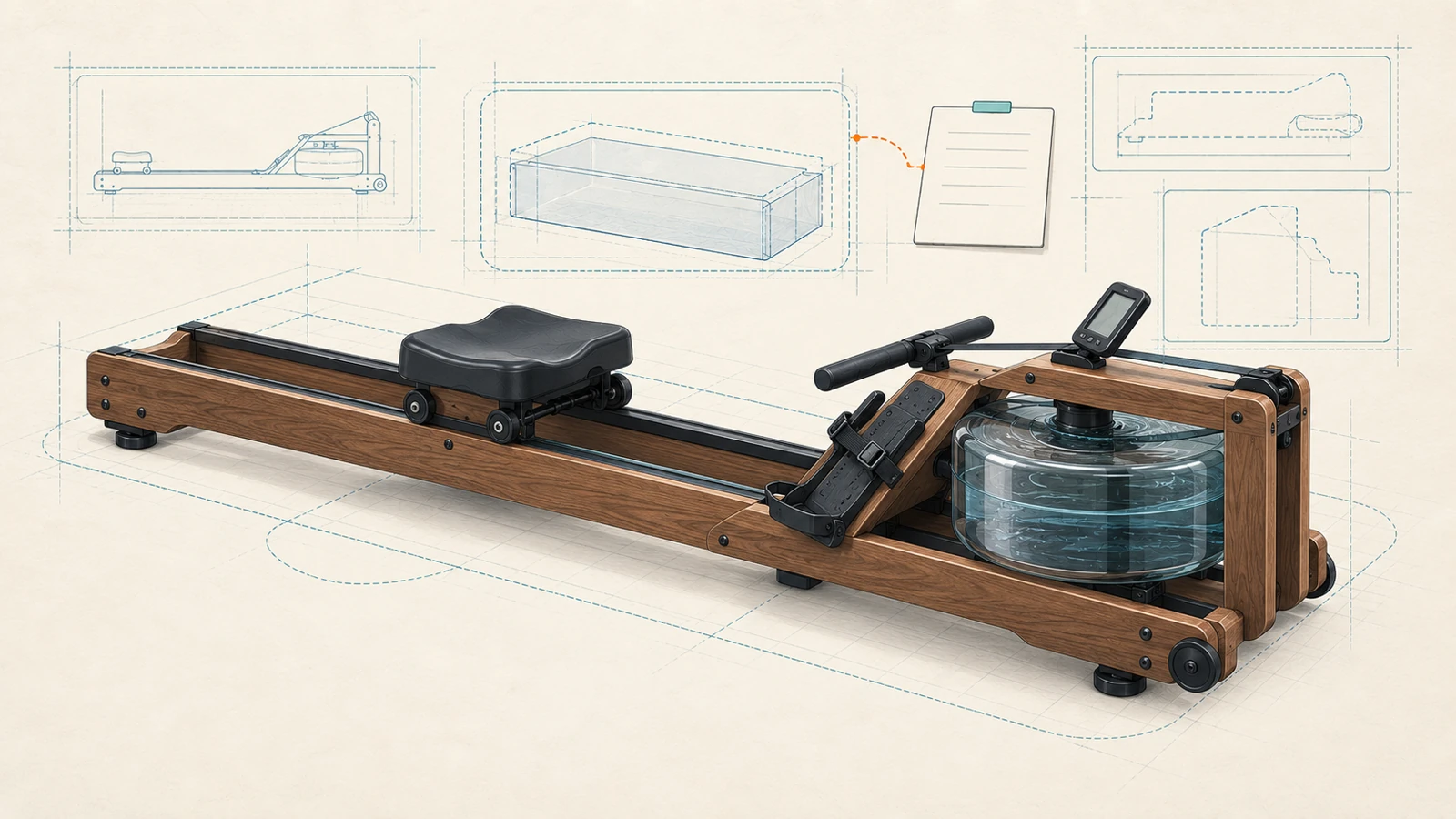
Quick verdict
The WR20 remains a current product candidate because the WalkingPad US product page exposed a $799 product group, Walnut and Red Oak variants, and an Add to cart path; its structured data marked Red Oak in stock and Walnut out of stock at the September 12 recheck. The same page states an unfolded envelope of 81.50 × 18.90 × 22.83 inches and a folded envelope of 28.94 × 18.90 × 22.83 inches.
That is enough to begin a buyer-specific geometry and ownership check. It is not enough to say the rower fits a small room, folds safely, is easy to move, is quiet, suits a particular user, or offers a complete $799 ownership cost. The current direct page does not expose a verified net weight or an exact current manual, and a separate official KingSmith storefront conflicts on product name, resistance, price, and availability. A buyer who cannot resolve the exact seller, hardware revision, manual, fold/storage instructions, operating zone, and return-freight exposure should defer the purchase.
Key facts from the current WalkingPad US listing
| Field | Current documentary record | What the record does not establish |
|---|---|---|
| Product | WR20 TriFold water rowing machine | Exact label, serial range, production revision, or manual binding |
| Direct-store price | $799 on WalkingPad US | Final checkout, tax, financing, or evergreen normal price |
| Color options | Walnut and Red Oak | Variant-specific inventory or finish equivalence |
| Unfolded envelope | 81.50 × 18.90 × 22.83 in | Complete operating and access zone |
| Folded envelope | 28.94 × 18.90 × 22.83 in | Exact permitted storage orientation, stability, or retrieval route |
| Weight-capacity wording | 331 lb in the technical table; 330 lb in other page copy | Buyer-specific fit or independent load verification |
| Resistance wording | 176 lb / 80 kg on WalkingPad US | Independent force measurement or equivalence to selectable weight |
| Power | Two AA batteries | Battery inclusion, life, or exact monitor behavior |
| Assembly | Fully assembled | Water filling, battery installation, inspection, or ready-to-row state |
| App wording | KS Fit, Bluetooth, and Kinomap references | Pairing, region, version, account, data direction, or offline behavior |
The key decision is not whether the folded number looks small. It is whether one exact unit can be delivered, unfolded, used, folded, moved, stored, inspected, and returned within the buyer’s real route and evidence limits.
Best for and avoid if
The WR20 may remain eligible for further diligence when a buyer has enough length for the full operating state, a documented route for the folded state, a place to manage a water-filled machine, and tolerance for unresolved app and service questions.
Avoid treating it as purchase-ready when any of these conditions applies:
- only the folded rectangle fits, while the full rowing and access zone does not;
- the machine must cross a threshold, stair, narrow turn, or fragile surface after every session;
- the buyer needs a verified exact manual before accepting a water-filled tri-fold mechanism;
- the buyer is at or near the published user-limit boundary;
- a low-noise or low-vibration result is mandatory;
- an exact return-freight ceiling is required before ordering;
- the $799 and $1,199 official storefront records cannot be reconciled to one exact seller and product revision.
Exact product, seller, market, and checked date
This page scopes the transaction to the current WalkingPad US direct listing titled “WR20 Water Rowing Machine | High-Resistance,” sold on walkingpad.com in USD and checked September 12, 2026. The page identifies KingSmith as the vendor but uses WalkingPad US as the storefront and policy path.
A second KingSmith official WR20 page is retained as a separate official record, not merged into the WalkingPad transaction. It displayed a different price and several conflicting technical fields. Price, shipping, return, warranty, and availability facts must stay attached to the exact storefront used for checkout.
Current purchase and availability state
The WalkingPad US page exposed a $799 product-group price and an Add to cart path; its structured data marked Red Oak in stock and Walnut out of stock at the recheck. Those page-level signals support “purchase path displayed on the checked page.” They do not prove that either color will pass checkout for a particular address or remain available after the page refreshes.
The current KingSmith product-group data marked both color variants in stock, but the storefront still uses generic sold-out/notify-me states in its purchase UI and does not establish a completed checkout. That source remains a separate availability record rather than clean buyer-specific availability evidence.
Current disposition:
WalkingPad US purchase path: displayed
Variant inventory: not locked
Checkout: not performed
Secondary storefront availability: page-level signal only; checkout not performed
Why the two official storefronts cannot be combined
The WalkingPad and KingSmith pages may refer to related branding and a similarly named product, but their records are not interchangeable without exact identity binding.
| Field | WalkingPad US | KingSmith official | Required treatment |
|---|---|---|---|
| Page title | WR20 | WR20 | Same marketing identity only |
| Technical product name | WR20 | WM20 in the technical table | Conflict; inspect exact label/manual |
| Price | $799 | $1,199 | Separate seller transactions |
| Pulling force | 176 lb / 80 kg | 154 lb / 70 kg in the technical table | Conflict; do not average |
| Weight capacity | 331 lb table / 330 lb copy | 330 lb copy | Preserve wording and operator |
| Availability | Add to cart; Red Oak structured data in stock and Walnut out of stock | Both color variants marked in stock in structured data; checkout not performed | Recheck the selected variant at checkout |
| Net weight | Not stated in the WalkingPad technical table | 75 lb / 34 kg | Secondary record only; not transferred |
The $400 storefront price difference is not evidence that one listing is a discount for the same exact revision. It is a signal to lock seller, market, color, warranty path, return terms, and product label before comparing cost.
Buyer scenario to define before shortlisting
A usable WR20 decision record should include:
- room dimensions and obstacles;
- full delivery path, including doors, turns, thresholds, stairs, and elevator limits;
- operating, access, folding, movement, storage, inspection, and return-packaging zones;
- buyer height, inseam or stroke-relevant dimensions, body mass, and accessibility constraints;
- floor type and any unresolved structural or moisture questions;
- how often the rower must be moved;
- whether water remains in the tank during folding and storage under the exact instructions;
- required monitor, app, account, and data behavior;
- acceptable noise and vibration evidence;
- exact seller, price, shipping, return, warranty, and financing inputs.
Without those inputs, “small-space rower” is only a marketing category.
Package and delivery-path inputs
The current WalkingPad page does not publish a complete shipping-carton envelope or gross shipping weight in the technical table. The KingSmith page lists a gross-weight field, but that record cannot be transferred automatically because its technical table also misnames the product WM20 and conflicts on pulling force.
A buyer still needs:
shipping carton length, width, and height
shipping weight
door and turn clearances
threshold and stair path
delivery handoff point
package opening and inspection area
packaging retention space
return repacking method
An assembled product can fit in a room while its carton fails the route, or the carton can enter while the assembled rower cannot be moved into its final operating state.
Unfolded product envelope
The WalkingPad US technical table states:
81.50 × 18.90 × 22.83 inUsing only the listed length and width, the product rectangle is about 10.70 square feet. That is a geometry calculation, not an operating-clearance recommendation.
The operational record must additionally account for:
- full seat travel;
- leg, knee, footplate, handle, torso, and recovery movement;
- entry and exit;
- display and device-holder access;
- water-tank fill or drain access;
- folding hinge and rail movement;
- inspection and cleaning;
- preserved household and emergency routes.
Folded product envelope
The same technical table states:
28.94 × 18.90 × 22.83 inUsing the listed length and width, the folded plan rectangle is about 3.80 square feet. This is a stated folded envelope, not proof that every 28.94 × 18.90 × 22.83-inch cavity is a permitted storage location.
The buyer must still verify ventilation, moisture, level support, nearby furniture, children and pets, retrieval access, fold-lock state, and whether the product can remain water-filled in the stored orientation.
Folded-area arithmetic conflict
WalkingPad and KingSmith marketing copy describes the folded product as roughly 3.1 or 3.23 square feet. The listed folded dimensions calculate to about 3.80 square feet:
28.94 × 18.90 ÷ 144
≈ 3.80 sq ft
This difference is material for a tight storage plan. The page does not explain whether the smaller marketing number uses a different revision, a different axis, rounded source data, or an error.
Decision rule:
use the full stated L × W × H envelope for preliminary planning
do not replace it with the smaller marketing area
recheck the exact current label/manual before purchase
Stored orientation and stability claims
The seller shows and describes a compact self-supporting folded state. Marketing copy says there is “zero chance” of falling over. This analysis does not adopt that absolute claim.
A storage conclusion requires:
- exact supported faces and contact points;
- lock or latch confirmation;
- tank orientation and water state;
- floor level and surface condition;
- permitted proximity to walls or furniture;
- child and pet access;
- collision and trip exposure;
- the manual’s exact storage instruction.
A product image is not a substitute for an exact current manual.
The general fold, move, and store workflow can organize those states, but it does not create WR20-specific handling or safety evidence.
Fold and unfold sequence
The current page markets one-hand folding and unfolding. No direct fold cycle was observed, and the checked official routes did not expose a recoverable exact current WR20 manual tied to the product revision.
Until the manual is bound, the following remain unknown:
required hand positions
pinch points
latch or lock checks
seat position
monitor or holder position
water-level restrictions
floor requirements
whether force is required at each hinge
pre-use inspection after unfolding
A buyer who needs the machine folded after every session should treat the manual gap as a purchase blocker rather than infer the sequence from video or marketing copy.
Product mass and handling
The WalkingPad US technical table does not state net product weight. The separate KingSmith page states 75 lb / 34 kg, but that table also labels the product WM20 and conflicts on pulling force. Therefore, the exact current WalkingPad US unit mass remains unresolved.
This matters because movement burden depends on:
- actual mass and center of mass;
- water volume in the tank;
- wheel location;
- tilt angle;
- grip or manufacturer-approved contact points;
- floor transitions;
- turns and thresholds;
- handler capacity;
- whether the machine may be moved while folded and filled.
Do not use the secondary 75-pound field as a one-person handling approval.
Transport wheels and movement path
WalkingPad markets built-in wheels for easy mobility. Wheel presence does not establish controlled movement across carpet, tile transitions, thresholds, ramps, stairs, or a crowded room.
The movement record should identify:
starting state
water state
folded or unfolded state
approved grip
tilt requirement
route width
turning envelope
threshold height
surface condition
destination support
reset and inspection steps
If any of those are missing, the correct result is “movement not verified,” not “easy to move.”
Complete operating zone
The product envelope is only one object state. A complete operating zone must preserve:
- rowing stroke and seat-travel envelope;
- mounting and dismounting route;
- handle and arm path;
- footplate access;
- device-holder and display access;
- water-tank access;
- inspection and service access;
- preserved door and household routes;
- floor, moisture, noise, and vibration questions.
The FitFootprint room-measurement guide can structure those inputs, while Equipment Dimensions Explained defines the distinction between footprint, clearance, access, folding, and storage. Neither page supplies a WR20-specific clearance number.
User-limit records
The WalkingPad technical table states 331 lb, while other copy on the same page says 330 lb. The KingSmith page also uses 330 lb. Those values are manufacturer or seller statements, not independent capacity tests.
At or near the boundary, do not round the record in the buyer’s favor. Confirm:
- exact unit and revision;
- whether the number applies to user mass only;
- any manual wording about being below the maximum;
- water and accessory state;
- floor and setup requirements;
- buyer-specific accessibility or clinical constraints.
A buyer at 330 or 331 lb remains at a documentary boundary, not a verified pass.
Track, handle, and height records
The WalkingPad technical table lists a 49.21-inch track and a 16.54-inch handle. Marketing copy also states a maximum user height around 7 feet 5 inches, while another official record uses approximately 7.38 feet.
Track length and seller height wording do not create a universal height-to-fit formula. A direct fit conclusion would require exact seat travel, catch and finish positions, footplate geometry, user proportions, mobility, and an observed setup.
Current disposition:
Track and handle fields: documented by the seller
Buyer-specific stroke fit: not verified
Official height wording: not normalized
Water-resistance record
The WalkingPad US technical table states:
water resistance
12 blades
1.85–2.91 gallons
176 lb / 80 kg maximum resistance
These are seller-stated design fields. They do not establish a calibrated selectable-weight equivalent, resistance curve, stroke-to-stroke consistency, or suitability for a specific training plan.
A water rower changes resistance with stroke effort and water state. Do not compare “176 lb” directly with a cable stack, barbell, or another rower’s marketing number without a validated method.
Resistance and identity conflict
The separate KingSmith technical table for the WR20 route says:
Product Name: KingSmith WM20
Pulling Force: 154 lb / 70 kg
Its surrounding marketing copy says WR20 and 176 lb. This is an unresolved source conflict.
Do not:
- average 154 and 176;
- assume WM20 is a harmless typo;
- transfer 176 lb into every WR20 revision;
- use either figure as an independent performance result.
The exact label and manual should determine which record applies to the purchased unit.
Water tank, filling, and storage state
The seller states a water-volume range but does not provide an exact current manual in the checked routes. Important unresolved inputs include:
- fill line and measurement method;
- supplied pump or funnel;
- treatment-tablet inclusion;
- permitted water source;
- whether the tank remains filled during folding and storage;
- spill and leak inspection;
- drain route and disposal method;
- freeze, heat, sunlight, and humidity restrictions;
- required distance from flooring or furniture.
“Fully assembled” does not mean filled, inspected, battery-ready, or ready to row.
Display and battery state
The technical table states “AA battery × 2,” and the page describes a plug-free display with pace, strokes, time, distance, and calories.
The checked page does not establish:
- whether batteries are included;
- expected battery life;
- low-battery behavior;
- sensor accuracy;
- metric definitions;
- calibration or reset procedure;
- replacement frequency or cost.
Battery and display behavior remain documentary-only until the exact unit is observed.
Exact manual and instruction gap
The checked WalkingPad and KingSmith product, policy, FAQ, and contact routes did not expose a recoverable exact current WR20 manual tied to the current US listing.
That gap blocks independent confirmation of:
- unfolding and locking;
- water filling and treatment;
- battery installation;
- user-limit operator;
- maintenance schedule;
- storage orientation;
- movement state;
- warnings and prohibited use;
- inspection and service sequence.
Do not substitute a third-party generated manual or a manual for WR3L, WM10, RM1, or another rower.
Regulator and recall diligence
A search of current CPSC recall records did not identify the WR20 in the reviewed results. Absence from a search is not a safety certificate.
The 2025 NordicTrack rower recall applies to exact NTRW19147 model revisions and a specified console hazard. It illustrates why model numbers and revision labels matter; it does not transfer that hazard or remedy to the WR20.
Before purchase, recheck the CPSC recalls database using the exact brand, model, label, and seller identity.
Direct evidence
FitFootprint did not:
- inspect or buy a WR20;
- verify the label, serial, revision, carton, or manual;
- fill or drain the tank;
- install batteries;
- fold, unfold, move, store, or row the machine;
- measure dimensions, mass, sound, vibration, force, or water volume;
- pair KS Fit, Kinomap, or Apple Watch;
- complete checkout, delivery, return, warranty, or service.
All product findings are limited to the cited public documentation and explicit arithmetic.
Current price state
The current WalkingPad US listing field is $799. The KingSmith official page field is $1,199. Those are separate dated storefront inputs, not one normal price and one promotion.
The WalkingPad page also says taxes and shipping are calculated at checkout. The home-fitness total-cost framework defines the missing cost categories; it does not turn a listing subtotal into a complete total. The known product-only listing subtotal for the scoped WalkingPad transaction is therefore:
$799It is not a complete total.
Shipping boundary
The WalkingPad shipping policy states free shipping for US orders over $100, excluding Hawaii and Alaska, with processing and transit windows described separately. The WR20 product page also uses checkout-calculation language.
For an eligible address, $0 outbound shipping can be modeled only as a conditional input after checkout confirms it. The policy does not establish:
- service to every address;
- exact package handling;
- room-of-choice delivery;
- stair or threshold service;
- appointment timing;
- damage-free arrival;
- return shipping.
Noise, water sound, and vibration
Seller copy uses positive language about smoothness and quietness. No controlled sound or vibration test is available in this package.
A useful future record would need:
exact unit and revision
water level
rider mass
stroke rate and effort
room and floor
microphone or meter position
background sound
duration and repeat count
seat/rail and water-sound separation
structure-borne observation at relevant locations
A water sound description is not an apartment-noise result, and a floor mat is not proof of vibration isolation.
App, Bluetooth, and device-holder claims
WalkingPad markets KS Fit, Bluetooth, and Kinomap. The KingSmith page additionally references Apple Watch. Article 33 does not have a compatibility-testing scope, and no app, phone, watch, account, region, or product was paired.
Therefore:
Seller-stated app support: present
Pairing: not observed
Data direction: unverified
Account and region behavior: unverified
Offline behavior: unverified
Subscription terms: unverified
The app record should not decide room fit, folding, storage, or purchase value.
Maintenance and algae-control boundary
WalkingPad says the dark tank helps reduce algae growth. That does not define a maintenance interval or prove that water changes are unnecessary.
A current exact manual or support confirmation is still needed for:
water treatment interval
water replacement trigger
tank cleaning
rail and seat-wheel cleaning
hinge and latch inspection
fastener inspection
battery replacement
wood-surface care
leak response
replacement parts
No recurring maintenance cost is set to zero.
Returns and return-freight exposure
The WalkingPad return policy describes a 30-day direct-purchase return path, authorization, product and packaging evidence, and buyer-paid freight for consumer-caused returns.
The policy lists prepaid-label floors for several treadmills and desks, but it does not publish a WR20 rower amount. Do not transfer another product’s $100 or $120 figure to this rower.
Current state:
Return window: documented
Authorization and packaging requirements: documented
WR20 return freight: unknown
Restocking or handling exposure: not fully locked
Warranty, service, and parts
The same policy states a one-year guarantee and says that after 30 days a customer may have to ship the product to a maintenance center at the customer’s expense for warranty service. The current product page also displays a one-year warranty headline.
The checked official pages do not provide a WR20-specific covered-parts list, service-freight ceiling, local technician path, repair time, or parts inventory. The WalkingPad FAQ directs customers to support for replacement parts, and the contact page requests model, serial, order, platform, country, and problem evidence.
A contact channel is not a verified repair outcome.
Documented strengths
Within the documentary boundary, the WR20 offers several reasons to continue diligence:
- current WalkingPad US purchase path;
- two seller-stated color options;
- a much shorter folded length than unfolded length;
- a published folded envelope;
- a battery-powered local display;
- water-resistance design;
- no-assembly seller claim;
- current support, shipping, return, and contact routes.
These are shortlist reasons, not proof of usability, reliability, safety, or value.
Material burdens
The main burdens are:
- 81.5-inch unfolded length before access clearance;
- unknown direct-store product mass;
- water filling, treatment, leak, and storage requirements;
- tri-fold manual and lock-state gap;
- official identity, resistance, capacity, footprint, price, and availability conflicts;
- daily movement uncertainty;
- app and data behavior not tested;
- unknown return freight and service shipping;
- no complete ownership total;
- missing direct noise, vibration, fit, and durability evidence.
Scenario: room accommodates both product states
Assume a hypothetical room and route can accommodate the 81.50-inch unfolded product envelope, the 28.94-inch folded envelope, and all mapped access zones.
Result:
Preliminary geometry screen: passes for the stated rectangles
Manual and handling conditions: unresolved
Actual room fit: not verified
Recommendation: withheld
The scenario may proceed to exact label/manual and delivery checks. It does not become a purchase recommendation.
Scenario: only the folded state fits
Assume a buyer has a 30 × 20 × 24-inch storage cavity but cannot preserve the full rowing, entry, exit, and service zone.
Result:
Stored rectangle: may fit
Operating state: fails
Decision: do not purchase yet or defer
A small folded state cannot rescue a failed operating state.
Scenario: the rower must move after every session
Assume the buyer must roll the machine over a threshold and around a tight turn every day.
Because the exact mass, water state, approved grip, tilt, turning envelope, and threshold behavior are unresolved, the current result is:
Movement path: not verified
Decision: do not purchase yet or defer
Transport wheels alone do not close the handling question.
Scenario: buyer is near the stated user limit
Assume a buyer’s mass is 330 lb.
The official records use 330 and 331 lb and do not provide a direct observed fit or a clear lower-than-maximum instruction in the reviewed product page.
Result:
Buyer position: at the documented limit boundary
Required next check: exact manual and seller confirmation
Independent fit or safety conclusion: unavailable
Scenario: low-noise apartment use is mandatory
The product is a water rower with moving seat and rail components, but no controlled WR20 sound or vibration evidence is available.
Result:
Noise and vibration fit: unknown
Decision when low-noise use is mandatory: defer or choose another documented option
Seller adjectives cannot replace a comparable measurement protocol.
When to defer the purchase
Defer when:
- the exact WR20/WM20 identity remains unclear;
- the manual cannot be obtained before ordering;
- the storage plan depends on 3.1 or 3.23 square feet rather than the full listed envelope;
- only the folded state fits;
- movement burden is central and exact mass/route evidence is missing;
- the buyer is near a limit boundary;
- exact return freight must be known;
- low-noise or low-vibration suitability is mandatory;
- the buyer expects tested app, durability, or maintenance performance;
- the broader rower-category buyer pillar is outside this exact-product scope and the buyer scenario remains undefined.
No purchase is a valid result.
Alternatives and category boundary
WalkingPad currently lists other rower architectures, including the WM10 water-and-magnetic rower, the WR3L tri-fold water rower, and the RM1 magnetic rower.
These are not automatically alternatives for the same buyer. They differ in resistance system, dimensions, weight-capacity wording, assembly, app claims, price, and storage state. Article 33 remains an exact-product analysis; it does not rank this non-exhaustive current catalog or make a category-wide claim.
Recommendation boundary
The WR20 is a current documentary candidate, not a verified recommendation.
A responsible shortlist decision requires:
exact WalkingPad US product label and revision
exact current manual
seller and color locked
full room and delivery route
folded and operating zones
water and maintenance plan
movement plan
user-limit confirmation
noise/vibration tolerance
checkout, return, warranty, and service inputs
Until those are resolved, the article supports further diligence or deferral—not “best,” “worth it,” “apartment-friendly,” or “easy to store.”
Material source conflicts and unknowns
The major unresolved records are:
- WR20 page title versus WM20 technical-table name on the KingSmith storefront;
- $799 versus $1,199 official storefront prices;
- 176 lb versus 154 lb official resistance fields;
- 330 lb versus 331 lb capacity wording;
- 3.1/3.23 square feet marketing versus approximately 3.80 square feet from listed dimensions;
- WalkingPad net weight omitted versus secondary 75 lb / 34 kg field;
- WalkingPad purchase path versus KingSmith mixed in-stock/sold-out signals;
- exact manual, storage instruction, water-maintenance method, package size, and return freight unknown.
None of these is repaired by selecting the more favorable value.
Next step
Record the exact seller URL, color, displayed price, product label, serial or revision information, carton dimensions, manual, room measurements, route, floor, water plan, and required app behavior. Recheck the source and policy pages on the purchase date.
Use the FitFootprint room-measurement workflow for the physical record, then stop if any required input remains unknown.
Methodology
This analysis:
- fixed the current US direct-store scope before comparing records;
- separated WalkingPad and KingSmith storefront facts;
- preserved official conflicts instead of averaging them;
- separated product, folded, operating, access, movement, storage, maintenance, and return states;
- calculated plan rectangles only from published dimensions;
- treated price and stock as dated listing fields;
- excluded marketplaces, affiliate pages, copied specifications, user reviews, and uncontrolled videos;
- withheld direct-use, noise, vibration, stability, comfort, durability, fit, and safety conclusions;
- allowed a no-purchase or defer outcome;
- kept the conclusion documentation-only and separate from any direct-use result or recommendation.
For a cross-category format comparison, see the Compact Rower vs Exercise Bike vs Walking Pad for a Small Room.
For delivery, assembly, and return planning, see Doorways, Stairs, Delivery, Assembly, and Returns: A Large-Equipment Checklist.
Sources
- WalkingPad — WR20 Water Rowing Machine | High-Resistance — US direct product listing — checked September 12, 2026
- KingSmith — WR20 Tri-fold Water Rowing Machine — separate official storefront record — checked September 12, 2026
- WalkingPad — Shipping Policy — United States — checked September 12, 2026
- WalkingPad — Return & Refund Policy — direct purchases — checked September 12, 2026
- WalkingPad — FAQ — orders, shipping, returns, and parts contact — checked September 12, 2026
- WalkingPad — Contact — support identity and evidence fields — checked September 12, 2026
- WalkingPad — WM10 Tri-fold Water Rowing Machine — distinct model record — checked September 12, 2026
- WalkingPad — WR3L Tri-fold Water Rowing Machine — distinct model record — checked September 12, 2026
- WalkingPad — RM1 Rowing Machine — distinct model record — checked September 12, 2026
- U.S. Consumer Product Safety Commission — iFIT NordicTrack NTRW19147 rowing-machine recall — exact-model boundary — checked September 12, 2026
- U.S. Consumer Product Safety Commission — Recalls and Product Safety Warnings database — checked September 12, 2026
- FitFootprint — How to Measure Your Space for Home Fitness Equipment — verified-live internal workflow