
Quick answer
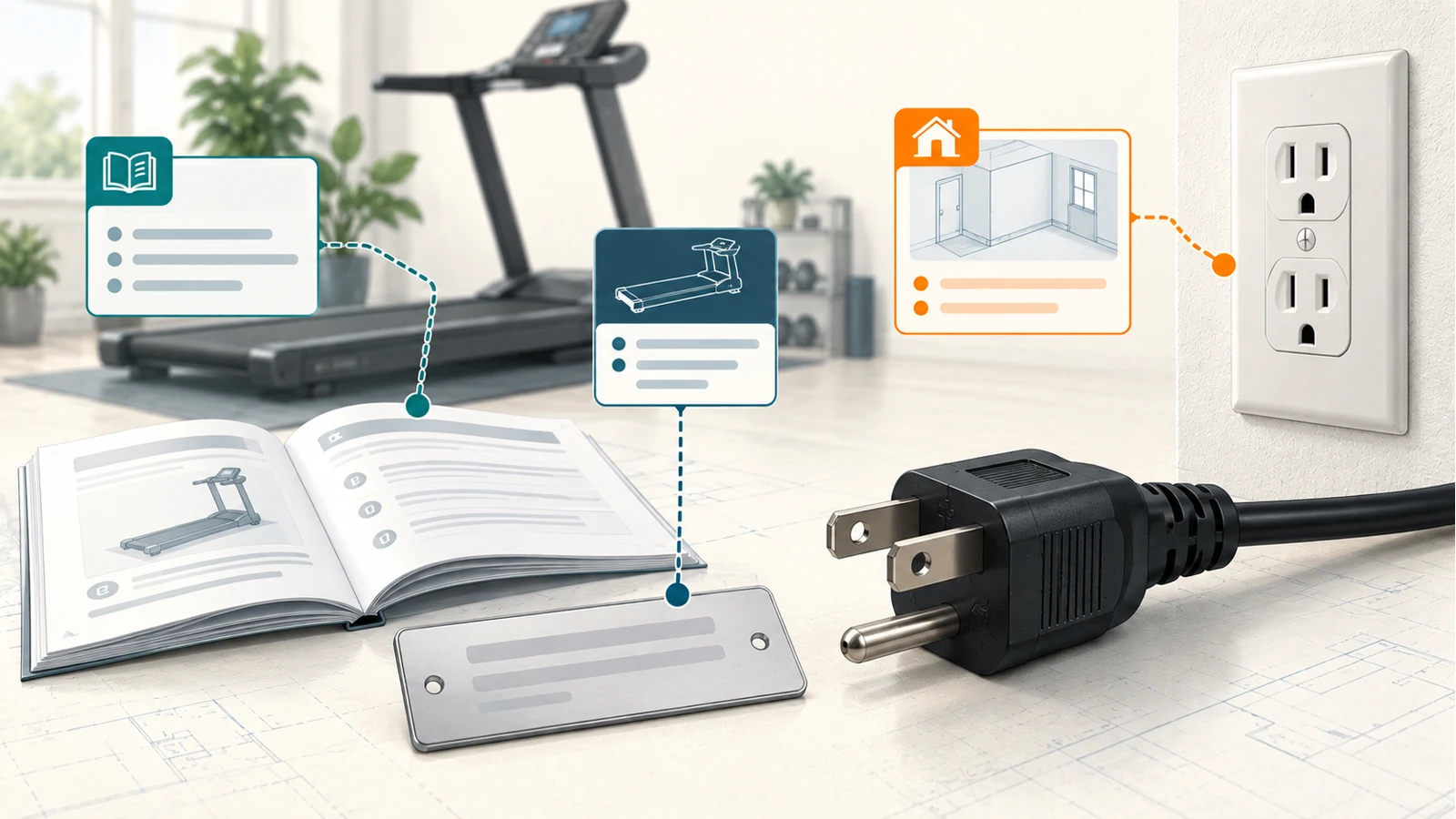
Before buying or placing motorized or electronically powered home-fitness equipment, build one dated power record for the exact product and the exact site. Record the product label and manual, input voltage and frequency, stated current or circuit requirement, plug and connector, grounding, dedicated-circuit rule, GFCI/GFI guidance, extension-cord and surge-protector rules, outlet location, cord length and route, full movement state, shutdown/unplugging instructions, and every unresolved conflict.
Do not choose a power strip, extension cord, adapter, replacement power supply, outlet conversion, or circuit merely because it appears to match. Manufacturer records differ materially. When the exact manual and actual site cannot be reconciled, stop the conclusion and use manufacturer support or a qualified electrician. No purchase or defer is a valid result.
Scope and authoritative boundary
This page is for United States buyers evaluating home-fitness equipment that uses line power, an external AC adapter, or another manufacturer-defined electrical supply. It includes motorized treadmills and walking pads, connected smart systems, and equipment whose console or control system depends on an adapter.
The page does not teach electrical work. It does not interpret the National Electrical Code, local code, lease terms, building rules, panel capacity, conductor size, breaker design, receptacle wiring, grounding continuity, arc-fault or ground-fault requirements, or permit obligations. It does not authorize replacing an outlet, adding a circuit, bypassing GFCI protection, removing a grounding pin, opening a motor cover, testing live conductors, or diagnosing a fault.
Use the exact current manufacturer record first. Use CPSC recall search for exact model and remedy status. Use qualified electrical help when the decision depends on the site rather than the product document.
Why this is separate from the cross-risk checklist
Article 10 owns the concise cross-risk screen for floor, power, clearance, handling, household access, and manufacturer limits; use the live home-fitness safety checklist for that broad screen. For doorway, assembly, and return-route questions, use the live delivery, assembly, and returns checklist. This Article 44 candidate has a narrower and deeper buyer question: how to build a product-and-site electrical record without turning generic electrical advice into a product rule.
The distinct scope includes:
- line-powered versus adapter-powered versus battery-powered states;
- exact input, connector, grounding, and circuit fields;
- dedicated-circuit verification;
- GFCI/GFI conflicts between manufacturer records and the actual site;
- extension-cord, surge-protector, and power-strip dispositions;
- outlet and cord placement through full product movement;
- plug retention and equipment-end socket inspection;
- shutdown, unplugging, restart, and repeated-fault behavior; and
- manufacturer versus qualified-electrician escalation.
Article 10 remains the broad cross-risk hub. This page owns the narrower electrical-placement workflow and does not certify an exact product, outlet, circuit, installation, or site.
The exact power record
Create one record for one exact product, one exact market, one exact installation location, and one checked date.
| Record block | Minimum fields | What it supports |
|---|---|---|
| Product identity | brand, model, SKU, revision, serial route, market, label photos, current manual | binds the electrical requirements to the correct unit |
| Input | voltage, frequency, current, wattage when stated, AC/DC, connector, polarity when applicable | identifies the required supply without inventing missing fields |
| Circuit | dedicated or shared rule, stated amperage, breaker/outlet wording, manufacturer GFCI/GFI guidance | identifies the site question that may need qualified review |
| Plug and outlet | plug type, grounding pin, outlet type, location, condition, retention, accessibility | separates physical fit from verified suitability |
| Cord | included/removable, exact part, length, gauge/type when stated, full-motion route, slack, pinch/heat/moisture/traffic exposure | tests whether placement preserves the documented cord path |
| Accessories | extension cord, adapter, power strip, surge protector, in-outlet protector, replacement supply | records only exact supported or prohibited configurations |
| Operation | power switch, startup, safety key, idle state, outage/restart, emergency stop | preserves product-specific operating instructions |
| Service | shutdown, unplugging, wait time, cleaning, inspection, damaged-cord route, support contact | stops buyer-led live electrical diagnosis |
| Site | actual branch circuit, shared loads, GFCI/AFCI state, building/lease constraints, outlet work, electrician record | separates product documentation from site approval |
| Outcome | verified fields, conflicts, unknowns, stop conditions, responsible party, next action | prevents a nearby outlet from becoming an unsupported pass |
Outcome labels used in this guide
Documentation supports further site review
Eligible only with named manufacturer conditions
Qualified electrician confirmation required
Manufacturer support required
Configuration blocked by a documented requirement
No purchase or defer
These labels describe the next action. None certifies the equipment, outlet, circuit, wiring, grounding, installation, or building.
Use an authority ladder
Use the most specific applicable source and do not let a lower-level source override it.
| Question | First source | Escalate when |
|---|---|---|
| Product input, connector, cord, switch, shutdown, and prohibited accessories | exact current manufacturer manual/support record | product identity, revision, label, or instructions are missing or conflict |
| Recall, warning, loose connection, overheating, fire, or stop-use action | exact current CPSC notice plus manufacturer remedy route | model/serial/remedy state is unresolved |
| Outlet, branch circuit, grounding, GFCI/AFCI, breaker, adapter, or wiring | exact product requirement plus qualified electrician | actual site condition or local requirement is uncertain |
| Outlet relocation, concealed outlet, wall installation, or new circuit | manufacturer installation specification plus qualified electrician and applicable building permission | work changes the building or installed wiring |
| Cord path, room route, and product movement | exact manual plus measured room/product states | cord must cross traffic, pass under equipment, or move through an undocumented path |
| Fire-safety messaging about damaged cords and overloaded outlets | public authority such as USFA | product-specific requirement is needed |
The approved shared safety source map supports source routing and editorial boundaries. It does not approve the exact product/site configuration.
Identify the exact product and power architecture
A retail family name such as “treadmill,” “walking pad,” “Peloton,” “Schwinn,” or “Tonal” is not an electrical record. Record the exact model, market, revision, current product page, current manual, label, input connection, and power-supply architecture.
Products that look similar may use:
- direct line power through a removable or fixed cord;
- an external AC-to-DC adapter;
- batteries for a console while the resistance mechanism remains mechanical;
- batteries plus an optional adapter;
- a separate touchscreen supply;
- USB charging that does not power the main equipment; or
- professional installation with a manufacturer-defined outlet location.
Do not transfer a plug, adapter, circuit, or cord rule from another model or regional version.
Separate power-source states
Use separate records for:
main drive or motor power
console/display power
external adapter input
adapter DC output
battery type and count
USB/accessory charging
networked standby
power-off state
unplugged state
service or maintenance isolation
A bike whose console uses a wall adapter does not inherit a treadmill’s dedicated-circuit rule. A battery console does not prove the whole product has no electrical requirements. A USB port for a phone does not establish input power for the equipment.
Read the nameplate and exact manual
Capture the label exactly. Do not round, convert, or fill missing fields from another product page.
Record:
- voltage or voltage range;
- frequency;
- current or wattage when stated;
- AC or DC;
- plug and equipment-end connector;
- adapter input and output;
- polarity when stated;
- grounding language;
- dedicated-circuit language;
- permitted and prohibited accessories;
- product and market identity; and
- label/manual revision or checked date.
If the label and current manual conflict, preserve both and stop the affected conclusion. Do not select the field that makes the placement easier.
Keep voltage, frequency, current, and connector fields separate
120V, 60Hz, 15A, 12A, 15–20A circuit, and a connector name are different fields. A circuit rating is not the same as measured product current. A nameplate maximum is not the same as typical energy use. A wall adapter’s AC input is not the same as its DC output.
This article does not calculate branch-circuit capacity or infer conductor/breaker suitability. It records what the manufacturer states and routes the site question to a qualified electrician.
Plug shape does not prove circuit suitability
A three-prong plug that enters an outlet proves only a physical interface at that moment. It does not prove:
- correct branch circuit;
- verified grounding;
- sufficient capacity;
- absence of shared loads;
- required GFCI/AFCI state;
- acceptable outlet condition;
- correct polarity or wiring;
- code or building compliance; or
- a safe cord route through the product’s full motion.
Do not label a site “compatible” from a photo of the receptacle.
Verify the dedicated-circuit requirement
When a manufacturer states dedicated circuit, record the exact product, stated amperage, market, source, and meaning. The checked Horizon record defines its dedicated circuit as one where no other electronic device shares the same 15–20A circuit. Wahoo defines the U.S. KICKR RUN dedicated circuit in similarly specific terms. Those records do not prove the buyer’s circuit is dedicated. (Horizon electrical requirements; Wahoo KICKR RUN requirements)
Outlet location alone cannot identify every load on the branch circuit. Do not repeatedly trip breakers or switch devices around as a substitute for qualified verification when the result matters.
Verify grounding without modifying the plug
The checked Horizon and Tonal records state grounded three-prong requirements for their named equipment. The checked Tonal cord record says no adapter should be used. (Horizon placement guidance; Tonal supported cords)
Do not:
- remove a grounding pin;
- force a three-prong plug into a two-slot outlet;
- use an unapproved grounding adapter;
- assume a three-slot receptacle is grounded; or
- diagnose the grounding conductor from this guide.
USFA also warns against forcing a three-prong cord into a two-slot outlet. When grounding is uncertain, use a qualified electrician. (USFA electrical safety)
Treat GFCI and GFI conflicts as an escalation
Manufacturer records can differ materially. Horizon’s checked North American treadmill support says GFCI outlets are not compatible. Wahoo’s KICKR RUN support specifies a non-GFI/non-GFCI outlet and breaker. Tonal says it is compatible with a grounded three-prong GFCI meeting its stated specifications. (Horizon electrical requirements; Wahoo KICKR RUN requirements; Tonal outlet requirements)
These differences must remain product-specific. This article does not tell a renter or homeowner to replace, bypass, or defeat GFCI protection. When the site and manufacturer requirements appear incompatible, the result is Qualified electrician confirmation required or a different placement/product—not a DIY workaround.
Extension cords are product-specific
USFA describes extension cords as temporary and warns against damaged or pinched cords. The checked Horizon record prohibits extension cords for its treadmill example. Tonal supports only a defined cord path with minimum gauge, connector, rating, and maximum length. Wahoo permits an extension cord only within exact rating, length, and single-connection conditions. (USFA prevention messages; Tonal supported cords; Wahoo KICKR RUN requirements)
Therefore:
one manufacturer permits a defined cord
!=
another product permits it
Do not recommend a generic “heavy-duty extension cord.” Record the exact manufacturer-supported configuration or mark the path unsupported/unknown.
Power strips and relocatable taps
The checked Horizon record prohibits power strips for its treadmill example. Tonal says power bars are unsupported. Wahoo prohibits a power strip between the wall and KICKR RUN. These are product-specific records, not a universal statement about every piece of fitness equipment. (Horizon electrical requirements; Tonal outlet requirements; Wahoo KICKR RUN requirements)
CPSC’s current CCCEI record shows why the exact accessory also matters: the named power strips lacked supplementary overcurrent protection and created a fire risk when overloaded. That notice applies to exact products and does not certify any unnamed strip. (CPSC CCCEI warning)
Surge protectors are product-specific
The checked Horizon record says surge protectors are not supported for its treadmill example. Wahoo prohibits surge protector/power strip use for KICKR RUN. Tonal supports a specific in-outlet surge-protector specification while rejecting strip-style power bars. (Horizon electrical requirements; Tonal outlet requirements)
A seller recommendation or high joule rating does not override the exact equipment record. Do not assume “more protection” means compatible.
Adapters, modified plugs, and two-slot outlets
Do not select an adapter to make a plug fit. Do not alter the plug, outlet, grounding pin, cord, or equipment connector. The checked Horizon placement record says not to modify its supplied plug and to have a proper outlet installed by a qualified electrician if the plug does not fit. Tonal’s supported-cord record says no adapter should be used. (Horizon placement guidance; Tonal supported cords)
A travel adapter, voltage converter, replacement connector, or regional cord requires exact manufacturer approval and market compatibility. Physical connection is not evidence of voltage, frequency, grounding, or warranty compatibility.
Inspect outlet condition and plug retention
USFA advises fully inserting plugs and replacing outlets when plugs do not fit snugly. It also advises replacing damaged cords. (USFA electrical safety)
A buyer-led visual screen can record:
- cracked, broken, discolored, loose, or damaged visible parts;
- whether the plug fully seats without force;
- whether the plug remains supported rather than hanging by the cord;
- whether the outlet is blocked or inaccessible; and
- whether prior heat or melting is visible.
It cannot certify internal contacts, grounding, torque, wiring, or circuit condition. Heat, discoloration, arcing, smoke, or a loose connection is a stop condition.
Inspect the equipment-end socket and removable cord
Some equipment uses a detachable cord with a connector at the machine. Record the exact cord part, connector, retention mechanism, insertion state, and manufacturer inspection/remedy instructions.
CPSC’s Matrix/Vision recall demonstrates why this matters: the power cord could become loose from the treadmill’s power socket, creating a fire hazard. The remedy is exact to the named models and serial ranges. (CPSC Matrix/Vision recall)
Do not transfer that recall to another treadmill. Do not treat a different cord that “fits” as an approved remedy.
Place the outlet for the full motion path
The outlet must be evaluated against every relevant product state:
assembled
level
inclined or declined
folding or unfolding
moved for cleaning
stored
retrieved
serviced
emergency shutdown
The checked Horizon placement record calls for space in front for the power cord. Tonal defines a six-foot outlet-location rule and a separate concealed-outlet geometry. Peloton publishes a dedicated-circuit requirement for current Tread models, but the buyer still needs the exact current manual for outlet distance and cord routing. (Horizon placement guidance; Tonal outlet requirements; Peloton treadmills)
A cord that reaches at one static state may be pulled, crushed, or unplugged during incline, folding, movement, or service.
Route cords away from traffic, pinching, and heat
Record the complete cord route from outlet to product. Keep it out of walking paths, doorways, moving hinges, belt/deck paths, wheels, leveling feet, hot surfaces, ventilation openings, cleaning liquid, and places where furniture or the machine can pinch it.
USFA advises avoiding cords under rugs or carpets and places where they may be pinched or damaged. This supports a general fire/fall screen, not product-specific clearance. (USFA electrical safety)
Do not solve a route problem by taping over a damaged or underspecified cord.
Preserve outlet access and the shutdown path
The person responsible for the equipment should be able to reach the product’s power switch, safety key, plug, or manufacturer-defined shutdown control without crossing a moving mechanism or blocked route.
Do not conceal an outlet or connection unless the exact product installation record permits it and qualified work is completed before installation. Tonal’s concealed-outlet option uses specific height and stud-center geometry and tells buyers to work with a certified electrician. That geometry is not transferable to another product. (Tonal outlet requirements)
Power off, unplugging, and stored-energy boundary
Follow the exact manual for shutdown, unplugging, wait time, cleaning, moving, and service. The checked Horizon power-up record tells users not to operate equipment with a damaged cord or plug and describes unplugging when not in use. Tonal tells users to switch its AC rocker to OFF before connecting or disconnecting the cord. (Horizon power-up guidance; Tonal supported cords)
This page does not authorize opening a motor cover, touching boards/capacitors, testing live voltage, or assuming unplugged means every internal component is immediately safe to service.
Breaker trips, resets, and repeated faults
A tripped breaker is not a normal placement-validation method. Record when it occurred, exact equipment state, other known loads, error messages, heat/odor, and the manufacturer support case.
Do not repeatedly reset a breaker, move to a larger breaker, bypass protection, or keep exercising through interruptions. The checked Horizon electrical record routes dedicated-circuit uncertainty to an electrician. Repeated trips, hot motor/cord, burning odor, or abnormal stops require manufacturer and qualified-site review. (Horizon electrical requirements)
Heat, odor, discoloration, sparking, and smoke
Stop using the equipment when any of these appear at the outlet, plug, cord, adapter, equipment socket, switch, or product:
- heat beyond ordinary manufacturer-described behavior;
- burning or unusual odor;
- discoloration, melting, or deformation;
- sparking, arcing, crackling, or smoke;
- repeated interruptions or resets;
- loose connection; or
- damaged insulation, plug, strain relief, or connector.
Disconnect power only when it can be done safely and follow emergency guidance. Do not touch a damaged live connection or troubleshoot internally. CPSC’s Matrix/Vision notice and Sperax warning show exact-product thermal/fire events must be handled through their specific stop-use or remedy instructions. (CPSC Matrix/Vision recall; CPSC Sperax warning)
Moisture, climate, and cleaning
Use only in the environment documented for the exact product. Record indoor/climate limits, humidity, nearby water, condensation after cold transport, cleaning method, and the instruction for unplugging before cleaning.
Do not place powered equipment where the outlet, adapter, connector, or cord can be wetted by a humidifier, leak, open window, wet cleaning, or stored water. Do not infer bathroom/garage/basement suitability from “indoor use.” When condensation or water exposure may have occurred, keep the equipment out of service pending the exact support route.
Dust, pet hair, and ventilation
Electrical placement also depends on ventilation and cleaning access. Record fan/motor openings, console vents, adapter airflow, pet-hair exposure, dust accumulation, wall/furniture proximity, and manufacturer cleaning intervals.
A power strip or cord should not block a vent. A concealed outlet should not create an inaccessible hot connection. This article does not create generic ventilation clearance; use the exact manual.
Outlet relocation, concealment, and installation
Moving or adding an outlet, changing a circuit, concealing a receptacle, or routing wiring through a wall is building electrical work—not a furniture adjustment. Tonal explicitly directs this work to a certified electrician and requires it before the installation date. (Tonal outlet requirements)
Record:
- building/landlord/HOA permission;
- qualified electrician scope;
- permit/inspection requirements when applicable;
- final outlet/circuit documentation;
- exact product installation geometry;
- installer acceptance; and
- access for service and future removal.
This article does not approve the work or interpret local requirements.
Household and unauthorized access
Control access to plugs, power switches, safety keys, cords, remotes, adapters, and outlets when children, pets, roommates, visitors, or caregivers can reach the equipment.
Do not leave a damaged or energized cord where it can be handled. Do not route a cord across an escape or normal circulation path. A tamper-resistant receptacle can be a general household measure, but it does not replace product-specific access control or site review. (USFA electrical safety)
Power outage and restart behavior
Record what the exact manual says about:
- state after power loss;
- automatic or manual restart;
- safety key or lock state;
- incline/deck position;
- session/data loss;
- required reset;
- user position before restart; and
- unplugging during storms or long idle periods when stated.
Do not assume a treadmill, smart gym, adapter-powered bike, or walking pad resumes safely from the same state. This package does not test outage behavior.
External adapters and replacement power supplies
An external adapter is an exact part with input, output, connector, polarity, current, and product/revision scope. Do not replace it using voltage alone.
The checked Schwinn comparison identifies IC4 as wall-adapter powered but does not establish a universal replacement-adapter specification. Obtain the exact adapter label, manual, and manufacturer parts route. (Schwinn compare bikes)
A visually matching connector can have different voltage, polarity, current capacity, wiring, or communication behavior.
USB ports and accessory charging
A product USB port may charge a phone or accessory without powering the equipment. Record:
- port purpose;
- stated output;
- whether it works in standby/off states;
- supported device limits;
- cable route; and
- whether charging changes the product’s power requirement.
Do not use a USB port as evidence that the main product is low-power, battery-powered, or safe on a shared circuit.
Battery consoles and optional adapters
Schwinn’s current comparison page shows different power architectures across bikes: IC3 uses batteries, IC4 uses a wall adapter, AD7 is battery-powered with adapter-ready wording, and other models use included adapters. (Schwinn compare bikes)
These differences show why a category label cannot own the electrical rule. Record the exact model, battery type/count, included versus optional adapter, adapter specification, and which functions depend on each source.
Horizon treadmill example
The dated checked Horizon North American treadmill record says most models use 120V/60Hz, should be on a dedicated 15–20A circuit, and should be plugged directly into a grounded outlet without extension cords, surge protectors, or power strips. It also says GFCI is not compatible and directs uncertainty to a certified electrician. The 2026-09-20 route recheck was unavailable/transport-limited, so these remain dated manufacturer-specific examples rather than a current fetch. (Horizon electrical requirements)
This is a manufacturer support record, not proof of the buyer’s circuit. The exact treadmill manual still controls model-specific instructions.
Peloton Tread and Tread+ example
Peloton’s current U.S. treadmill comparison lists a dedicated 15A circuit for both products and distinguishes the current power fields: Tread 120Vac, 60Hz, 12A; Tread+ 120Vac, 60Hz, 15A. (Peloton treadmills)
Do not import older/manual-copy details that are not bound to the exact current product revision. The buyer still needs the exact current manual, site circuit, outlet location, cord route, and installation state.
Wahoo KICKR RUN example
Wahoo’s current U.S. support specifies a dedicated 120V, 15A or 20A circuit and non-GFI/non-GFCI outlet/breaker. It prohibits a surge protector or power strip, while allowing an extension cord only under stated amp, length, and single-connection conditions. (Wahoo KICKR RUN requirements)
This product-specific exception is exactly why a generic “never” or “always” rule is unsafe editorially.
Tonal example
Tonal requires a standard 120V grounded three-prong outlet within six feet, a 15A dedicated circuit, and direct connection when possible. It permits a specific grounded GFCI state, specific in-outlet surge protection, and exact alternative/extension-cord specifications while rejecting power bars. It also gives exact concealed-outlet geometry and requires electrical work before installation. (Tonal outlet requirements; Tonal supported cords)
No Tonal field may be transferred to another smart gym or treadmill.
Schwinn IC4 example
The current Schwinn comparison record identifies IC4 as wall-adapter powered. It does not provide, in that comparison record, the complete adapter-output, connector, cord-route, circuit, GFCI, or replacement-supply decision. (Schwinn compare bikes)
The correct result is not “any standard adapter.” It is exact adapter/manual verification, with unknown site fields preserved.
WalkingPad U.S. power-cord example
WalkingPad’s current accessory page offers a U.S. 110V power-cord version and says the accessory is used across named WalkingPad treadmill families. (WalkingPad power cord)
A country/version selector does not establish exact current product revision, plug/outlet condition, dedicated-circuit requirement, GFCI guidance, cord route, or site suitability. The exact current product manual remains required.
CPSC loose-cord recall example
CPSC’s January 22, 2026 Matrix/Vision recall covers named treadmill models and serial ranges because the power cord can become loose from the treadmill’s power socket, creating a fire hazard. CPSC reported 27 overheating incidents at the connection and a specific replacement-cord remedy. (CPSC Matrix/Vision recall)
This is an exact identity/remedy record. It does not establish that all detachable cords are hazardous or that an unlisted replacement cord is acceptable.
Current requirement matrix
| Example | Direct/adapter state | Dedicated circuit | GFCI/GFI state | Extension/protector state | What remains unresolved |
|---|---|---|---|---|---|
| Horizon treadmill support | direct line power | 15–20A stated | not compatible in checked record | extension, strip, surge prohibited | exact model/manual and actual site |
| Peloton Tread | direct line power | 15A stated | not normalized from current comparison | current manual required | outlet location, cord route, actual site |
| Wahoo KICKR RUN | direct line power | 15A or 20A stated | non-GFI/non-GFCI stated | exact rated extension exception; strip/surge prohibited | actual circuit and local requirements |
| Tonal | direct line power | 15A stated | compatible when stated conditions met | exact cord/in-outlet protector path; power bars unsupported | wall/install/electrical approval |
| Schwinn IC4 | wall adapter | not stated in checked comparison | unknown | exact adapter/manual required | adapter output, connector, route, site |
| WalkingPad U.S. cord | product cord accessory | unknown in checked accessory page | unknown | exact manual required | product revision and site |
The matrix is a source-state comparison, not a compatibility table for the reader’s home.
Scenario: grounded outlet but shared circuit
Result: Qualified electrician confirmation requiredA grounded-looking outlet does not prove the branch is dedicated. Record the exact product requirement, known shared devices, breaker/outlet identifiers, and site. Do not create a “dedicated” circuit by merely unplugging one nearby device when the branch topology remains unknown.
Scenario: only a GFCI outlet is available
Result: Configuration blocked or qualified review requiredDo not bypass GFCI protection. If the exact product says non-GFCI while the available location uses GFCI or local requirements call for it, route the conflict to the manufacturer and a qualified electrician. A different location or product may be the correct fallback.
Scenario: the outlet is too far away
Result: Use only an exact manufacturer-supported cord path or change the placementThe checked Horizon record prohibits extension cords for its treadmill example. Tonal and Wahoo permit only exact specified cord paths. Do not choose a generic extension cord by appearance or marketplace description. If no supported path exists, move the equipment plan or install an outlet through qualified work.
Scenario: loose plug, heat, or discoloration
Result: Stop use and escalateDo not continue to “see if it gets worse.” Do not wedge the plug, bend prongs, tape the connection, or substitute an unverified cord. Preserve product/serial photos, connection photos when safe, symptoms, and the support/recall case.
Scenario: renter wants a concealed outlet
Result: Building permission and qualified electrical work requiredA renter should not hide or relocate an outlet based on a product article. Record landlord/building approval, manufacturer geometry, electrician scope, installation timing, service access, and future removal. Tonal’s concealed-outlet measurements apply only to its exact installation path.
Scenario: breaker trips during use
Result: Stop repeated resets; manufacturer and electrician review requiredRecord the exact state, error, other loads, heat/odor, and source instructions. Do not upsize a breaker, bypass protection, move to an unverified circuit, or continue exercising through power interruptions.
Scenario: exact manual or label is missing
Result: No product-specific power conclusionA retailer listing, copied PDF, regional manual, or family name cannot substitute for the current exact product/market record. Obtain the label and manual from the manufacturer or defer.
When a qualified electrician is required
Escalate before use when the decision requires verifying or changing:
- branch-circuit dedication or capacity;
- grounding;
- receptacle wiring or condition;
- GFCI/AFCI applicability or conflicts;
- breaker or panel questions;
- new, moved, or concealed outlets;
- adapters, voltage conversion, or regional supply;
- repeated trips, heat, arcing, burning odor, or damaged installed wiring; or
- code, permit, landlord, HOA, or building requirements.
The electrician’s scope should identify the exact equipment requirement and actual site. Their review is not a product warranty or manufacturer compatibility decision.
When manufacturer support is required
Contact the manufacturer before powering the unit when:
- exact manual or label is missing;
- product page and manual conflict;
- cord/adapter part identity is uncertain;
- a replacement power supply is proposed;
- the product-end socket is loose or damaged;
- the product has heat, odor, smoke, or repeated fault behavior;
- a recall/warning may apply;
- cord, surge, GFCI, or extension rules are unclear; or
- shutdown, restart, cleaning, or service isolation instructions are missing.
Use independently obtained manufacturer contact information and preserve the case record.
When no purchase or defer is valid
Use No purchase or defer when:
- exact model, market, label, or manual cannot be verified;
- the product and site electrical records conflict;
- the required circuit/outlet cannot be confirmed;
- the only proposed connection uses a prohibited strip, protector, adapter, or cord;
- the cord route crosses traffic, pinch, moisture, heat, or movement hazards without a supported solution;
- the outlet or product socket is loose, hot, discolored, melted, or damaged;
- repeated breaker trips or faults remain unresolved;
- a recall or stop-use instruction applies; or
- qualified electrical/building work is required but not approved or completed.
A different product, room, or purchase path is often a better outcome than forcing an unsupported electrical configuration.
Prohibited inferences
Do not infer:
three-prong plug fits
→ grounded, dedicated, or suitable circuit

outlet is nearby
→ cord route is valid through all product states

15A appears on a page
→ measured product current or site capacity

manufacturer permits one extension cord
→ extension cords are allowed for another product

surge protector has a high rating
→ equipment compatibility

GFCI trips
→ GFCI should be bypassed

breaker trips
→ larger breaker is the solution

power strip is listed for sale
→ safe or supported for the equipment

adapter connector fits
→ correct voltage, polarity, current, or communication

unit powers on
→ electrical safety, grounding, or long-term reliability

no recall found
→ safety certification
Safe fallback paths
When the preferred configuration is blocked, safer decision paths include:
- choose an existing location that meets the exact documented requirement;
- obtain a qualified electrician’s site record;
- complete approved outlet/circuit work before delivery or installation;
- use the exact manufacturer-supported cord or adapter part;
- select equipment with a documented power architecture that fits the site;
- use a battery/manual alternative when it meets the buyer’s actual task; or
- defer purchase until the product/site conflict is resolved.
A fallback creates a new scenario record. It is not automatically approved because it appears simpler.
Missing and conflicting inputs
Keep every unresolved field visible. Common blockers include:
- current exact manual;
- label/revision;
- circuit dedication;
- grounding;
- GFCI/AFCI state;
- outlet retention/condition;
- cord length and full-motion route;
- replacement cord/adapter identity;
- permitted extension/protector path;
- startup/restart behavior;
- building approval; and
- recall/remedy status.
Do not average conflicts, select the favorable source, or replace an unknown with zero, pass, compatible, safe, or not applicable.
Recommendation boundary
This guide does not recommend a treadmill, walking pad, bike, rower, smart gym, outlet, cord, surge protector, power strip, adapter, electrician, or electrical configuration. The documentary result is limited to whether the current source record is complete enough for the next site review.
Next step
- Download the exact current manual and photograph the product label.
- Build the power record before choosing the final location.
- Measure the room and route with the FitFootprint measurement workflow.
- Interpret object and state dimensions with the dimension methodology.
- Route product questions to manufacturer support.
- Route circuit, outlet, grounding, GFCI/AFCI, wiring, and installation questions to a qualified electrician.
- Do not power the equipment while a stop condition remains open.
Methodology
This candidate uses official United States public-authority and manufacturer records checked on 2026-07-28. A 2026-09-14 freshness and transport recheck revisited the same accepted routes without adding sources; redirects, HTTP errors, and fetch differences are transport limitations, not safety, no-warning, or site-suitability results. Each source remains scoped to its exact product, family, accessory, market, or warning, and the page preserves differences rather than creating a generic electrical rule.
The six-example matrix is explicit, bounded, and non-exhaustive. No product was inspected, powered, measured, or paired with a real site. Scenario outcomes are synthetic workflow tests; they route the next evidence step and do not create a site or product result.
Sources
- U.S. Fire Administration — Appliance and Electrical Fire Safety — general outlet, cord, overloading, damaged-cord, and routing messages Checked 2026-07-28.
- U.S. Fire Administration — Prevent Electrical Fires — temporary extension-cord and electrician escalation context Checked 2026-07-28.
- Horizon Fitness — Treadmill Electrical Requirements — North American treadmill voltage, circuit, grounding, GFCI, extension-cord, and surge guidance Checked 2026-07-28.
- Horizon Fitness — Where To Put Your Treadmill — grounding, dedicated-circuit, outlet, cord, and placement record Checked 2026-07-28.
- Horizon Fitness — How to Power Up Your Treadmill — power switch, damaged-cord stop, unplugging, and breaker-trip route Checked 2026-07-28.
- Tonal — Electrical Outlet Requirements — 120V grounded outlet, six-foot location, dedicated circuit, GFCI, in-outlet protector, and concealed-outlet instructions Checked 2026-07-28.
- Tonal — Supported Power Cords — exact cord/connector/gauge/length fields and power-off-before-connection instruction Checked 2026-07-28.
- Peloton — Treadmill Comparison — current Tread and Tread+ power and dedicated-circuit fields Checked 2026-07-28.
- Wahoo — KICKR RUN Power, Space, and Connectivity Requirements — direct wall connection, dedicated circuit, non-GFCI record, and conditional rated extension-cord path Checked 2026-07-28.
- Schwinn — Compare Bikes — IC4 wall-adapter state and battery/adapter differences across bikes Checked 2026-07-28.
- WalkingPad — U.S. Power Cord Accessory — 110V U.S. version and exact replacement-cord route Checked 2026-07-28.
- CPSC — Matrix and Vision Treadmill Power-Cord Recall — exact loose cord/socket fire-hazard and remedy example Checked 2026-07-28.
- CPSC — CCCEI Power Strip Warning/Recall Record — exact accessory overcurrent/fire example; not a category rule Checked 2026-07-28.
- CPSC — Sperax Walking Pad and Treadmill Warning — exact model stop-use, overheating, burn, and fire boundary Checked 2026-07-28.
- CPSC — Recalls — current exact-model recall search Checked 2026-07-28.
- FitFootprint — How to Measure Your Space — verified-live room and route workflow Checked 2026-07-28.
- FitFootprint — Equipment Dimensions Explained — verified-live object/state/clearance methodology Checked 2026-07-28.