
Quick answer
Do not choose fitness equipment for an apartment from a “quietest” list or one dB figure. First define the exact receiver and protected activity, then separate airborne sound from impact and structure-borne vibration. Audit every claim for a complete protocol, record the source–path–receiver configuration, check the lease, building, schedule, and local-rule inputs, and decide whether documentary evidence, an actual-room screening event, or a qualified professional is required.
The correct result may be “unknown until the missing evidence is available”, “a qualified professional assessment is required”, “choose a different equipment category”, or “do not purchase or defer the decision”. A quiet motor, magnetic resistance, slow speed, concrete-sounding floor, thick mat, transport wheels, or lack of complaints is not a universal pass.
Define the receiver and decision before the equipment
Noise is a receiver problem, not only a product feature. Write one dated decision record before comparing equipment:
- the exact room and intended equipment location;
- the material receiver: operator, another room, adjacent unit, downstairs unit, hallway, sleeping occupant, remote worker, conversation, media, or another activity;
- intended time, duration, frequency, speed, resistance, incline, load, cadence, stride, and handling;
- equipment that will run, beep, play media, fold, roll, latch, strike, or be placed on the floor;
- known floor finish, mat or underlayment, and only verified building-assembly facts;
- lease, building, HOA or condo, quiet-hour, and local-rule records;
- complaint history and any manager or landlord instruction;
- what evidence would be sufficient, what remains unknown, and what condition stops the purchase.
“Apartment-friendly” is not a receiver record. A result for daytime conversation in the same room does not answer sleep in the unit below.
Scope of the cited authorities
This guide combines current authoritative noise, measurement, advertising-substantiation, environmental-health, transit-vibration, building-acoustics, and recall sources with a conservative editorial screening method. It keeps occupational hearing references separate from residential acceptance, and it does not import FTA transit criteria, GSA building-assembly values, WHO regional recommendations, or local rules as fitness-equipment thresholds.
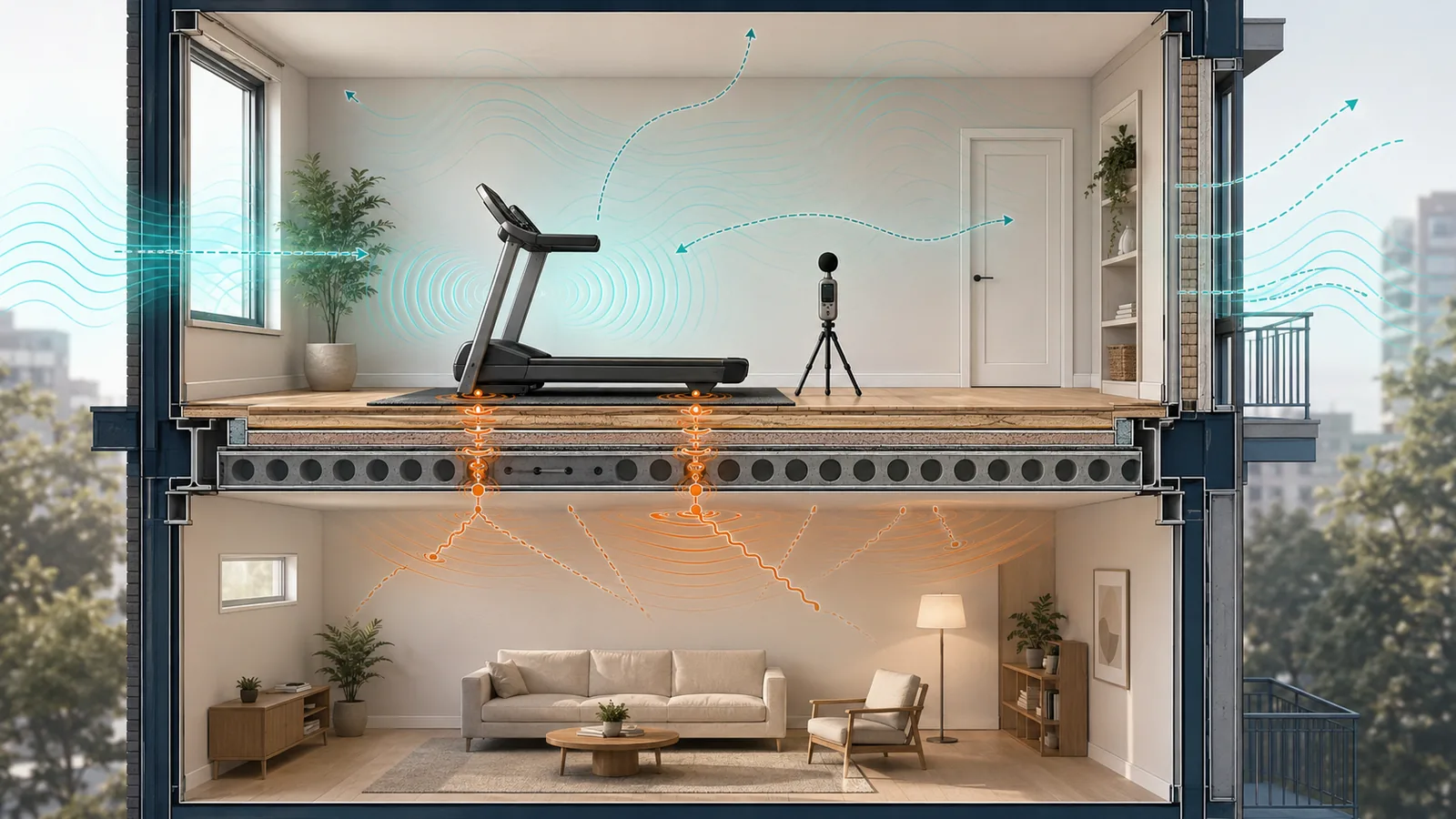
Separate airborne sound, impact, and structure-borne vibration
These channels must remain separate.
| Channel | Examples | Evidence needed | Shortcut to reject |
|---|---|---|---|
| Airborne sound | Motor, belt, fan, flywheel, chain, drivetrain, media, alerts | Exact mode, metric, instrument, room, distance, baseline, duration | “Quiet motor” means quiet apartment |
| Impact sound | Footfalls, weights, latches, folding contact, dragging, caster thresholds | Event, contact behavior, surface, repetition, receiver | Continuous dBA describes impacts |
| Structure-borne vibration | Rocking, imbalance, machine-floor coupling, repeated impacts | Source, path, receiver and appropriate measurement when critical | Same-room microphone proves no vibration |
| Vibration-radiated sound | Floor, wall, ceiling, window, shelf, or furniture radiates rumble or rattle | Receiver-room observation or qualified measurement | Source-room result predicts the receiver |
| Secondary noise | Loose covers, fasteners, belt/chain, furniture resonance | Maintenance and receiver-specific record | New or worn equipment behaves identically |
A-weighted sound is useful for specific sound questions. It does not replace a structural-vibration record.
Use the source–path–receiver record
The Federal Transit Administration manual uses a source–path–receiver framework in environmental noise and vibration work. This guide reuses the framework, not the transit criteria.
Source
Bind the exact equipment, variant, accessories, operating state, user, speed or resistance, incline or load, media and alert state, maintenance, leveling, and handling behavior.
Path
Record the air path and every known contact path: feet or base, mat, floor finish, underlayment, floor assembly, walls, framing, penetrations, furniture, and objects that can rattle. Do not infer the building assembly from age, appearance, or a marketing description.
Receiver
Name the location and activity that matters. Receiver response can depend on the room, building components, furnishings, time, and existing background. If the material receiver cannot be observed lawfully and with permission, keep that receiver result unknown.
Classify the risk before collecting numbers
Classify each source event before asking whether a number is low or high:
- continuous or changing airborne sound;
- intermittent alerts, tonal content, incline changes, selectors, or latches;
- rhythmic impact such as footfall;
- occasional or repeated weight/contact impact;
- structure-borne vibration and secondary rattles;
- folding, moving, rolling, dragging, setup, and storage events;
- operational changes caused by user, speed, intensity, maintenance, or loose parts;
- schedule, receiver, lease, and local-rule risk.
One machine may occupy several classes. A buyer who resolves the motor but ignores footfall, moving, or a downstairs receiver has not completed the screen.
Audit every quiet or low-noise claim
The FTC advertising-substantiation policy provides the retained boundary that objective claims need an evidence basis, but the claim still has to match the buyer decision. For a numerical sound claim, look for:
- exact model and variant;
- machine-only or user-on-machine condition;
- speed, resistance, incline, cadence, load, and duration;
- floor, mat, room, and maintenance condition;
- instrument or app, device, calibration, metric, weighting, and time response;
- microphone position, distance, height, baseline, and repetitions;
- source room or receiving room;
- test date and limitations.
When material fields are absent, record source protocol incomplete. Do not convert “whisper quiet,” “silent,” “brushless,” “magnetic,” or “apartment-friendly” into a verified result.
Use a pre-purchase evidence ladder
| Evidence state | What it means | What it does not mean |
|---|---|---|
| marketing only | Adjective, testimonial, or unexplained number | No comparison or acceptance result |
| source protocol incomplete | Some source data exists, but material fields are missing | Not a portable dB rating |
| source protocol complete | Exact source discloses the protocol for its own claim | Not the buyer’s room or receiver |
| independent controlled measurement | Exact unit and controlled protocol are disclosed | Not a different building or user |
| screening in the actual setting | Exact configuration is screened in the actual source/receiver context | Not a universal or future-state guarantee |
| professional assessment | A qualified professional owns a defined technical scope | Not broader than the contracted scope |
A higher evidence state can answer a narrower question more defensibly. It does not turn the page into a certification.
Record sound measurements without inventing comparability
The NIOSH Sound Level Meter app documentation supports a documented workplace-noise screening record on validated iOS devices. NIOSH measurement guidance also cautions that apps may not meet regulatory requirements. This guide uses that information as a measurement boundary, not as an apartment standard.
For a screening event:
- take a baseline and operating record with the same device and settings;
- record LAeq, maximum, peak, weighting, and time response as separate fields when available;
- use the exact intended operation, not an undefined “normal use”;
- record microphone location, distance, height, duration, and repeated events;
- keep same-room and receiver-room records separate;
- do not compare different phone models or apps as if they were calibrated instruments;
- repeat after a material maintenance, leveling, mat, user, speed, or accessory change.
The NIOSH hearing-exposure guidance and OSHA occupational-noise guidance supply an occupational 85 dBA context. It is not a universal apartment, sleep, lease, neighbor, or nuisance threshold.
Treat vibration and impact as a separate evidence problem
A microphone measures sound pressure, not floor velocity or acceleration. Visible movement, a rattling object, or a complaint may reveal a receiver problem, but it is not a quantitative vibration result.
The FTA manual distinguishes airborne noise, ground- or structure-borne vibration, and sound radiated by vibrating building components. Its transit metrics and criteria are not equipment thresholds. The transferable lesson is that source, transmission path, building response, and receiver all matter.
When vibration is decisive, disputed, or connected to apparent building movement, use “a qualified professional assessment is required”. Do not improvise a structural conclusion from a phone accelerometer, product weight, floor type, or neighbor report.
Scenario: motorized walking or running equipment
A walking pad or treadmill can produce motor and belt sound, footfall impact, deck response, incline or folding events, and floor coupling. A machine-only dB figure does not describe a user walking or running, and an in-room result does not describe the unit below.
Record the exact speed, user-on or machine-only state, incline, stride, surface, mat, leveling, maintenance, session duration, fold/move workflow, and receiver. If below-unit disturbance is a hard constraint and no lawful receiver evidence, credible trial, acceptable return path, or professional assessment is available, keep the result “unknown until the missing evidence is available” or “do not purchase or defer the decision”.
Scenario: bikes, rowers, and flywheel or fan equipment
Resistance labels do not decide the acoustic result. A bike or rower may produce flywheel or fan sound, chain or belt noise, pedal or seat movement, rocking, leveling noise, alerts, app audio, and floor coupling.
Magnetic resistance does not prove silence. Air resistance does not prove unacceptability. Compare the exact intended cadence, resistance, standing/seated behavior, fan or damper state, maintenance, media, surface, and receiver. If the protected activity cannot coexist with the intended operating state, use “choose a different equipment category” for that room or schedule rather than forcing a product.
Scenario: weights, benches, and repeated impacts
Strength equipment may be quiet while stationary and disruptive during contact. Separate controlled placement from failed repetitions, dropped weights, plate contact, selector clicks, bench movement, stand loading, and storage.
If the buyer’s intended program requires dropping or uncontrolled impact and the receiver constraint prohibits that event, a continuous dB test cannot solve the mismatch. Use “choose a different equipment category” or “do not purchase or defer the decision”. Do not promise that pads, tiles, or bumpers eliminate transmission.
Scenario: folding, moving, and storage noise
The loudest event may occur before or after exercise. Record:
- folding and latch steps;
- wheels, handles, dragging, and turns;
- thresholds and uneven floors;
- contact with walls, furniture, bed frames, or cabinets;
- setup and retrieval time;
- the person responsible;
- schedule and receiver during movement;
- cords, remotes, trays, weights, and accessories.
A quiet operating state does not prove a quiet ownership workflow.
Check lease, local, schedule, and receiver constraints
EPA’s federal noise-pollution overview and Noise Control Act summary place substantial noise-control responsibility at state and local levels. That does not create one national apartment rule.
Before purchase, collect the current lease, building or HOA/condo rules, quiet hours, property-manager instructions, and the authoritative local-government route. Record what the text says and who owns interpretation. Do not infer a legal conclusion or assume common quiet hours.
Schedule is part of the scenario. A daytime result cannot be transferred to sleeping hours, and a neighbor conversation does not replace the written rule or a technical record.
Evaluate mats and floor treatments cautiously
GSA building-acoustics guidance explains that soft floor finishes can reduce some footfall/caster sound and that IIC-rated floor assemblies can reduce impact transfer in their tested scope. That does not mean a retail equipment mat has an IIC rating or guarantees a downstairs result.
For any mat or isolation layer, record:
- exact material, thickness, area, compression, and condition;
- equipment and manufacturer compatibility;
- stability, leveling, ventilation, heat, cord, trip, and clearance effects;
- the complete floor assembly when known;
- before/after evidence using the same source, path, receiver, and protocol.
A mat is a configuration variable. If it creates wobble or conflicts with instructions, stop rather than trading one unresolved risk for another.
Synthetic screening examples
| Case | What is known | What remains unknown | Result |
|---|---|---|---|
| A — “quiet” walking platform above a bedroom | Exact page and intended use | Claim protocol, floor assembly, below-room response, trial/return path | “unknown until the missing evidence is available” |
| B — magnetic bike with a same-room iOS screen | Exact configuration, baseline and operating LAeq in source room | Adjacent/below receiver and structural vibration | screening completed in the actual setting for the same room only |
| C — dumbbell program requires dropping | Intended impact event is defined | No documentary number can remove the required impact | “choose a different equipment category” or “do not purchase or defer the decision” |
| D — visible floor movement and disputed complaint | Qualitative event and dispute exist | Vibration measurement, structure, and rule interpretation | “a qualified professional assessment is required” |
Together, the cases show that a complete same-room screen remains receiver- and event-specific, while unresolved impact, structural, or rule questions can still require category exit, professional assessment, or no purchase.
Stop and escalate when the evidence cannot answer the risk
Stop or escalate when:
- the material receiver cannot be evaluated and disturbance is a hard constraint;
- the only evidence is marketing wording or an unexplained number;
- the intended use includes impact that the location cannot accept;
- the lease, building rule, manager instruction, or authoritative local route is unresolved;
- an apparent structural movement, crack, instability, or formal dispute exists;
- the buyer needs a medical, hearing, structural, code, legal, or professional-acoustics conclusion;
- the mat or mitigation changes stability, clearance, heat, power, or manufacturer instructions;
- the product identity or exact-model recall status is unresolved;
- an acceptable trial, return, alternative location, or evidence path does not exist.
Prohibited interpretations
Do not infer that:
- 85 dBA occupational guidance is an apartment-acceptance threshold;
- a quiet motor means quiet footfalls or no vibration;
- magnetic means silent, fan means unacceptable, or low product weight means low transmission;
- an in-room dB value predicts an adjacent or downstairs receiver;
- a mat, carpet, foam, rubber, IIC statement, or marketing percentage guarantees mitigation;
- one test applies to another user, mode, room, floor, device, or maintenance state;
- no complaint means compliance or acceptability;
- no recall search result means safety certification;
- annoyance proves structural damage, or lack of visible damage proves no receiver problem.
Safe fallback when uncertainty remains
When uncertainty remains, consider these decision paths:
- defer purchase until the material receiver can be screened;
- use a location with fewer shared receiver constraints, if lawfully available;
- choose a category or activity that removes the buyer’s required impact event, subject to its own evidence review;
- limit the decision to documented facts and keep the unresolved outcome visible;
- obtain a qualified acoustical, vibration, building, legal, or health assessment when that scope is material;
- return “do not purchase or defer the decision” when no acceptable path exists.
Handle missing or conflicting information
Keep source records separate by exact model, state, metric, instrument, device, weighting, time response, distance, room, receiver, surface, user, mode, date, and rounding.
Do not:
- average incompatible dB figures;
- select the lowest number to keep a product;
- replace an unknown receiver with a source-room result;
- convert a qualitative rattle into a vibration velocity;
- transfer a test across buildings, floors, mats, users, speeds, or maintenance states;
- hide a local-rule or lease conflict;
- treat a manufacturer claim as an independent test;
- use transit, occupational, or environmental criteria outside their scope.
Name the missing field and the exact conclusion it blocks.
Next step
Save one dated source–path–receiver record for each material operating and ownership event. If documentary evidence cannot answer the buyer’s hard constraint, identify the exact trial, receiver observation, professional assessment, category exit, or no-purchase decision required.
For related guidance, use Home Fitness Equipment Dimensions Explained, Compact Home Fitness Equipment for Small Spaces, Walking Pad Buyer Guide for Apartments and Small Rooms, Compact Exercise Bike Buyer Guide for Apartments, Floor, Power, Clearance, and Safety Checks for Home Fitness Equipment, the documentation-only Schwinn IC4 small-space analysis, and the documentation-only WalkingPad A1 Pro source-state analysis and WalkingPad C2 source-state analysis and the documentation-only WalkingPad WR20 Folding Rower: Space, Storage, Cost, and Limitations for current exact-product examples whose quietness claims remain unverified.
For field-by-field report review, see How to Read Fitness Equipment Noise and Vibration Reports for separate sound and vibration lanes, missing or conflicting conditions, and bounded interpretations; it does not validate a physical test or produce a product result.
Methodology
No equipment or building was tested. This guide uses the article-specific c09-noise-vibration-screening-v01 screening method, not a reusable measurement standard. It does not claim a formal acoustics or vibration standard, and every conclusion remains bounded by the documented source, path, receiver, and evidence state.
For an exact fan-bike product analysis using this boundary, see Schwinn AirDyne AD7 for home use: space, noise, cost, and limitations.
Sources
- U.S. Environmental Protection Agency — Clean Air Act Title IV: Noise Pollution — federal/state/local scope — checked August 21, 2026.
- U.S. Environmental Protection Agency — Summary of the Noise Control Act — public-information and responsibility context — checked August 21, 2026.
- National Institute for Occupational Safety and Health — NIOSH Sound Level Meter App — workplace screening tool and metric scope — checked August 21, 2026.
- National Institute for Occupational Safety and Health — Understand Noise Exposure — typical-operation measurement context — checked August 21, 2026.
- National Institute for Occupational Safety and Health — Noise-Induced Hearing Loss — occupational hearing-exposure context — checked August 21, 2026.
- Occupational Safety and Health Administration — Occupational Noise Exposure — workplace dB and hearing-control context — checked August 21, 2026.
- Federal Trade Commission — Policy Statement Regarding Advertising Substantiation — objective-claim evidence boundary — checked August 21, 2026.
- Federal Transit Administration — Transit Noise and Vibration Impact Assessment Manual, Report 0123 — source–path–receiver and vibration framework, transit-specific — checked August 21, 2026.
- U.S. General Services Administration — Buildings and Health: Acoustic Comfort — building-acoustics and floor-assembly context — recheck attempted August 21, 2026; page fetch was unavailable in this environment.
- World Health Organization — Environmental Noise Guidelines for the European Region — environmental-health context, not an equipment threshold — checked August 21, 2026.
- U.S. Consumer Product Safety Commission — Recalls — exact-product recall diligence route — checked August 21, 2026.