
Quick answer
Neither format is automatically better for an apartment or small room.
If the buyer needs only a few exact pair loads, fixed dumbbells can cost less and remove the weight-selection step. In the dated example below, REP Ergo Hex pairs at 10, 20, and 30 lb total $299.97, which is $36.02 less than the current $335.99 QuickDraw 30 lb pair listing.
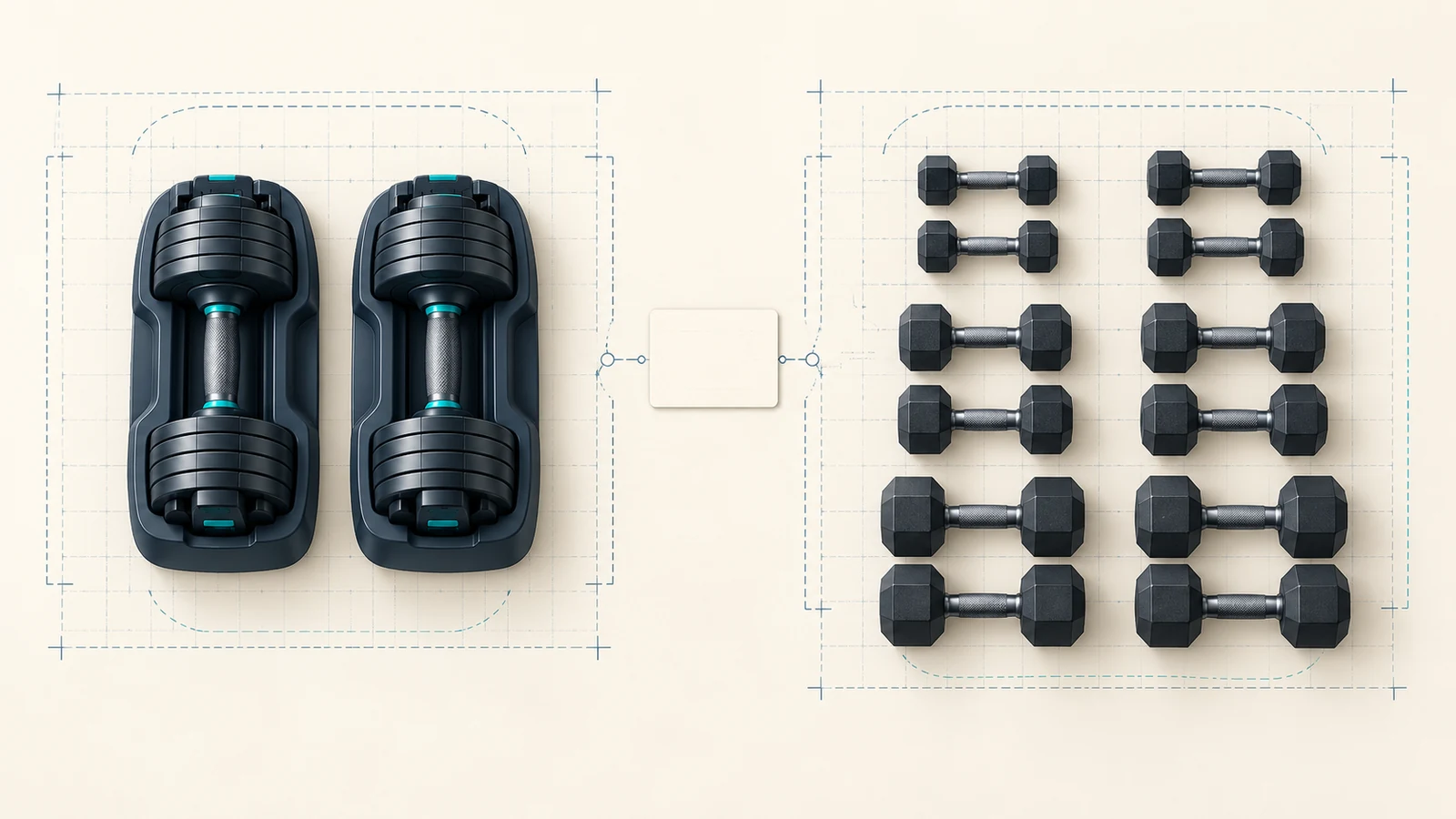
If the buyer needs every 5 lb step from 5 through 30, the same fixed-pair basket totals $544.94 before a rack, while the QuickDraw pair remains $335.99. In that bounded scenario, the adjustable pair is $208.95 less and replaces six fixed pairs with one adjustable pair and two cradles.
Those arithmetic results are not universal break-even claims. The correct answer depends on the exact load set, simultaneous-use requirement, storage object, move frequency, mechanism tolerance, return exposure, and current checkout.
Comparison scope
This page compares two equipment architectures:
- Adjustable pair: one pair changes among multiple loads through a product-specific selection system and storage cradles.
- Fixed pairs: each pair has one permanent nominal load; wider coverage requires more pairs.
The current source-state example is intentionally bounded to one seller so that product-page and policy differences do not dominate the format decision:
This does not make either product representative of every adjustable or fixed dumbbell.
Article 6 remains the category-shortlisting context; use the Adjustable Dumbbell Buyer Guide before narrowing to an exact system. For dimension definitions and missing-value handling, use Home Fitness Equipment Dimensions Explained.
Eligible formats and evidence parity
Both example lanes have current U.S. manufacturer pages, pair scope, published price fields, and product or storage specifications. Evidence parity is still partial:
- QuickDraw publishes cradle dimensions and changing dumbbell length by maximum configuration.
- Ergo Hex publishes pair prices and available set/pair options, but not a complete 5–30 basket footprint.
- The fixed-rack page publishes a rack envelope and says one rack holds the 5–50 lb set, but complete access clearance is not published.
- Neither lane has FitFootprint handling, adjustment, storage, noise, durability, comfort, or service observations.
A seller statement is a source record, not an independent test result.
Fixed criteria
Use the same criteria before looking at price or marketing:
- Exact pair loads required now.
- Smallest acceptable increment.
- Maximum load required during the decision horizon.
- Whether two different pair loads must be available at the same time.
- Number of physical objects and the complete storage/access zone.
- Whether the setup must move after each session.
- Tolerance for a selector, plates, micro weights, and cradle dependency.
- Product-only price, optional storage, tax, return, and service exposure.
- Exact model, lot, manual, warranty, and recall diligence.
- A valid no-purchase or defer outcome.
Key facts at a glance
| Field | QuickDraw 30 lb pair | Fixed 5–30 lb basket |
|---|---|---|
| Current example | One adjustable pair plus two cradles | Six Ergo Hex pairs: 5, 10, 15, 20, 25, 30 lb |
| Published range | 5–30 lb per dumbbell | Six permanent pair loads |
| Current product-only listing arithmetic | $335.99 | $544.94 from current individual-pair fields |
| Physical dumbbells | 2 | 12 |
| Seller-stated storage object | Two cradles included; stand optional | Rack not included; rack optional |
| Simultaneous pair loads | One selected pair load at a time | Multiple pair loads can remain available |
| Derived dumbbell/system mass | 69.28 lb at the 30 lb state including two empty cradles | 210 lb of dumbbell mass before a rack |
| Complete room fit | Unknown until local measurement | Unknown until local measurement |
The mass values are arithmetic from seller-stated nominal loads and empty-cradle weight. They are not shipping weights, structural assessments, or movement approvals.
Define the required load set first
Do not compare “5–30” labels alone. Write the actual pair loads that must be available.
Examples:
10, 20, 30 lb only5, 10, 15, 20, 25, 30 lb7.5, 12.5, 17.5, 22.5, 27.5 lbAlso record whether those loads must exist simultaneously. One adjustable pair may cover many loads sequentially but cannot be two different pair loads at the same moment.
Adjustable format: object and state model
The QuickDraw example is not one simple object. Its relevant states include:
- two handles and selected plates;
- unused plates retained in two cradles;
- two 2.5 lb micro weights per dumbbell;
- a 30, 40, 50, or 60 lb maximum configuration;
- an optional stand or cart;
- a selected-use state;
- a re-racked state;
- an inspection or service state.
The current page states a 20.6 in cradle length, 8.45 in cradle width, 7.9 in height with the dumbbell in the cradle, and 4.64 lb per empty cradle. It gives dumbbell lengths of 12.2, 14.3, 16.4, and 18.5 in for the 30, 40, 50, and 60 lb versions respectively. Those are source-state dimensions, not a complete two-cradle placement plan.
Fixed format: object and state model
The 5–30 fixed basket contains six pairs and twelve dumbbells. Relevant states include:
- each individual pair;
- every pair not currently in use;
- floor, shelf, or rack storage;
- the retrieval path for each shelf position;
- temporary staging during a workout;
- a multi-user or superset state;
- return packaging and shipment by pair or order.
The Ergo Hex product page says racks are not included and that sets use 5 lb increments. It also offers individual pairs below 30 lb in 2.5 lb increments. It does not publish a complete buyer-room envelope for a custom basket.
Load coverage and increments
The QuickDraw page says the base pair spans 5–30 lb and can be expanded to 40, 50, or 60 lb. Steel switches change 10 lb blocks, while micro weights allow 5 lb increases or a 2.5 lb change if the buyer accepts the small imbalance described by the seller.
Fixed pairs let the buyer purchase only the exact permanent loads required. The current Ergo Hex page lists 2.5 lb increments below 30 lb and 5 lb jumps from 35 lb upward.
Therefore:
- broad sequential coverage can favor adjustable object compression;
- a sparse exact load set can favor fixed-pair purchasing;
- a need for many simultaneous loads can favor multiple fixed pairs;
- neither category label proves the exact required sequence.
Product-only price logic
The current listing-only arithmetic is:
The cost boundary follows the home-fitness total-cost framework, while the current dumbbell-specific cost bridge is recorded in Adjustable Dumbbell Total Cost. Neither route turns these dated listing inputs into a complete ownership total.
| Basket | Current fields | Product-only subtotal |
|---|---|---|
| QuickDraw 30 lb adjustable pair | One pair | $335.99 |
| Fixed 10/20/30 lb basket | $54.99 + $94.99 + $149.99 | $299.97 |
| Fixed 5/10/15/20/25/30 lb basket | $39.99 + $54.99 + $74.99 + $94.99 + $129.99 + $149.99 | $544.94 |
These are dated seller fields, not checkout quotes. Tax, financing, order eligibility, and later price changes remain outside the subtotal.
Storage systems and floor envelope
The QuickDraw pair includes cradles. A dedicated stand is optional. The current REP Adjustable Dumbbell Stand is listed at $299.99 and publishes a 31 by 22.3 in plan envelope for the QuickDraw version, or about 4.80 sq ft before access clearance. The stand is stated at 65 lb.
The current REP Dumbbell Rack is listed at $209.99, measures 48 by 23.4 by 34.6 in, and weighs 75 lb. Its published plan envelope is 7.80 sq ft before access clearance. The page says one rack holds a 5–50 lb set.
These floor-area calculations describe rectangular product envelopes only. They exclude hand access, body position, door swing, retrieval, exercise clearance, and escape route. Use the live FitFootprint space-measurement workflow before treating either envelope as usable.
Equipment mass and delivery burden
The 5–30 fixed basket contains 210 lb of dumbbell mass:
2 × (5 + 10 + 15 + 20 + 25 + 30) = 210 lbAdding the 75 lb reference rack produces 285 lb of equipment in that optional storage state.
At the 30 lb maximum setting, two QuickDraw dumbbells plus two empty 4.64 lb cradles produce a 69.28 lb system snapshot. Adding the 65 lb reference stand produces 134.28 lb.
These values do not determine floor suitability, delivery method, one-person handling, or safe movement. Packaging, shipment splits, load distribution, route constraints, and local structural conditions remain separate.
Access, re-racking, and simultaneous use
One adjustable pair needs a clear selection and re-racking path to both cradles. A fixed rack needs clear access to every required shelf position. Neither published rectangle includes the user’s body or hand path.
A fixed basket can keep 10 lb and 30 lb pairs available at the same time. One adjustable pair cannot. A buyer who needs two simultaneous pair loads must either use multiple fixed pairs, buy a second adjustable pair, or change the workflow.
No source reviewed here proves which format is faster, easier, quieter, or more accessible for a particular person.
Adjustment mechanism and downtime
The adjustable format requires a product-specific selection system and correct plate/cradle state. The QuickDraw page describes Lock-N-Load steel switches, micro weights, and cradles.
Fixed dumbbells remove the between-load selection step because each pair has one permanent nominal load. That architectural difference provides no evidence that fixed dumbbells have superior safety or durability. Heads, handles, coatings, racks, and storage still require exact-product diligence.
If the adjustable pair is unavailable because its mechanism, handle, plates, or cradle require service, many covered loads can be unavailable together. If one fixed pair is unavailable, other fixed pairs can remain usable. This is an object-dependency observation, not a failure-rate claim.
Returns, warranties, and service
Both examples use the same current seller, but product-specific conditions still matter.
The REP warranty page lists lifetime home-use coverage for dumbbells and a lifetime warranty for QuickDraw, subject to terms and exclusions. The QuickDraw page states original-purchaser, nontransferable coverage and excludes normal wear and abusive or negligent use.
REP’s current terms and refund policy describes a 30-day return path, authorization, and a 15% restocking fee for used items not in original packaging. Product pages state free shipping, while tax is calculated at checkout. Return eligibility, shipping treatment, and final refund remain order-specific.
A support channel exists through REP Contact Us, but a contact route does not prove response time, parts availability, or a successful resolution.
Scenario: only 10, 20, and 30 pounds
Current fixed-pair arithmetic:
$54.99 + $94.99 + $149.99 = $299.97Compared with the $335.99 QuickDraw 30 lb pair, the three fixed pairs are $36.02 less before tax or storage.
Disposition:
fixed_candidate_with_named_conditionsThis requires the buyer to accept six physical dumbbells, 120 lb of dumbbell mass, and a verified storage/access plan. The adjustable pair remains eligible if additional loads or fewer objects matter more than the $36.02 difference.
Scenario: every 5 pounds from 5 to 30
Current fixed-pair arithmetic:
$39.99 + $54.99 + $74.99 + $94.99 + $129.99 + $149.99 = $544.94The QuickDraw listing is $335.99, a $208.95 lower product-only subtotal in this bounded example.
Disposition:
adjustable_candidate_with_named_conditionsThe conditions include current product identity, selection-system acceptance, two-cradle access, exact checkout, and service tolerance.
Scenario: 2.5-pound changes below 30
Both formats can enter the candidate set, but not in the same way:
- QuickDraw uses micro weights and the seller describes 2.5 or 5 lb changes.
- Ergo Hex offers individual 2.5 lb pairs below 30 lb.
The buyer must list the exact required sequence and decide whether a one-sided 2.5 lb micro-weight state is acceptable. A fixed basket with every 2.5 lb pair increases object count and current cost.
Disposition:
unknown_pending_exact_sequenceScenario: two users or two pair loads at once
One adjustable pair can supply one selected pair load at a time. If two users need different pair loads simultaneously, or a superset requires two pair loads to remain ready, one adjustable pair fails that exact requirement.
Disposition:
fixed_candidate_or_second_adjustable_pair_requiredThe second adjustable pair changes price, storage, service concentration, and object count and must be modeled separately.
Scenario: frequent moves after each session
The bounded QuickDraw 30 lb system snapshot is materially lighter and contains fewer objects than the six-pair fixed basket. That makes it a candidate for further route analysis, not an automatic movement pass.
The seller’s stand has wheels, and the fixed rack is a 75 lb storage object, but wheels or lower object count do not prove one-person handling, threshold suitability, or safe repeated relocation.
Disposition:
adjustable_candidate_pending_route_and_handling_evidenceScenario: a dedicated rack is acceptable
A buyer who can dedicate a verified 48 by 23.4 in rack envelope plus retrieval clearance may keep the fixed lane open. The current product-only 5–30 basket plus rack subtotal is:
$544.94 + $209.99 = $754.93This is not a minimum required total because the rack is optional and another verified storage method may exist.
Disposition:
fixed_candidate_with_storage_conditionScenario: future range above 60 pounds
The exact QuickDraw lane tops out at 60 lb per dumbbell after add-ons. The fixed 5–30 basket also does not meet a requirement above 60 lb.
Disposition:
neither_current_example_fitsThe buyer must reopen the candidate universe with exact higher-range adjustable systems or heavier fixed pairs. Do not extrapolate price, dimensions, or mechanism from the 30 lb example.
Scenario: mechanism downtime is unacceptable
A buyer who requires every purchased load to remain available even if one unit needs service may prefer the distributed-object architecture of fixed pairs. Damage to one pair does not automatically remove the other pairs.
This is not a durability or safety verdict. It is a dependency requirement.
Disposition:
fixed_candidate_with_named_reliability_requirementCurrent dated listing examples
Checked September 11, 2026:
- QuickDraw 30 lb pair: $335.99; Add to Cart; seller-stated free shipping; taxes at checkout.
- Ergo Hex 5, 10, 15, 20, 25, and 30 lb pairs: $39.99, $54.99, $74.99, $94.99, $129.99, and $149.99.
- REP Dumbbell Rack: $209.99.
- REP Adjustable Dumbbell Stand: $299.99.
Dynamic seller controls do not prove successful checkout, inventory at purchase time, address acceptance, or final delivery.
Known listing subtotals
| Scenario | Known listing subtotal | What it excludes |
|---|---|---|
| QuickDraw 30 lb pair | $335.99 | Tax, optional stand/cart, financing, return exposure |
| Fixed 10/20/30 lb pairs | $299.97 | Storage, tax, return exposure |
| Fixed 5–30 lb in 5 lb steps | $544.94 | Storage, tax, return exposure |
| QuickDraw plus reference stand | $635.98 | Tax, financing, access clearance |
| Fixed 5–30 basket plus reference rack | $754.93 | Tax, access clearance, local handling |
No row is a complete ownership total.
Conditional and unknown costs
Keep these outside the known listing subtotal until evidence exists:
- sales tax;
- financing APR, fees, and total of payments;
- optional stand, rack, cart, flooring, or anchoring;
- address-specific delivery or access burden;
- return shipment and exact restocking applicability;
- packaging storage;
- replacement parts and service freight;
- value of buyer time;
- disposal cost or actual resale proceeds;
- cost of buying a second adjustable pair for simultaneous loads.
Unknown is not zero.
Exact recall and model diligence
CPSC recalled the exact Amazon Basics 55 lb adjustable dumbbell in May 2026 because plates could fail to engage completely and dislodge during use. The notice is limited to that identified product and lot code; it is not a recall of QuickDraw or all adjustable dumbbells. (CPSC recall)
The accepted exact recall route was not re-opened in the current transport. That is a source-access limitation, not a no-warning result or safety clearance; verify the exact brand, model, lot, and remedy from the official route before treating the record as current.
Use the current CPSC recalls search for the exact brand, model, lot, and remedy before buying new or used equipment.
Non-equivalence rules:
one recalled adjustable model != all adjustable dumbbells
not named in a checked recall != safety certification
fixed format != automatically safe
current listing != exact used-unit identity
Direct evidence and testing boundary
FitFootprint did not:
- inspect product labels or manuals;
- operate QuickDraw switches or micro weights;
- re-rack either format;
- measure a two-cradle or six-pair layout;
- carry the equipment or rack;
- test drop, impact, noise, coating, balance, comfort, or durability;
- complete checkout, return, warranty, or service transactions.
Seller statements about space saving, speed, comfort, durability, or stability remain attributed vendor claims unless independently tested.
Documented advantages of adjustable dumbbells
In the bounded example, adjustable dumbbells provide:
- broad sequential load coverage from one pair;
- fewer physical dumbbells;
- lower product-only subtotal than a fixed 5–30 basket covering every 5 lb step;
- lower derived equipment mass than that six-pair basket;
- a smaller optional reference-stand envelope than the reference fixed rack.
Each advantage remains conditional on exact required loads, accepted mechanism, cradle access, and current seller terms.
Documented advantages of fixed dumbbells
In the bounded example, fixed dumbbells provide:
- the ability to buy only a sparse set of required loads;
- no between-load selection step;
- multiple pair loads available simultaneously;
- distributed dependency, where other pairs remain available if one pair is removed from service;
- a straightforward path to add one exact pair later.
These are architecture observations, not claims of better safety, durability, comfort, or value.
Material burdens by format
| Format | Material burdens that require verification |
|---|---|
| Adjustable | Selector and plate state, micro-weight storage, cradle access, mechanism/service concentration, one pair cannot supply two pair loads simultaneously |
| Fixed | More objects, higher mass as coverage expands, rack or shelf burden, longer retrieval path, higher product-only cost for dense load coverage |
Neither format is automatically quiet, apartment-friendly, maintenance-free, or easy to move.
When neither format fits
Choose no purchase or defer when:
- the required load set is not defined;
- the room, delivery path, storage, and retrieval zone are not measured;
- neither format provides required simultaneous loads;
- the total equipment mass or storage object cannot be handled or placed with verified conditions;
- current checkout and return exposure exceed the budget;
- exact model or used-unit identity is unresolved;
- a relevant recall or remedy remains unresolved;
- the buyer cannot tolerate either mechanism concentration or fixed-object burden.
A valid decision can be to reduce the load set, use another resistance format, or wait for better evidence.
Recommendation boundary
The evidence does not support a single overall winner.
- Sparse exact loads can make fixed pairs the lower-cost candidate.
- Dense sequential coverage can make an adjustable pair the lower-cost and lower-object candidate.
- Simultaneous-use requirements can eliminate one adjustable pair.
- Mechanism tolerance, route, storage, and service can reverse a price-only result.
The output is a scenario disposition, not a ranking.
Next step
Write the required pair-load list, mark which loads must be simultaneous, and calculate the two exact baskets. Then measure the storage and retrieval path with the FitFootprint space-measurement guide.
Do not add a stand or rack cost until that object is required by the verified room plan.
For a one-corner strength workflow, see the compact strength setup guide; it separates storage, retrieval, movement, set-down, inspection, and preserved-route zones while leaving room-specific unknowns explicit.
Methodology
This comparison used current U.S. manufacturer pages and regulator records checked September 11, 2026. It normalized:
- pair scope and exact load coverage;
- object count;
- seller-stated dimensions and storage objects;
- dated product and accessory price fields;
- derived arithmetic for selected baskets, equipment mass, and rectangular floor envelopes;
- return, warranty, and support boundaries;
- exact-model recall scope;
- missing-data and no-purchase behavior.
Arithmetic is deterministic, but every amount remains a dated example rather than a quote. The current project-wide shared total-cost method is not approved, so this page does not claim a reusable total-cost model or complete ownership total.