
Quick answer
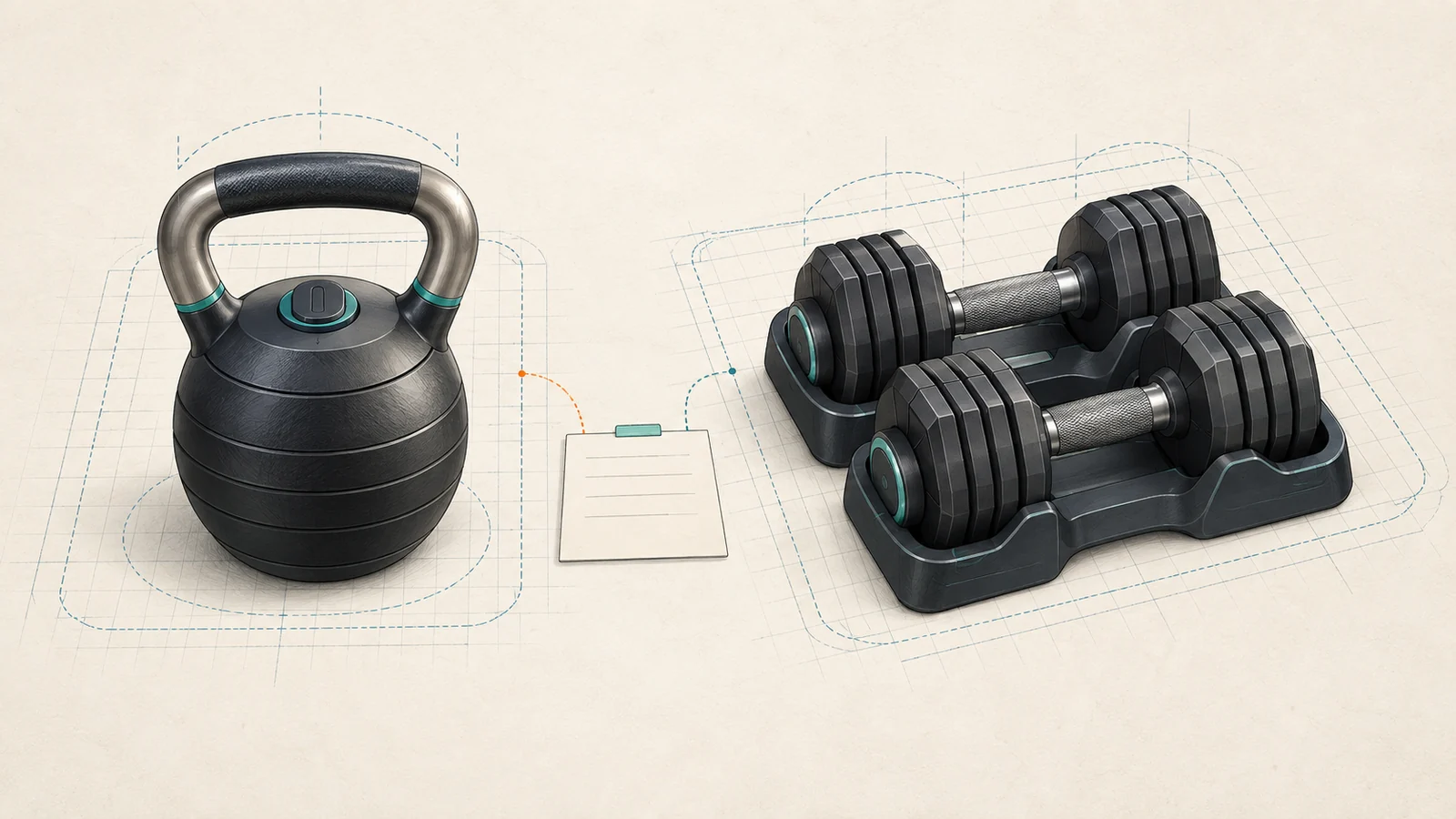
Choose the format only after writing the exact exercises, load steps, quantity of implements, storage state, movement path, and stop conditions your plan requires. A single adjustable kettlebell can cover five seller-listed settings inside one shell and may support a one-implement plan. A QuickDraw purchase is a pair with two cradles and a different load sequence, which may better match exercises that require one implement in each hand. Those are format differences, not a universal verdict.
The current bounded examples are the REP Adjustable Kettlebell and the REP QuickDraw adjustable dumbbell pair. One default kettlebell listing and one dumbbell pair are not quantity-equivalent, load-equivalent, geometry-equivalent, or exercise-equivalent. A valid outcome can be kettlebell with named conditions, dumbbell pair with named conditions, both still viable, neither format fits, or defer the purchase.
Comparison scope
The decision is: Which adjustable format survives one declared small-space exercise scenario? The comparison does not rank every adjustable kettlebell or dumbbell. It does not transfer specifications between models, infer that a familiar exercise name produces the same task with different implements, or assume that the product occupying fewer storage objects needs less exercise clearance.
The bounded source set uses the same current U.S. seller to reduce seller-policy noise. It still does not create a market census. The kettlebell example is one unit. The dumbbell example is the 30 lb QuickDraw pair. Other sizes, sellers, fixed implements, cable systems, resistance bands, and body-weight options remain outside this exact comparison.
Use the live Adjustable Dumbbell Buyer Guide for the category-shortlisting record before treating this bounded dumbbell example as a candidate. It does not turn this comparison into a product recommendation.
Eligible formats and evidence parity
Both current product pages expose seller identity, purchase scope, selectable settings, a dated default price field, Add to cart controls, shipping language, and handling limitations. Evidence is not fully equal. The QuickDraw page publishes several per-dumbbell and cradle dimensions, while the parsed current kettlebell page does not publish a complete product envelope. Neither product has FitFootprint direct-use evidence.
| Evidence field | Adjustable kettlebell | QuickDraw pair | Comparison use |
|---|---|---|---|
| Exact current product route | Present | Present | Eligible |
| Purchase quantity | One unit | Pair | Must normalize |
| Listed load sequence | Present | Present | Eligible |
| Complete system dimensions | Unresolved | Partial | Fit comparison withheld |
| Direct handling evidence | None | None | Performance claims withheld |
| Current policy sources | Same seller | Same seller | Useful but order-specific |
A documentation difference must not be turned into a product advantage. “Unknown” is not “larger,” “smaller,” “worse,” or “not applicable.”
Define the buyer’s exact exercise list
Write the actual planned movements before choosing equipment. Avoid a vague label such as “full-body training.” A useful record states whether each movement requires one implement, two implements, one or two hands on one implement, a bench, overhead clearance, a ballistic path, a floor start, or an unloaded reset between sets.
The ACE kettlebell-filtered library and ACE dumbbell-filtered library show that both equipment categories appear across multiple movements, but those catalogs are navigation aids rather than prescriptions for a specific buyer. The broader ACE equipment library displayed 17 kettlebell-tagged and 38 dumbbell-tagged entries when checked. Counts do not establish versatility for one person, nor do they prove that one implement can replace another for a declared plan.
A minimum exercise record should include:
- exact movement name and source;
- one implement or two;
- one-hand, two-hand, alternating, or bilateral requirement;
- required starting load and progression steps;
- floor, bench, overhead, swing, and lateral clearance;
- whether the implement must be changed while the user is fatigued;
- technique or health questions that require a qualified professional.
Key facts at a glance
| Field | REP Adjustable Kettlebell | REP QuickDraw 30 lb pair |
|---|---|---|
| Current default listing | $149.99 | $335.99 |
| Purchase quantity | One kettlebell | Two dumbbells and two cradles |
| Default listed sequence | 8, 10, 12, 14, 16 kg | 5–30 lb with seller-described switches and micro weights |
| Other current variants | 16–24 kg; 20–40 lb | 40, 50, and 60 lb pair variants; add-on path documented |
| Product envelope | Not resolved in checked page | Partial dimensions published by seller |
| Drop/slam boundary | Seller says not designed to be slammed or dropped | Exact current handling instructions still require model-bound review |
| Direct FitFootprint test | None | None |
The price row is a dated listing snapshot, not a quote or complete total. The setting rows are seller-stated options, not independent weight measurements.
Quantity basis: one kettlebell versus a dumbbell pair
The default kettlebell page sells one unit. The selected QuickDraw page sells a pair. That distinction controls exercise eligibility, product-only arithmetic, object count, storage, and return exposure.
Two kettlebells would be a different scenario. Buying two default units produces a product-only listing subtotal of $299.98, but it does not turn them into a QuickDraw pair. The two kettlebells retain the 8–16 kg sequence, large-handle geometry, one-shell adjustment system, and unresolved complete dimensions. QuickDraw retains a dumbbell handle, two cradles, a 5–30 lb default path, and its own micro-weight workflow.
Never compare $149.99 with $335.99 as though both rows buy the same quantity or training function.
Current adjustable kettlebell variants
The current REP kettlebell page presents three distinct variants:
| Variant | Seller-listed settings | Quantity |
|---|---|---|
| 8–16 kg | 8, 10, 12, 14, 16 kg | One kettlebell |
| 16–24 kg | 16, 18, 20, 22, 24 kg | One kettlebell |
| 20–40 lb | 20, 25, 30, 35, 40 lb | One kettlebell |
These are separate selectable products. They are not one continuous 8 kg-to-24 kg system. A buyer who needs 10 kg and 20 kg does not obtain both settings from one variant. The page’s default price field must not be copied to every unselected variant without purchase-day verification.
The page describes a push-and-twist adjustment, internal fasteners, a competition-style shell, a powder-coated surface, and a rubber bottom. Those remain manufacturer descriptions. FitFootprint has not verified adjustment force, plate movement, handle feel, shell consistency, or reset behavior.
Current adjustable dumbbell range
The current QuickDraw page presents 30, 40, 50, and 60 lb pair variants. The 30 lb pair is the bounded example because the current default listing exposes that pair and its price. The page describes 5 lb main steps plus 2.5 lb micro weights; the exact workflow includes two dumbbells, two cradles, selector switches, and removable micro weights.
The QuickDraw add-on page documents an expansion path in which paired add-ons raise each dumbbell by 10 lb, with the required number of add-ons depending on the starting and target pair. An expansion path is not already included weight, and an add-on price is not part of the default pair unless selected.
The page publishes a 12.2-inch length for a 30 lb dumbbell, a 7.3-inch plate diameter, and a cradle envelope of 20.6 by 8.45 inches, with height stated for the dumbbell in the cradle. These are object-state records, not complete pair or exercise-zone dimensions.
Load units and setting sequence
Do not merge kilogram and pound variants into a fabricated universal sequence. The seller gives an approximate pound equivalent for one kilogram value, but the buyer should preserve the unit printed for the selected product and confirm that the exact training plan uses compatible units.
The default kettlebell sequence uses 2 kg steps. The default dumbbell system uses a different pound-based selection structure. A buyer who needs 5 lb starting loads will not meet that requirement with the 8 kg kettlebell variant. A buyer who specifically needs one 16 kg competition-style shell does not get the same object by selecting a 30 lb dumbbell.
A load comparison should store:
selected_variant
seller_unit
exact_available_settings
required_settings
missing_settings
quantity_required
conversion_used_for_context_only
Conversions can help orientation, but they must not create a setting that the product does not actually provide.
Two-handed and single-implement movements
A single adjustable kettlebell may remain eligible when the declared plan centers on one object held with one or two hands, provided the selected variant contains the required loads and the user has a suitable movement path. Examples may include a two-hand goblet hold, a carry, or a swing pattern, but the exact exercise source and technique requirement still matter.
The seller says the selected plates are intended to remain secured during swings. That is a manufacturer claim, not an independent FitFootprint observation. A buyer should still inspect the exact product, instructions, selected state, and condition before use.
One implement also means one user cannot perform a truly simultaneous two-implement movement unless a second unit is purchased. Alternating sides is a different programmed task, not an automatic substitute.
Bilateral and two-implement movements
A QuickDraw pair remains eligible when the buyer’s declared plan requires one implement in each hand at the same time and the default load sequence contains the required settings. Common examples can include bilateral presses, rows, curls, raises, lunges, or loaded carries, but naming an exercise does not establish medical suitability or correct technique.
One kettlebell fails a strict two-implement requirement. Two kettlebells may restore quantity, but that changes cost, storage, adjustment workload, and available loads. The buyer must calculate the two-unit scenario explicitly rather than treating “kettlebell” as a pair by convention.
A dumbbell pair may also be unnecessary if the buyer’s entire list uses one central implement. Buying two objects is not automatically a benefit when the second object provides no declared function.
Overlapping movements are not equivalent by default
Some exercise names appear with both formats. That overlap does not mean equal geometry, muscle demand, technique, range of motion, or progression. A 2026 surface EMG study indexed by PubMed compared pressing, rowing, and swinging tasks across kettlebells, dumbbells, and elastic bands in 20 healthy males. It reported exercise- and muscle-specific activation patterns. It did not establish a universal winner, did not study apartment fit, and cannot be transferred to every product, user, load, or program.
For an overlapping movement, record the exact implementation:
- object shape and center of mass;
- one or two implements;
- grip and wrist position;
- starting and ending positions;
- selected load;
- movement speed and control;
- user experience and supervision needs.
Without that record, “both can do presses” is too broad to decide the purchase.
Grip, shell, and handle geometry
The kettlebell page describes a competition-style shell and a 34.6 mm or 35 mm handle diameter depending on variant. QuickDraw describes a 32 mm knurled handle and a plate/cradle system. These are different objects around the hand and forearm.
FitFootprint did not measure either handle, verify surface finish, or assess wrist contact, hand size, comfort, accessibility, or fatigue. Seller terms such as nonslip, consistent, or comfortable are not independent conclusions. Buyers with pain, mobility limits, rehabilitation needs, or technique uncertainty should use qualified guidance rather than a format label.
A smaller published handle diameter is not automatically easier to grip. A large kettlebell window is not automatically better for two hands. Those are person- and task-specific questions.
Adjustment systems and reset path
The kettlebell uses a push-and-twist selection process inside one shell. QuickDraw uses switches and removable micro weights while each dumbbell is seated in its cradle. Both systems create a reset path between loads.
Record the complete sequence:
- return the implement to its required base or supported state;
- confirm it is fully seated;
- select the intended load using the exact manufacturer process;
- verify the selected state without inventing a test;
- remove the implement while keeping hands and nearby objects clear;
- store removed parts so they cannot be lost or become a trip object.
No adjustment-speed conclusion is permitted because FitFootprint did not time, repeat, or observe either process. A seller’s “quick” or “fast” description is not a measured result.
Storage objects and complete footprint
Storage is not the same as one product’s published envelope. The kettlebell scenario includes the selected unit and any stable location required to adjust and retrieve it. The current parsed page does not provide a complete kettlebell dimension set, so a numeric storage comparison is blocked.
The dumbbell scenario includes two dumbbells, two cradles, selector access, removed micro weights, optional add-ons, hand space, and a route to and from the exercise zone. The seller’s cradle dimensions are partial object records. They do not prove that the pair fits a shelf or that the user can re-rack without conflict.
Use the verified-live FitFootprint room-measurement guide to record the actual room, route, storage object, and operating state. Do not infer complete fit from a product photo.
Exercise clearance and movement path
A compact storage object can require a large movement envelope. Swings, overhead work, carries, lunges, floor starts, and bench-supported movements use different paths. Ceiling height, furniture, doors, people, pets, and the path of an implement all matter.
Create separate records for:
stored_state
adjustment_state
retrieval_state
starting_position
movement_envelope
set_down_state
return_to_storage_path
The kettlebell’s numeric product dimensions remain unresolved in the checked source. The QuickDraw pair’s complete movement zone is also unresolved. Therefore the article cannot declare either format more apartment-friendly or smaller in practical use.
Dropping, slamming, and handling limits
The kettlebell seller explicitly says the product is not designed to be slammed or dropped and warns that doing so can damage the system’s ability to retain plates. Preserve that exact model instruction.
For the broader floor, power, clearance, handling, and household-risk questions, use the live Floor, Power, Clearance, and Safety Checks guide. That guide is also documentation-only and does not certify either product here.
The REP warranty page excludes damage associated with negligent use, storage, modification, and other stated conditions. It lists lifetime home-use categories for kettlebells, dumbbells, and QuickDraw, but a warranty headline is not permission to drop equipment, a guarantee of service outcome, or proof that every failure is covered.
Do not transfer a drop claim from a different dumbbell model, region, generation, or marketing page. Do not call fixed or adjustable equipment safe merely because one exact warning is absent.
Direct evidence and specialist boundary
FitFootprint has no physical access to either exact product. The following were not performed:
- product-label or manual binding;
- setting verification or weighing;
- adjustment-cycle testing;
- plate-retention observation;
- swing, press, row, carry, or floor exercise;
- noise, impact, durability, or drop testing;
- grip, comfort, balance, or accessibility assessment;
- checkout, return, warranty, parts, or service transaction.
Exercise selection can involve technique, health status, training history, supervision, and medical considerations outside this article’s scope. The article may route readers to an authoritative exercise library and a qualified professional; it may not prescribe an exercise or declare it safe for a person.
Current dated listing prices
The current seller page displayed $149.99 for the default 8–16 kg adjustable kettlebell and $335.99 for the default 30 lb QuickDraw pair when rechecked on September 12, 2026. Both pages displayed fulfillment and Add to cart fields. These are listing inputs, not completed checkout evidence.
The default price cannot be transferred to every unselected size. Promotion, membership, ExpertVoice, local pickup, financing, and add-on messages are separate conditional records. Tax and final address acceptance remain unknown.
Product-only quantity scenarios
| Scenario | Arithmetic | What it means |
|---|---|---|
| One default kettlebell | $149.99 | One 8–16 kg unit only |
| Two default kettlebells | 2 × $149.99 = $299.98 | Two units; still not QuickDraw-equivalent |
| QuickDraw 30 lb pair | $335.99 | Two dumbbells plus two cradles |
| Listing difference | $335.99 − $299.98 = $36.01 | Quantity-normalized arithmetic only |
The $36.01 difference does not prove the kettlebell scenario is cheaper in ownership terms or better value. The load sequences, units, shape, included objects, adjustment mechanisms, exercise eligibility, tax, returns, and service exposure differ.
If one kettlebell is sufficient for the declared plan, comparing it with a pair can overstate the required purchase. If two implements are mandatory, comparing one kettlebell with a pair understates the kettlebell scenario.
Shipping, tax, and financing
The seller’s shipping information describes current fulfillment boundaries, but final shipping depends on the exact product, address, order, and checkout state. A general free-shipping message is not an address-specific quote or proof of delivery date. For the shared price, delivery, return, and service fields, use the live total-cost framework; it does not make the dated listing arithmetic a complete ownership total.
Sales tax is unknown until checkout. Financing displays are not purchase prices. To include financing, record principal, down payment, APR, fees, term, payment schedule, and total of payments. Do not multiply a promotional payment and call it the product price without the underlying agreement.
Current known listing arithmetic must stay separate from conditional or unknown transaction costs.
Returns, warranties, and service
The seller’s Terms of Service and warranty page must be rechecked on purchase day. Current records describe a return-authorization path, condition and packaging requirements, customer responsibility for certain return shipping, and potential restocking exposure. Exact applicability depends on the order and product state.
Warranty categories are limited by purchaser, use, modification, storage, handling, normal wear, and other terms. “Lifetime” does not mean every event, every owner, free freight, immediate parts availability, or a lifetime refund. The support route provides a channel, not a verified service outcome.
Keep these unknown until a real transaction or current exact policy answers them:
return_freight
restocking_applicability
warranty_service_shipping
parts_inventory
service_turnaround
replacement_unit_terms
Exact recall and model diligence
The CPSC’s May 14, 2026 Amazon Basics 55 lb adjustable-dumbbell recall is exact-model and lot scoped. CPSC says plates can fail to engage completely and dislodge from the handle, reports about 2,900 units and eight incidents, and instructs consumers to stop using the recalled product and follow the refund remedy.
That notice is not a recall of REP QuickDraw or the REP Adjustable Kettlebell. It also does not certify either REP product. Its relevance is methodological: identify the exact manufacturer, model, purchase scope, markings, and current regulator record before relying on a used or ambiguous listing.
exact recalled model != entire adjustable category
not named in one recall != safety certificate
seller plate-retention claim != independent observation
Scenario: bilateral pressing and rowing
Buyer record:
requires_two_implements_simultaneously = yes
required_loads_per_hand = 10, 15, 20, 25 lb
bench_or_floor_path = verified separately
One kettlebell fails the quantity requirement. Two default 8–16 kg kettlebells do not provide the declared 10–25 lb-per-hand sequence. QuickDraw contains seller-listed pound settings in the relevant region, but complete room, adjustment, and direct-use evidence remains unresolved.
Disposition: QuickDraw remains eligible with named conditions; the bounded kettlebell variant does not meet the exact quantity-and-load record. This is not an overall recommendation.
Scenario: kettlebell swing and goblet-focused plan
Buyer record:
one_implement_sufficient = yes
required_settings = 8, 10, 12, 14, 16 kg
large_handle_shell_required = yes
movement_clearance = not yet verified
The 8–16 kg adjustable kettlebell is the documentary survivor for the exact settings and object format. QuickDraw is not assumed to recreate the same shell or two-hand grip. The purchase still stops until movement clearance, exact instructions, condition, and user technique are addressed.
Disposition: Kettlebell remains eligible with named conditions; recommendation remains withheld.
Scenario: shared overlapping movements
Buyer record:
movements = goblet squat, carry, single-arm press
quantity = one acceptable
required load range = overlaps both examples
geometry preference = unresolved
Both formats may remain viable. The exercise names alone do not resolve grip, center of mass, wrist position, selector workflow, storage, or movement path. The PubMed study supports treating modality as a real variable, not as an interchangeable label.
Disposition: Both remain viable pending exact exercise implementation and direct fit evidence.
Scenario: two users or simultaneous loads
A household may want one user at one load while another uses a different load, or may want a circuit with two loads staged at once. One adjustable kettlebell cannot occupy two settings simultaneously. A dumbbell pair also cannot provide two different bilateral pairs at the same time.
Possible responses include buying additional units, selecting fixed equipment, changing the program, or deferring the setup. Each response changes object count, cost, storage, and route burden.
Disposition: Neither bounded purchase automatically meets a multi-user or multi-load simultaneity requirement.
Scenario: very light starting loads
The default 8 kg kettlebell starts substantially above the 5 lb QuickDraw setting. A buyer whose required first step is 5 lb cannot treat the kettlebell’s lowest setting as equivalent. The correct response is not to force the movement or round the requirement upward.
QuickDraw may survive the numeric start-load gate, but health, technique, geometry, and exercise suitability remain outside documentary evidence.
Disposition: Dumbbell pair survives the exact listed-load gate; buyer-specific suitability remains unverified.
Scenario: heavier future progression
The default kettlebell stops at 16 kg, while other kettlebell variants start at higher ranges rather than expanding the same shell continuously. The default QuickDraw pair has documented add-on paths up to 60 lb per dumbbell, subject to the exact starting pair and required number of add-ons.
A buyer who needs both very light starting loads and materially heavier future loads must compare the complete staged purchase, not just the default product. The kettlebell variants may create a gap or require a second unit; QuickDraw add-ons create cost, storage, compatibility, and order requirements.
Disposition: No format wins until the full required progression and staged ownership path are locked.
Scenario: movement clearance is unresolved
If the buyer has not measured overhead, swing, floor, lateral, set-down, and household paths, neither product receives a fit pass. A small storage state does not solve an unsafe or blocked movement path.
Disposition: No purchase or defer. Use the room guide, define the exercise zone, and preserve unknowns rather than assuming the equipment will fit.
Documented advantages of adjustable kettlebells
Within the bounded source record, an adjustable kettlebell can:
- provide five seller-listed settings in one shell;
- support a one-implement quantity basis when the exercise list permits it;
- preserve a kettlebell-specific large-handle and competition-style form;
- avoid buying a second implement when bilateral quantity is unnecessary.
These are documentary format features. They do not establish measured compactness, adjustment reliability, comfort, safety, or value.
Documented advantages of adjustable dumbbells
Within the bounded source record, the QuickDraw purchase can:
- provide two implements in the base pair;
- start at 5 lb in the selected variant;
- offer a seller-documented pound-based sequence with micro-weight options;
- support a documented staged add-on path;
- publish more object-state dimensions than the checked kettlebell page.
These are not proof of complete fit, ease, durability, or superior exercise results.
Material burdens by format
| Burden | Adjustable kettlebell | QuickDraw pair |
|---|---|---|
| Quantity ambiguity | One unit by default | Pair by default |
| Variant continuity | Three separate sequences | Staged pair/add-on system |
| Adjustment dependency | Internal shell mechanism | Switches, micro weights, cradles |
| Complete dimensions | Unresolved | Partial only |
| Simultaneous bilateral use | Requires two units | Base pair provides two |
| One-object plan | May avoid second object | Second dumbbell may be unused |
| Movement path | Kettlebell-specific clearance | Dumbbell/bench/floor clearance |
| Return/service | Order-specific | Order-specific |
A burden can matter enough to eliminate a format even when the product passes a numeric load gate.
When both formats remain viable
Keep both in the decision when:
- the exercise list can be performed with either exact object under qualified guidance;
- the required settings exist in both selected products;
- one versus two implements is not decisive;
- the room can accommodate both complete movement paths;
- adjustment, storage, return, and service burdens remain acceptable;
- no material unknown is being treated as a pass.
At that point the next task is not to invent a winner. It is to obtain missing dimensions, read exact instructions, test the room with inert placeholders, and—only with a safe approved protocol—collect direct observations.
When neither format fits
Neither format is valid when:
- the required settings are absent;
- two simultaneous loads or users exceed the selected quantity;
- movement or escape clearance is unresolved;
- the buyer cannot follow the exact adjustment and handling instructions;
- a used product’s identity or recall status is ambiguous;
- the planned exercise requires specialist guidance that has not been obtained;
- complete cost or return exposure exceeds the buyer’s risk tolerance;
- the buyer would need to misstate an unknown as zero or safe.
Deferring or choosing a different category is a valid outcome.
Recommendation boundary
This canonical analysis does not name an overall winner. It identifies documentary survivors by scenario:
- QuickDraw survives strict two-implement and very-light-starting-load scenarios when its exact settings and room conditions fit.
- The adjustable kettlebell survives a one-implement, kettlebell-geometry scenario when the selected variant exactly matches the load plan.
- Both remain viable for some overlapping movements.
- Neither remains valid when quantity, load, movement clearance, technique, identity, or ownership-risk gates fail.
A recommendation requires an exact buyer record, current transaction evidence, complete room state, and evidence appropriate to the claims being made.
Next step
Create a one-page buyer record with the exercise list, required implement quantity, exact load sequence, selected product variant, stored objects, movement path, checkout unknowns, and stop conditions. Measure the room through the FitFootprint measurement workflow. Then recheck the exact product and policy pages on the purchase date.
Do not proceed from a generic label such as “kettlebells are more functional” or “dumbbells are more versatile.” Proceed only from the declared scenario and evidence state.
For a one-corner strength workflow, see the compact strength setup guide; it separates storage, retrieval, movement, set-down, inspection, and preserved-route zones while leaving room-specific unknowns explicit.
Methodology
This comparison uses a bounded current-source design:
- lock one current seller and market;
- define exact product and purchase quantity;
- normalize seller-listed settings without inventing conversions;
- separate storage objects from movement clearance;
- map exact exercises to one- or two-implement requirements;
- distinguish seller claims, public-authority records, a primary study, and direct evidence;
- calculate only transparent product-listing arithmetic;
- keep tax, freight, return, service, parts, and terminal value unknown when not verified;
- preserve both, neither, and defer outcomes;
- withhold a recommendation while canonical dependencies and direct evidence remain incomplete.
The examples are not a market census, and the method is not a universal total-cost method. Material source or product changes require a fresh source review.
Sources
- REP Adjustable Kettlebell current product page — current route returned HTTP 200; variant settings, quantity, listing field, seller descriptions, and no-drop/no-slam boundary retained from the accepted source record; rechecked September 12, 2026.
- REP QuickDraw adjustable dumbbell current product page — current route returned HTTP 200; pair scope, settings, dimensions, cradles, listing field, and seller descriptions retained; rechecked September 12, 2026.
- REP QuickDraw add-on weight page — current route returned HTTP 200; staged expansion boundary retained; rechecked September 12, 2026.
- REP warranty information — current route returned HTTP 200; category warranty and exclusions retained; rechecked September 12, 2026.
- REP Terms of Service — current route returned HTTP 200; return and transaction boundary retained; rechecked September 12, 2026.
- REP shipping information — same accepted Terms route returned HTTP 200; general shipping boundary retained; rechecked September 12, 2026.
- REP support route — current route returned HTTP 200; contact channel only; rechecked September 12, 2026.
- ACE kettlebell exercise library — browser rendered the accepted filtered library and displayed 17 kettlebell-tagged entries; rechecked September 12, 2026.
- ACE dumbbell exercise library — browser rendered the accepted filtered library and displayed 38 dumbbell-tagged entries; rechecked September 12, 2026.
- ACE equipment library — browser rendered the accepted category library and its equipment counts; rechecked September 12, 2026.
- PubMed record for the 2026 modality EMG study — accepted limited exercise-modality record retained; the September 12, 2026 direct transport check returned a minimal 203 response and did not refresh article content, so no claim was expanded.
- CPSC Amazon Basics 55 lb adjustable-dumbbell recall — current route returned HTTP 200; exact-model regulator boundary retained; rechecked September 12, 2026.