
Quick answer
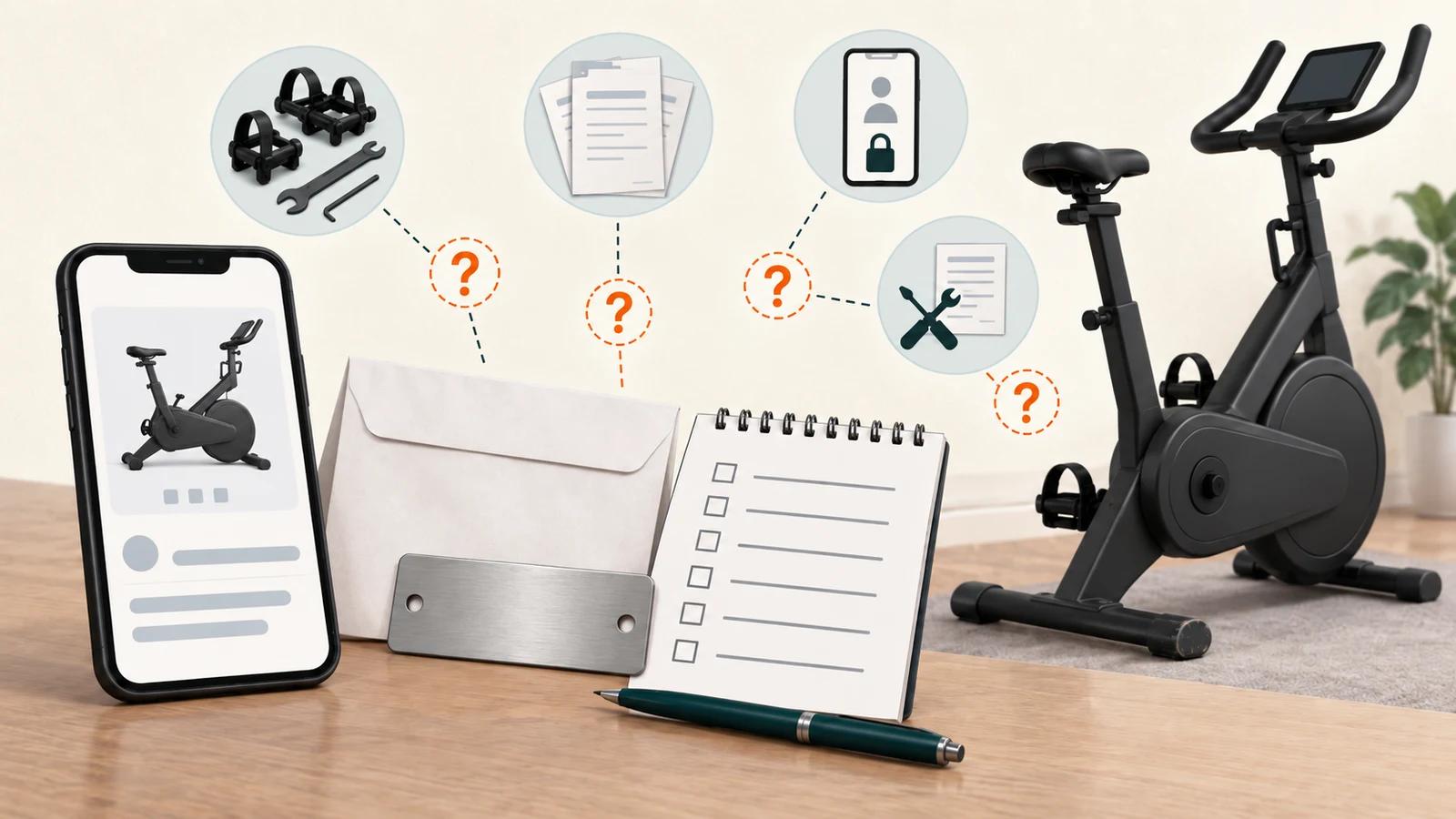
A used compact-fitness listing should remain a candidate, not a purchase, until you can document five gates:
- the exact product, revision, serial or lot, seller, and proof of ownership;
- current recall or safety-warning status and whether the required remedy was completed;
- all required parts, controls, power components, accessories, installation hardware, and account credentials;
- warranty transferability, parts and service routes, activation or membership obligations, and transport or installation requirements; and
- a payment and transaction path that preserves the marketplace or card protections you intend to rely on.
A visual pass does not prove internal condition. A successful powered demonstration is not an extended-use test. A private-sale price is not a complete ownership cost. When identity, recall, ownership, activation, installation, or support remains unresolved, No purchase or defer is a valid result.
Scope and authoritative boundary
This risk guide applies to United States buyers considering compact home-fitness equipment from a private seller, a third-party marketplace, a used-equipment dealer, or a manufacturer-certified refurbished program. The examples are exact and current as of 2026-07-28, but they are not a market census.
The guide can help you build a diligence record, identify a blocked transaction, and decide which party must answer the next question. It cannot determine whether a damaged structure is repairable, whether wiring is acceptable, whether a seller has legal title, whether a product is medically appropriate, whether a recall remedy will remain available, or whether a future claim or repair will succeed.
Use current manufacturer instructions for the exact item. Use CPSC recall search for current recall/remedy status. Use qualified technical, electrical, structural, installation, legal, or medical help when the decision crosses those boundaries. For the broader floor, power, clearance, and safety checklist, see Floor Protection, Power, Clearance, and Safety Checks for Home Fitness Equipment.
Connected-equipment continuity is a separate diligence lane; see App Shutdown, Data, Subscription, and Device Lock-In Risks in Smart Fitness when an account, app, subscription, or transfer path is material.
The used-purchase record
Create one dated record for one exact item and one transaction path.
| Record block | Minimum fields | Decision it supports |
|---|---|---|
| Listing | listing URL or screenshot, seller identity, date, price, included items, claimed condition | preserves what was offered |
| Product identity | brand, exact model, revision, serial/lot, market, label photos, manual | binds recalls, parts, and support |
| Ownership | original receipt or order confirmation, seller name, rental/lease status, lien or unpaid-obligation questions | identifies provenance and transfer blockers |
| Safety status | CPSC search, manufacturer recall page, remedy state, stop-use instruction | determines whether testing or use may proceed |
| Completeness | required guards, pins, keys, cradles, adapters, cords, hardware, accessories, tools | identifies missing systems and replacement costs |
| Physical condition | only visible, non-invasive observations permitted by the exact instructions | documents—not certifies—condition |
| Digital state | prior account, activation, membership, firmware, device generation, factory-reset or transfer route | identifies connected-equipment lock-in |
| Support | transferability, proof requirements, parts route, service geography, owner-install permission | identifies post-sale support exposure |
| Logistics | disassembly, route, package state, transport, installation, reverse route, disposal | identifies handling and site blockers |
| Payment | marketplace protections, payment channel, deadlines, messages, receipt | preserves transaction recourse |
| Outcome | blockers, conditions, unknowns, owner, next action | prevents a listing from becoming an unsupported purchase decision |
Outcome labels used in this guide
Eligible for limited in-person diligence
Eligible only with manufacturer confirmation
Policy or support path unresolved
Recall, ownership, account, or installation block
Official refurbished/new path has materially different protections
No purchase or defer
These labels describe the next decision, not product quality. None means the item is safe, authentic, repairable, a good value, or suitable for a particular user.
Risk class 1: exact identity and proof of ownership
A seller title such as “Peloton,” “BowFlex 552,” “PowerBlock Elite,” or “Tonal” is not enough. Record the label, exact model, serial or lot, device ID when applicable, market, revision, and every included component. Similar retail names can span different generations, recalled products, replacement products, screen revisions, incompatible expansion systems, or unsupported regional versions.
Request proof of ownership before revealing sensitive information or sending payment. Peloton explicitly recommends proof of ownership for a used Bike and says rental-program equipment cannot be resold or activated for All-Access after resale. Tonal recommends proof of purchase plus serial and device ID because a trainer may be disabled if its status indicates theft or misappropriation. (Peloton used-bike guidance; Tonal used-equipment guidance)
Proof of ownership is evidence for diligence; it is not a legal-title opinion. A missing receipt does not prove theft, and a receipt does not guarantee there is no later dispute. Record the limitation.
Risk class 2: recall, stop-use, and remedy state
Check both CPSC recalls and the current manufacturer route using exact model, serial, lot, and market. CPSC notes that recall remedy data can change as company and remedy availability change. A prior screenshot or a seller statement is not enough for a high-impact decision.
CPSC tells secondhand sellers to examine products for recalls and states that it is illegal to sell a recalled product. A buyer should treat an unresolved exact match as a transaction block—not as a discount opportunity. (CPSC online-seller guidance)
A recall lookup must use exact model and serial or lot scope. A model that is not named in one recall is not thereby certified. A remedy reported as completed must be documented for the exact unit; do not infer completion from a replacement part that merely looks newer.
Risk class 3: seller, listing, and payment fraud
The FTC marketplace guide recommends using payment methods and marketplace systems that preserve the protections you intend to rely on, keeping records, and tracking dispute or return deadlines. It warns against paying outside the marketplace system because platform protection may be lost.
The FTC also identifies urgency and insistence on hard-to-recover payment methods as scam patterns. A seller who will not allow identity checks, wants gift cards, wire transfer, cryptocurrency, or an off-platform payment, or pressures you to skip inspection creates a transaction risk independent of the product. (FTC scam signs)
Keep the original listing, messages, agreed included items, payment confirmation, pickup address, and any condition or return representation. Do not treat a marketplace profile, review count, or verified-payment badge as proof that the product identity, ownership, recall status, or condition is resolved.
Risk class 4: warranty and transferability
Used buyers often lose the contractual warranty even when substantial time remains on the original period. PowerBlock’s current warranty is limited to the original purchaser and is strictly non-transferable; third-party or auction-site purchases are outside that coverage. REP also describes selected product warranties as original-purchaser and non-transferable. (PowerBlock warranty; REP warranty)
Peloton says the limited warranty included with a directly purchased Bike is not transferable to a private-sale buyer. Tonal says its warranty covers only the original purchaser and that a used buyer cannot buy a separate Tonal warranty. (Peloton used-bike guidance; Tonal used-equipment guidance)
Do not deduct a vague “remaining warranty value” from the used price unless the exact transferable instrument, purchaser, product, territory, proof, and claim process are verified. A protection plan may have different transfer rules from the base warranty; treat it as a separate contract.
Risk class 5: parts, service, and repairability
A parts page is useful only when the exact model and revision match. PowerBlock says replacement parts are model specific and cannot be returned, and proof of purchase is required for warranty-related parts. (PowerBlock parts request)
A public part does not prove that the buyer may install it, that the failure has been correctly diagnosed, or that every dependent component is available. A support channel does not prove turnaround time or successful repair. A warranty headline does not prove transferability, labor, freight, or service geography.
Before payment, ask the manufacturer—using contact information you independently obtain—whether the exact serial/revision can receive parts or paid service as a secondhand unit. Record the answer, date, representative or case number, and limitations. If support will not answer without the original purchaser or proof you do not have, price and classify the item accordingly.
Risk class 6: accounts, subscriptions, and activation
Connected equipment can be physically present yet digitally blocked or reduced. Peloton currently charges new members buying a used Bike or Bike+ from a private seller a one-time $95 activation fee. Peloton also says a resold rental-program Bike will not receive All-Access activation and warns that first-generation touchscreens with serials beginning 7201 no longer receive feature updates. (Peloton used-bike guidance)
Tonal says prior-owner conduct can affect a used trainer, a trainer may be disabled if stolen or misappropriated, status confirmation may later change, and a buyer may inherit remaining months of the initial membership commitment. It also limits non-membership use to Basic Lift after the commitment issue is resolved. (Tonal used-equipment guidance)
Document account removal, activation eligibility, membership cost, prior-owner obligations, firmware support, screen generation, local fallback, and what happens if the service is unavailable. Official status confirmation is not a future guarantee. Do not send payment based only on a successful login by the seller.
Risk class 7: physical condition and missing components
Inspect only within the exact manufacturer’s documented limits. Start with labels and visible condition: cracks, bends, corrosion, damaged housings, frayed or modified cords, missing guards, loose or absent fasteners, worn adjustment points, damaged screens, incomplete cradles, missing selector pins, absent safety keys, substituted adapters, and non-original installation hardware.
Peloton’s current used-bike guide tells buyers to inspect in person when possible, check that levers and knobs move, inspect cable and power connections, look for screen damage, verify authentic parts, confirm recall-related replacement parts, and identify touchscreen generation. This is product-specific guidance, not a universal inspection protocol. (Peloton used-bike guidance)
A visual inspection is not a safety certification. It cannot reveal hidden fatigue, electrical faults, internal wear, calibration error, water damage, software lock, or a repair performed without the required procedure. Any material damage, modification, or unexplained noise should stop the unsupported conclusion and route the question to the manufacturer or qualified service.
Risk class 8: power, cords, batteries, and modifications
Do not energize unidentified, recalled, water-damaged, visibly modified, or cord-damaged equipment. Record the exact power input, adapter, plug, cord, battery, charger, grounding or outlet instruction, and whether every supplied component is original and correct for the model.
A seller-provided generic adapter or replacement cord is not automatically compatible. A unit that powers on does not prove electrical suitability, internal condition, or compliance with the exact instructions. Do not open covers, bypass interlocks, defeat safety keys, bridge sensors, or improvise wiring as part of a purchase inspection.
When site-specific electrical judgment is required, use the exact manual and ask a qualified electrician. When equipment repair or internal electrical inspection is required, use the manufacturer’s authorized route or a qualified technician who can work within the exact product and warranty constraints.
Risk class 9: transport, disassembly, installation, and return
A private sale may require the buyer to disassemble, carry, transport, reassemble, anchor, calibrate, connect, and later dispose of equipment without a return path. The purchase record should separate current installed state, approved move state, package state, vehicle loading, stairs and turns, destination assembly, professional installation, and reverse route.
Tonal says transportation is not included in its relocation service, improper uninstall or installation can affect warranty coverage, and international relocation is unsupported. Its used-equipment guidance recommends a new installation kit and professional installation rather than reusing the previous owner’s hardware. (Tonal relocation; Tonal used-equipment guidance)
Transport wheels are not one-person handling approval. A folded product is not automatically in a permitted transport or storage orientation. A private seller’s willingness to help load does not prove the buyer can unload or reinstall the product at the destination.
Risk class 10: personal data and prior accounts
Connected equipment may retain login shortcuts, workout history, device associations, network information, or prior profiles. The seller should follow the exact manufacturer account-removal, logout, reset, and transfer instructions before handoff, while the buyer independently confirms activation eligibility.
Do not assume that deleting a visible profile deletes cloud data, ends a subscription, removes the device from an account, clears a rental status, or erases every local credential. Do not ask the seller to share a password or verification code. The buyer should create a separate account through the official route after eligibility is confirmed.
This guide does not verify a complete data-erasure method for every product. If privacy or account separation is a hard requirement and the current manufacturer procedure is incomplete, defer the purchase.
Private sale, marketplace protection, and certified refurbished
These transaction classes must stay separate.
| Transaction path | Possible protections | Material limits |
|---|---|---|
| Private local sale | in-person identity/condition review and immediate possession | commonly no return, no platform dispute, no transferred warranty, buyer-managed transport |
| Marketplace transaction | payment/dispute system, messages, deadlines, possible buyer protection | protection depends on exact platform, item, payment channel, deadline, and evidence |
| Manufacturer or authorized certified refurbished | stated inspection, warranty, delivery, support, and return policy | price and program scope differ; inventory and exact terms are time-sensitive |
| Dealer-used equipment | written dealer warranty or service may exist | dealer authorization, exact coverage, parts, and return terms must be verified |
Peloton distinguishes private used equipment from its Certified Refurbished path, which includes a stated limited warranty and manufacturer-controlled delivery/support. That difference does not make every refurbished program equivalent or every private sale unacceptable; it changes the evidence and recourse available. (Peloton used-bike guidance)
Before contacting the seller
Prepare a short checklist before the conversation:
- identify the likely exact model and known label locations;
- search current recalls and manufacturer warnings;
- find the current manual, parts, warranty, and used-ownership guidance;
- list every required component and accessory;
- define your room, route, power, account, and activity requirements;
- identify payment, inspection, pickup, and dispute deadlines; and
- write your stop conditions before seeing the item or negotiating price.
Pre-commitment stop conditions reduce the chance that travel time, urgency, or a low price will override an unresolved risk.
Ask for the exact label, serial, and device identifiers
Ask for clear, current photos taken by the seller—not a catalog image—showing:
- the full product and installed/stored state;
- model, serial, lot, device ID, and power label;
- included components, safety parts, adapters, cradles, pins, and hardware;
- any visible damage or modification; and
- the screen or console version when support depends on it.
Do not post serials publicly. Use them only with the official manufacturer or regulator route needed for diligence. If the seller refuses an exact label or supplies a cropped/blurred image that prevents matching, the identity gate remains blocked.
Ask for proof of ownership and purchase
Request a receipt, order confirmation, manufacturer history report, or other evidence appropriate to the product. Match the seller’s story to the model, date, seller, and transaction channel.
Peloton recommends proof of ownership and provides a serial-based History Summary. Tonal recommends proof of purchase, serial, device ID, and an installed-location photo. These tools help organize evidence but do not guarantee title, future account status, repairability, or transaction success. (Peloton used-bike guidance; Tonal used-equipment guidance)
Do not accept a screenshot of an account as permission to take over that account. The buyer should use the official new-owner or activation path.
Check recalls and remedy availability
Search the exact identity on CPSC recalls and the current manufacturer recall page. Record:
search date
exact model and serial/lot
market
recall or warning identifier
hazard
stop-use direction
remedy
remedy availability
required proof
seller's claimed completion
independent confirmation
Recall remedy data can change. If the firm is no longer operating or the remedy is no longer available, the correct disposition may be disposal rather than repair or resale. The used price does not alter the recall direction.
Check warranty and support before agreeing on price
Ask the manufacturer four separate questions:
- Does the base warranty transfer to this buyer?
- Can a secondhand owner buy parts or paid service for this exact serial/revision?
- What proof, original purchaser participation, registration, shipping, or technician route is required?
- Does geography, prior installation, rental status, or modification block support?
Record unknowns as unknown. Do not convert a customer-service representative’s general statement into a written product-specific guarantee. Do not assign zero cost to freight, labor, diagnostic, installation, or replacement parts that have not been quoted. For a dated policy snapshot that helps identify transfer, return, service, and parts questions, see the Compact Fitness Equipment Warranty, Return, Service, and Repairability Matrix.
Check parts by exact model and revision
Build a completeness list from the current manual or manufacturer parts diagram. For selectable weights, confirm pair count, handles, plates, trays, selector pins, micro weights, and expansion stages. For cardio equipment, confirm pedals, adjustment hardware, safety key, console, power supply, sensors, guards, and required tools. For wall-mounted systems, confirm mounts, hardware, accessories, and installation kit.
A compatible-looking part is not proof of compatibility. PowerBlock explicitly says its parts are model specific and cannot be returned. Peloton’s used guide also distinguishes screen generations and selected replacement parts. (PowerBlock parts request; Peloton used-bike guidance)
Check account and subscription obligations
For every connected item, record:
new-owner activation available?
one-time activation fee?
mandatory or remaining commitment?
current membership price and tax?
local fallback without membership?
screen generation still supported?
prior rental, finance, or stolen/misappropriated state?
account removal and new-account route?
service available without original purchaser?
Peloton and Tonal demonstrate why these fields cannot be inferred from a powered screen. A seller’s active account can temporarily make a device look functional even when the buyer will face activation, membership, status, or warranty limits after handoff.
Check transport, installation, and site requirements
Before the pickup appointment, build both the forward and reverse route. Record equipment and component weights only from exact sources; do not invent a crew size or lifting limit. Confirm whether disassembly is permitted, what tools are required, which orientations are approved, and whether a professional installer must remove or reinstall the unit.
For large smart equipment, ask whether the seller will deinstall through the official route, whether original mounting hardware may be reused, whether the destination is supported, and who bears transport damage. A product that fits in the seller’s room may not pass your stairs, turns, vehicle, wall, floor, or power constraints. Use the doorway, stairs, delivery, assembly, and returns checklist to keep that logistics record separate from used-item condition.
Check payment method and marketplace deadlines
Use the exact marketplace’s payment and dispute system when you are relying on its protections. The FTC advises against off-platform payment and hard-to-recover methods, and recommends keeping messages and deadline records. (FTC marketplace guide)
Record:
- agreed item and included parts;
- price, fees, deposit, and balance;
- payment channel;
- inspection and rejection rights;
- pickup/delivery terms;
- platform dispute and return deadlines;
- seller representations; and
- receipt or bill of sale.
This guide does not determine the enforceability of a private-sale contract. Seek legal advice for a legal-title, lien, fraud, or contract question.
Inspect only within documented and limited scope
Do not improvise a load, speed, drop, fold, anchor, electrical, calibration, or endurance test. A purchase inspection should stay within the current manual, the observed condition, the seller’s authority, and the buyer’s competence.
If the exact identity, recall status, power system, safety components, structural condition, or required installation is unresolved, do not run the item merely to “see what happens.” Document the blocker and obtain manufacturer or qualified help.
What a visual inspection can support
A visual inspection can document that a label is present, components appear present, a cord or housing is visibly damaged, a screen is cracked, corrosion is visible, hardware is missing, or a seller’s photos do not match the item.
It cannot establish internal electrical condition, metal fatigue, bearing life, calibration, hidden water damage, software entitlement, service eligibility, or a complete maintenance history. A clean cosmetic appearance is not evidence of low usage or safe operation.
What a powered demonstration can and cannot support
A documented demonstration may show that the exact unit powered on at a stated date, displayed certain local functions, moved through a limited manufacturer-approved sequence, or connected under the seller’s current account/device state.
A successful powered demonstration is not an extended-use test. It does not prove reliability, accurate metrics, quietness, resistance under load, future account transfer, absence of intermittent faults, serviceability, or compatibility after a software update.
Do not test a recalled or unidentified product
If the item matches a stop-use recall, follow the current recall direction. Do not conduct a demonstration, negotiate a “use as-is” discount, or assume an old repair is adequate without exact remedy confirmation.
If the identity cannot be resolved, the recall question cannot be resolved. The safest editorial outcome is not a safety certification; it is a blocked purchase decision pending exact evidence.
Peloton private-sale example
Peloton’s current used-bike guidance requires a more complete record than “Bike turns on”:
- serial-bound History Summary;
- proof of ownership;
- rental status;
- recall-related seat post and pedal status;
- screen generation;
- authentic/missing parts;
- cadence and resistance demonstration when appropriate;
- one-time $95 activation fee for a new private-sale buyer;
- current membership path; and
- non-transferable base warranty.
If the seller will not provide the serial, the unit is a resold rental, recall status is unresolved, or activation is denied, the listing is blocked. (Peloton used-bike guidance)
Tonal private-sale example
Tonal’s current used-equipment guidance requires:
- proof of purchase;
- serial and device ID status check;
- confirmation of any remaining membership commitment;
- destination installation plan and new hardware/kit;
- understanding that warranty does not transfer and cannot be purchased from Tonal;
- confirmation of paid service/support options for the secondhand owner; and
- acceptance that Basic Lift is the non-membership fallback after commitment conditions are resolved.
Tonal says status can change after a pre-purchase check and that a stolen or misappropriated trainer may be disabled. A low price cannot compensate for a unit that cannot be activated, installed, or serviced. (Tonal used-equipment guidance)
PowerBlock third-party example
A used PowerBlock listing must identify the exact family, model, generation, pair completeness, selector pins, micro weights, and expansion stages. Similar shapes and names do not guarantee parts or stage compatibility.
PowerBlock’s current warranty is original-purchaser and non-transferable, and its terms exclude third-party or auction-site purchases from warranty coverage. Parts are model specific and cannot be returned. The used price should therefore be evaluated with no assumed transferable warranty and with the exact parts route confirmed first. (PowerBlock warranty; PowerBlock parts request)
Legacy BowFlex 552 and 1090 example
CPSC recalled specified BowFlex 552 and 1090 adjustable dumbbells because plates can dislodge during use. The notice identifies model/serial labels on the bottom of the tray and directs affected consumers to stop using the units and obtain the specified remedy. (CPSC BowFlex recall)
A used listing that says only “BowFlex 552” is not enough to distinguish a legacy recalled unit from a current Results Series replacement. Obtain the tray label, current recall status, seller history, and remedy record. Do not test or buy the item as usable equipment while the identity or remedy is unresolved.
FitRx SmartBell exact-recall example
CPSC’s 2026 FitRx notice applies to model 8361 within named serial ranges and directs immediate stop-use plus replacement registration. The model and serial are on the tray. (CPSC FitRx recall)
This example shows why brand, weight range, color, and appearance are not enough. The exact serial is part of the decision. A seller’s statement that “only some were recalled” does not resolve whether this unit is one of them.
Nautilus treadmill no-remedy example
CPSC’s T616/T618 treadmill recall states that the firm is no longer in business, the remedy is no longer available, and affected products should be discarded rather than donated or resold. (CPSC Nautilus treadmill recall)
A product can therefore have a known hazard and no available repair path. A low used price, local pickup, or working display does not create a remedy. Exact model and serial matching must happen before transport or operation.
Scenario: seller refuses serial or proof
Result: Recall, ownership, and support blockDo not send a deposit to unlock the serial or schedule. Ask the seller to provide non-publicly posted evidence through a secure channel. If they refuse or the evidence conflicts, preserve the messages and leave the transaction.
Scenario: smart equipment cannot activate
Result: No purchase or deferA powered screen under the seller’s account is not enough. Confirm the official new-owner activation path, fees, membership obligations, rental/stolen status, supported screen generation, and local fallback. When the manufacturer will not activate the exact unit, treat digital functionality as unavailable rather than assuming a workaround.
Scenario: missing parts and no transferable warranty
Result: Policy or support path unresolvedBuild an exact missing-parts list and obtain current parts availability and total cost before payment. Do not infer compatibility from a visually similar listing. If a required safety component, selector, cradle, adapter, mounting kit, or manual-bound part is missing and no exact route exists, defer.
Scenario: heavy equipment must be moved and reinstalled
Result: Eligible only with named logistics and installation conditionsDocument disassembly, allowed orientation, route, vehicle, destination, installation service, wall/floor/power prerequisites, packaging, and who bears damage. If the manufacturer requires professional installation or approved relocation, a private pickup plan does not replace that requirement.
Scenario: low listing price but incomplete ownership cost
Result: Complete cost unavailableA private-sale price is not a complete ownership cost. Add activation, missing parts, accessories, transport, disassembly, installation, power components, membership, repairs, service travel, payment fees, disposal, and the value of absent warranty/return recourse. Unknown is not zero.
Scenario: buyer requires a documented support path
Result: Manufacturer confirmation requiredConfirm whether a secondhand owner can buy parts, pay for service, activate the unit, and receive support in the destination geography. A public contact page is not a documented path for the exact used serial.
When manufacturer confirmation is required
Escalate before payment when any of these affect the decision:
- stolen, rental, lease, finance, or membership-commitment status;
- recall or remedy status;
- screen or hardware generation;
- parts compatibility;
- warranty or protection-plan transfer;
- secondhand paid-service eligibility;
- activation or account transfer;
- professional installation or relocation; or
- exact manual/revision mismatch.
Use independently obtained contact information, not a number supplied only by the seller.
When qualified technical help is required
Stop the buyer-led inspection when the answer requires internal disassembly, electrical diagnosis, structural assessment, wall/floor approval, welding, cable replacement, safety-device bypass, load testing, or a repair procedure not authorized for the owner.
A qualified technician’s scope should identify the exact product and task. Their inspection is not automatically a manufacturer warranty decision or a building/electrical certification outside their scope.
When marketplace or payment escalation is required
Use the marketplace dispute route or payment provider promptly when the item is not as described, never arrives, differs materially, has a concealed recall/ownership block, or the seller violates the platform transaction terms. Track the deadline and preserve evidence. The FTC marketplace guide explains general payment and reporting considerations; the exact platform rules still control the transaction process.
If you believe the item or seller is unsafe or fraudulent, report through the appropriate marketplace, payment provider, FTC, manufacturer, and CPSC unsafe-product route as applicable.
Stop conditions
Stop or defer when:
- exact model, serial, lot, or revision cannot be verified;
- proof of ownership or rental/lease status is materially unresolved;
- a recall, warning, or remedy applies and is incomplete;
- the product is unidentified but a relevant recall cannot be excluded;
- a required guard, selector, safety key, cord, adapter, cradle, mount, or hardware is missing;
- visible damage or modification requires technical assessment;
- the unit cannot be activated for the new owner;
- the manufacturer will not support or service the secondhand unit and that support is a hard requirement;
- transport or installation cannot be completed within documented requirements;
- the seller demands an unprotected or prohibited payment path; or
- the buyer cannot accept the absence of return, warranty, parts, or repair recourse.
Prohibited inferences
Do not infer:
powers on
→ safe, durable, calibrated, or transferable

looks clean
→ low use or no hidden damage

seller has an account
→ buyer can activate

serial exists
→ ownership is valid

not found in one recall search
→ safety certification

remaining warranty time
→ transferable coverage

parts page exists
→ exact part in stock or owner may install

transport wheels
→ one-person handling approval

low used price
→ lower complete cost or better value

visual inspection passed
→ professional inspection not needed
Fallback paths
When a private used path is blocked, alternatives include:
- manufacturer-certified refurbished equipment with stated warranty and support;
- an authorized used dealer with written coverage and return terms;
- a simpler non-connected product with fewer account/service dependencies;
- a different exact model with current parts and recall clearance;
- renting or borrowing only through an authorized program; or
- making no purchase until the required evidence is available.
A fallback is a new candidate, not proof that it fits the room, user, budget, or activity.
No purchase or defer
No purchase or defer is the correct result when the unresolved downside is material and cannot be bounded before payment. That includes a possible recalled unit, unclear ownership, blocked activation, unsupported installation, absent critical parts, no acceptable payment protection, or a support requirement the manufacturer will not confirm.
Declining a listing is not a claim that the product or seller is fraudulent. It means the buyer’s evidence threshold was not met.
Missing and conflicting inputs
Keep a separate unknown register for:
identity and serial
ownership and rental/finance status
recall and remedy
manual and revision
missing parts and authenticity
condition and maintenance history
activation and account removal
membership obligation and local fallback
warranty and protection-plan transfer
parts, service, labor, freight, and geography
transport and installation
return or buyer protection
complete ownership cost
Preserve official conflicts. Do not average, choose the favorable value, or let seller statements overwrite current manufacturer/regulator records.
Save the transaction record
Save the listing, photos, label/serial evidence, proof of ownership, recall checks, manufacturer confirmations, parts list, messages, payment receipt, pickup/delivery record, and final disposition. Avoid publishing sensitive serial, address, account, or payment data.
A saved record supports later correction, dispute, recall contact, service, and resale diligence. It does not create warranty coverage or legal ownership by itself.
Recommendation boundary
This guide does not recommend a used product, seller, marketplace, payment method, or inspection provider. It provides a risk-routing method. A purchase recommendation would require an exact buyer scenario, current transaction terms, resolved stop conditions, product-specific evidence, and any qualified review the scenario requires.
This guide does not import a general logistics checklist or a cross-product policy matrix as proof for a specific listing. Delivery, return, warranty, service, and repairability still require current exact records for the product, seller, market, and transaction.
Next step
Use the record to choose one next action:
request exact evidence from the seller
contact the manufacturer
check the current recall/remedy
obtain qualified inspection or installation review
price missing parts and logistics
use protected marketplace/payment channels
switch to an authorized refurbished/new candidate
No purchase or defer
Do not negotiate final price until the risk class that can block the transaction is resolved or explicitly accepted.
Methodology
FitFootprint reviewed current official U.S. government and manufacturer sources on 2026-07-28. The method follows the current FitFootprint risk-guide structure:
- define the exact transaction and authoritative scope;
- identify risk classes before evaluating price;
- separate official documentation from seller statements and buyer observation;
- keep identity, recall, ownership, account, support, logistics, and payment as separate evidence objects;
- preserve missing fields and conflicts;
- route professional questions to the appropriate qualified party;
- allow blocked, alternative-path, and no-purchase outcomes; and
- withhold product and seller recommendations.
The exact examples are explicit, bounded, and non-exhaustive. They are not evidence about another model or transaction. No direct product, seller, payment, activation, transport, or repair test was performed.
Sources
- FTC — Buying From an Online Marketplace — payment systems, platform protection, deadlines, and records — checked 2026-07-28.
- FTC — What Are the Signs of a Scam? — urgency and hard-to-recover payment warnings — checked 2026-07-28.
- FTC — Online Shopping — seller, order, return, and communication records — checked 2026-07-28.
- CPSC — Online Sellers Safety Guide FAQs — secondhand recall checks and recalled-product resale boundary — checked 2026-07-28.
- CPSC — Recalls and Product Safety Warnings — current recall search and remedy state — checked 2026-07-28.
- CPSC — Report, Search, Protect — unsafe-product reporting route — checked 2026-07-28.
- CPSC — BowFlex 552 and 1090 Recall and BowFlex Recall FAQ — exact identity, stop-use, and remedy — checked 2026-07-28.
- CPSC — FitRx SmartBell 5–52.5 lb Recall — exact model/serial and replacement remedy — checked 2026-07-28.
- CPSC — Nautilus T616/T618 Recall — remedy unavailable and do-not-resell direction — checked 2026-07-28.
- Peloton — Buying a Used Bike or Bike+, History Summary, and Replacement Parts — condition, identity, recall, activation, rental, warranty, screen, and parts — checked 2026-07-28.
- Tonal — Buying a Used Tonal, Warranty, and Relocation — status, commitment, warranty, service, installation, and relocation — checked 2026-07-28.
- PowerBlock — Warranty and Repairs, Parts Request, and Terms of Sale — original-purchaser, third-party, model-specific parts, proof, and shipping boundaries — checked 2026-07-28.
- REP Fitness — Warranty Information — original-purchaser and transferability example — checked 2026-07-28.