
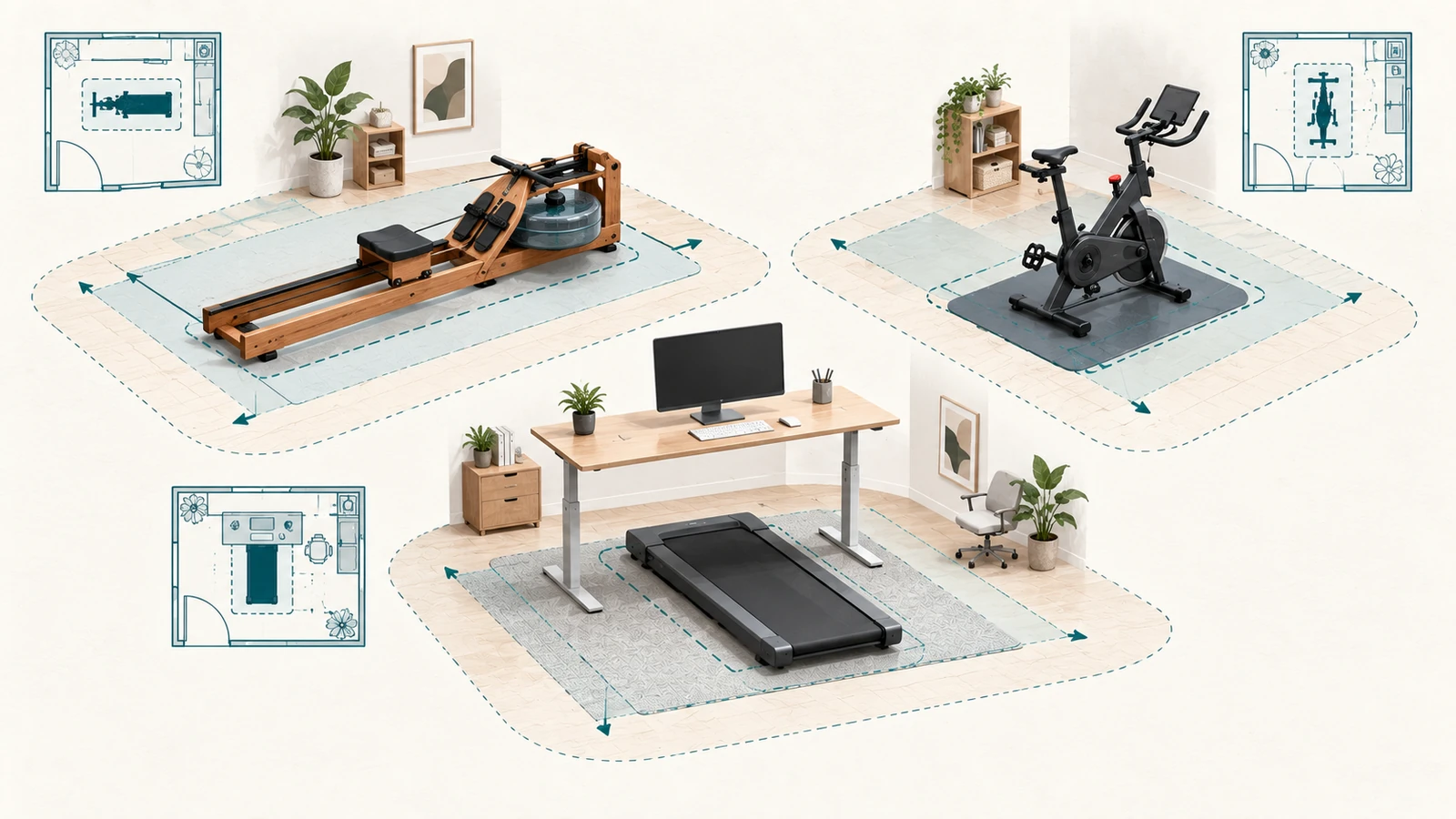
Quick answer
Choose the activity and room workflow before comparing rectangles. A walking pad can remain the documentary fit for walking while working, a bike can remain the fit for seated cycling, and a rower can remain the fit when rowing itself is non-negotiable. Those are task matches, not overall rankings.
The current examples also show why one compactness number cannot choose the category. The WalkingPad WR20 has a long 81.50-inch operating state but a tri-fold envelope of 28.94 × 18.90 × 22.83 inches. The XTERRA FB180 has a much shorter set-up length and a tall 18 × 18 × 51-inch folded state. The WalkingPad C2 folds low to 32 × 20 × 5.5 inches, while the UREVO SpaceWalk E1L does not fold but has a 42.1 × 19.3 × 4.2-inch product envelope.
A product rectangle is not a complete operating zone. Folded is not the same as safely stored. Transport wheels are not proof of one-person handling. When the activity requirement, exact model, operating route, storage orientation, user-fit input, power path, noise evidence, or ownership burden is unresolved, no purchase or defer is valid.
Scope and evidence boundary
This page compares category paths through six exact current examples:
- two rower records: WR20 tri-fold water rower and Sunny SF-RW1205 hydraulic rower;
- two bike records: Schwinn IC4 fixed indoor cycle and XTERRA FB180 folding bike;
- two walking-pad records: WalkingPad C2 folding walking treadmill and UREVO SpaceWalk E1L non-folding walking pad.
For the broader category frame, see the compact home fitness equipment buyer guide and the walking-pad versus treadmill format comparison.
The current examples are not a market census. They were selected to expose meaningful format differences, not to produce a preferred brand or winner. A different exact product may reverse a space, capacity, power, price, storage, or compatibility result.
The comparison is limited to public official documentation. Manufacturer statements about quietness, comfort, stability, smoothness, easy movement, durability, calorie burn, muscle engagement, or safety are not independent observations and do not become category conclusions here.
Why category labels are too broad
“Rower,” “exercise bike,” and “walking pad” are not single architectures.
The two rowers differ in water versus hydraulic resistance, operating length, folding evidence, mass, user limit, maintenance, app wording, and current listing price. The two bikes differ in fixed versus folding structure, product mass disclosure, power, rider range, pedals, and connectivity. The two walking pads differ in folding state, walking area, seller-stated mass, user limit, app path, and current price visibility.
A category decision therefore needs two layers:
- choose the movement task and household workflow;
- verify the exact product that supplies that task.
A category label cannot replace exact model identity, current manual, operating and stored states, or buyer-specific fit inputs.
Compact-rower pillar gate
The current rower sample still shows why a broader compact-rower buyer pillar could be useful: water and hydraulic architectures have materially different states. Under dec-061, that architecture question is resolved as not required for this existing bounded Article 39 scope. A separate pillar remains outside this article and is not assumed to exist.
WR20 and SF-RW1205 cannot share one normalized “compact rower” record without losing material differences:
- water versus hydraulic resistance;
- 81.50-inch versus 54-inch operating length;
- documented tri-fold envelope versus no numeric folded envelope;
- unresolved WR20 direct-store mass versus 20.9-pound SF-RW1205 mass;
- 331-pound versus 220-pound user-limit fields;
- water handling versus hydraulic-cylinder ownership;
- different monitor, app, assembly, maintenance, and price states.
This article does not create an unnumbered pillar or claim that its two rower examples represent the market. If a buyer needs a broader rower selection, the valid exit remains separate research or deferment.
Bounded current example set
| Category path | Exact current example | Why it is included | What it cannot represent |
|---|---|---|---|
| Folding water rower | WalkingPad WR20 | Long operating rail with a documented tri-fold state | All rowers, all water rowers, or every WR20 revision |
| Compact hydraulic rower | Sunny SF-RW1205 | Shorter, lighter, lower-price hydraulic path | A folded rower or the broader hydraulic market |
| Fixed connected bike | Schwinn IC4 | Indoor-cycle geometry, wall power, dual pedals, app support | Every exercise bike or every IC4/800IC region |
| Folding basic bike | XTERRA FB180 | Battery console and documented upright folded state | Every folding bike or taller/heavier-rider fit |
| Folding walking pad | WalkingPad C2 | Low folded state and walking-only speed range | Every walking pad or running use |
| Non-folding walking pad | UREVO SpaceWalk E1L | Short, low-profile fixed platform | Every non-folding pad or a verified storage orientation |
No model was included because of affiliate availability, a desired winner, review score, or seller marketing claim.
Evidence parity and what was not tested
The candidates do not have full evidence parity. Some official pages expose mass, folded dimensions, power, user range, manuals, or app direction; others do not. Missing fields remain unknown rather than being borrowed from another model or treated as zero.
No direct evidence exists here for:
actual room fit
assembly quality
fold or latch behavior
one-person handling
belt, pedal, rail, seat, or resistance feel
noise or structure-borne vibration
metric accuracy
app pairing
maintenance frequency
parts availability
return transaction
long-term reliability
A documentation-only survivor is only eligible for further diligence.
Fixed decision criteria
The criteria were fixed before looking for a winner:
- required activity and movement pattern;
- exact user-limit and rider-fit inputs;
- operating, access, and setup zone;
- folded or stored state and permitted orientation;
- retrieval and reset route;
- product mass and handling evidence;
- power, controls, account, and app dependency;
- noise and vibration evidence;
- maintenance, water, lubrication, batteries, and parts;
- current hardware price and incomplete ownership cost;
- return, warranty, service, and exact-model regulator diligence;
- valid neither, no-purchase, or defer outcome.
A price or rectangle cannot override an activity mismatch.
Space states that must stay separate
Use the measurement workflow in FitFootprint’s room-fit guide and the source-state distinctions in the equipment-dimensions methodology. Record at least:
shipping or package state
assembled state
operating state
user-entry and exit state
control and adjustment access
fold transition
stored state
retrieval state
inspection and service state
preserved doorway and household route
Do not rotate dimensions into an undocumented storage orientation. Do not add a seller’s product rectangle to a buyer’s room without adding the movement and access zones required by the exact task.
Current geometry matrix
| Example | Seller-stated operating or product envelope | Seller-stated folded or stored envelope | Seller-stated mass | Important missing geometry |
|---|---|---|---|---|
| WR20 | 81.50 × 18.90 × 22.83 in | 28.94 × 18.90 × 22.83 in | Not exposed on checked WalkingPad US table | Rowing stroke, entry, fold transition, water-filled movement, exact permitted storage state |
| Sunny SF-RW1205 | 54 × 20 × 23 in | No numeric folded envelope | 20.9 lb | Whether any alternate storage state is manufacturer-permitted |
| Schwinn IC4 | 54.6 × 30.7 × 51.8 in | None documented | 113.6 lb | Mount/dismount, pedal, knee, handlebar, adjustment, device, cord, service zone |
| XTERRA FB180 | 31.7 × 18.1 × 42.7 in | 18 × 18 × 51 in | Not exposed on checked specification block | Fold path, pin/lock confirmation, handler grip, turning route |
| WalkingPad C2 | 57 × 20 × 5 in | 32 × 20 × 5.5 in | 55 lb | Step-on/off, belt access, cord/control, fold transition, permitted storage route |
| UREVO E1L | 42.1 × 19.3 × 4.2 in | No folded state | 36.59 lb | Permitted storage orientation, step-on/off, cord/control, belt and lubrication access |
Product-rectangle arithmetic
The following plan areas are simple length-by-width arithmetic from seller-stated product envelopes:
WR20 unfolded: 10.70 sq ft
WR20 folded:   3.80 sq ft
Sunny rower:   7.50 sq ft
IC4:           11.64 sq ft
FB180 set-up:  3.98 sq ft
FB180 folded:  2.25 sq ft
C2 unfolded:   7.92 sq ft
C2 folded:     4.44 sq ft
E1L:           5.64 sq ft
These figures do not include the user, moving parts, access, transition, power, controls, storage support, service, or preserved route. A smaller rectangle does not establish a better room fit.
Rower example: WalkingPad WR20
The WR20 direct page displayed a $799 field, 81.50 × 18.90 × 22.83-inch unfolded dimensions, 28.94 × 18.90 × 22.83-inch folded dimensions, 331-pound technical-table capacity, 176-pound/80-kilogram resistance wording, two-AA-battery power, and fully assembled status when checked. The exact-model WR20 analysis keeps product-spoke questions separate from this cross-category decision.
Material limits remain:
- other page copy uses 330 pounds rather than 331;
- marketing area claims around 3.1 or 3.23 square feet do not equal the approximately 3.80-square-foot rectangle derived from the full folded dimensions;
- the checked U.S. table does not expose net product mass;
- an exact current manual was not bound to the unit;
- safe fold, water, movement, storage, noise, and service outcomes were not observed.
WR20 is a compact-storage candidate only when the buyer can accommodate its full operating length and resolve the exact fold/storage workflow.
Rower example: Sunny SF-RW1205
The Sunny SF-RW1205 page exposed 54 × 20 × 23-inch product dimensions, 20.9-pound product weight, 220-pound user limit, 45.27-inch slide rail, 40.16-inch slide-rail inseam, and 12 hydraulic-resistance levels on the 2026-09-13 recheck. The page displayed Sold out and did not expose a current price field in the checked output; an earlier 2026-07-28 snapshot carried $159.99, so no current Sunny price is normalized here.
The page calls the rower compact and easy to store, but the checked specification block does not provide a folded envelope. That marketing language cannot be converted into an under-bed, upright, wall-side, or closet storage conclusion.
The low documented product mass makes it eligible for a handling review; it is not proof that every buyer can lift, carry, turn, store, or retrieve it safely.
Bike example: Schwinn IC4
The Schwinn IC4 page publishes 54.6 × 30.7 × 51.8-inch dimensions, 113.6-pound assembled mass, a 330-pound user limit, 100 magnetic resistance levels, dual SPD/toe-cage pedals, wall-outlet power, and app-connection claims. The compact exercise-bike buyer guide supplies category context, while the fan-bike versus indoor-cycling comparison covers a separate bike-format decision.
Official rider-range records conflict. The product page states 5 feet 1 inch to 6 feet 4 inches or 29–39-inch inseam, while the IC4 FAQ states 4 feet 6 inches to 6 feet 6 inches and 30–39-inch inseam. Keep both records separate and require buyer-specific fit verification.
IC4 has no documented folded state. Transport wheels do not turn it into a fold-away bike or prove repeated one-person movement.
Bike example: XTERRA FB180
The XTERRA FB180 page displayed a $179.99 sale field and $249.99 reference field, 31.7 × 18.1 × 42.7-inch set-up dimensions, 18 × 18 × 51-inch folded dimensions, a 250-pound user limit, 4-foot-10-inch to 5-foot-10-inch recommended rider range, eight manual resistance levels, two included AAA batteries, and transport wheels.
The folded rectangle is small, but the 51-inch stored height matters. It is not an under-bed state. The checked specification block does not expose product mass, so movement burden remains unresolved.
Walking-pad example: WalkingPad C2
Current official C2 specifications on the WalkingPad bundle page state 57 × 20 × 5-inch unfolded dimensions, 32 × 20 × 5.5-inch folded dimensions, 55-pound net weight, 220-pound capacity, 47.2 × 15.8-inch walking area, 0.5–3.7-mph speed range, 110-volt power, remote/app/FootSense control, and fully assembled status.
The WalkingPad catalog displayed a $449 sale field and $599 reference field for the exact C2 listing when checked. The same catalog separately listed a C2 Mini at $399/$499; that is a different identity and is not transferred to the C2 record. These are dated listing states, not an evergreen normal price or final checkout.
C2 is a walking-only candidate in this comparison. Its folded dimensions do not prove under-bed access, approved vertical storage, easy movement, desk compatibility, or a complete operating zone. Use the walking-pad buyer guide for the broader shortlist boundary.
Walking-pad example: UREVO SpaceWalk E1L
The UREVO E1L page states a 42.1 × 19.3 × 4.2-inch product envelope, 35.43 × 15-inch belt area, 36.59-pound product weight, 265-pound maximum load, 0.6–4.0-mph speed range, app support, remote control, power cord, lubricant, and manual in the box.
The checked U.S. page did not expose a stable purchase-price field. Price remains unknown rather than being borrowed from another region, retailer, sale, or cached result.
E1L does not have a documented fold state. Its low height is a product dimension, not permission to stand it vertically, slide it under every bed, or block belt and maintenance access.
Storage architecture
The six examples create four different storage questions:
- tri-fold supported state: WR20;
- upright folding state: FB180;
- low flat folded state: C2;
- low-profile but non-folding state: E1L;
- fixed non-folding state: IC4;
- compact marketing without a numeric alternate state: SF-RW1205.
The buyer must match the exact storage state to height, width, length, support, route, household access, and manufacturer instructions. A product that stores in a smaller rectangle can still fail because of height, weight, turns, water, pin/lock state, or retrieval effort.
Operating and access zones
Each category expands beyond the product rectangle differently:
- rower: seat travel, handle and arm path, foot entry, rail access, stroke clearance, monitor visibility, and fold transition;
- bike: mount/dismount side, pedal and knee path, handlebar/seat adjustment, device access, power cord, and service zone;
- walking pad: step-on/off ends, belt edges, control reach, power path, desk or handrail clearance, fold transition, and emergency exit.
No universal clearance is supplied. The correct operating zone is product-, task-, user-, room-, and instruction-specific.
Delivery, assembly, and setup
“Fully assembled” does not mean ready for every intended task. WR20 still requires water, batteries, identity checks, and instruction review. C2 still requires placement, power, control, belt, and fold checks. IC4 and FB180 have assembly/manual implications. Sunny and UREVO include manual or setup records but no installation event was observed.
Package dimensions, doorways, stairs, turns, elevator limits, floor protection, and return extraction were not normalized across the six examples. A product can fit the final room yet fail the delivery or return route.
Movement and retrieval burden
Current seller-stated masses exist for Sunny SF-RW1205, IC4, C2, and E1L; WR20 direct-store mass and FB180 mass remain unresolved in the checked records.
Mass alone is not a handling approval. Movement also depends on:
center of mass
water or accessory state
wheel location
tilt angle
approved grips
thresholds and turns
floor surface
handler capacity
storage height
frequency of movement
Transport wheels are not proof of one-person handling.
User limits and fit inputs
A seller user-limit field is a screening input, not a complete fit or safety result. Record the exact operator and equality wording. Do not invent a percentage reserve or universal buffer.
Additional inputs differ by category:
- rower: slide-rail inseam, track length, footplate, handle reach, seat entry, and stroke;
- bike: rider height, inseam, seat and handlebar range, pedal reach, mount/dismount;
- walking pad: body mass, walking-area length and width, intended speed, control path, step-on/off, and exact activity.
When the buyer is at the source boundary, recheck the current manual and seller wording rather than assuming automatic pass or fail.
Activity and use-case boundary
The categories do not deliver the same task.
A walking pad can support walking while working only when the desk, control, cable, step-on/off, and storage workflow passes. A bike supports seated cycling; a folding bike changes storage, not the activity. A rower supports a rowing movement pattern with a long dynamic path even when its folded state is compact.
Do not convert seller claims about full-body work, low impact, calories, muscle activation, joint comfort, rehabilitation, or injury prevention into buyer-specific conclusions.
Power and local controls
Current documentation indicates:
| Example | Power/control record | Limitation |
|---|---|---|
| WR20 | Two AA batteries for monitor; water resistance | Battery inclusion/life and exact monitor behavior unobserved |
| Sunny SF-RW1205 | Digital monitor and hydraulic knob; exact checked power field not normalized | Do not infer battery type from another variant |
| IC4 | 110–120V wall outlet and local resistance/console | Wall power is required; app behavior remains separate |
| FB180 | Two included AAA batteries and manual resistance | Battery console does not create app connectivity |
| C2 | 110V, remote/app/FootSense | Exact control and fallback behavior untested |
| E1L | Power cord, remote, app | App support is not proof of required app use or successful pairing |
A no-outlet requirement can eliminate motorized walking pads and IC4, but it does not automatically approve the remaining equipment.
App and connectivity
IC4 has documentary app paths. C2 and E1L name apps. WR20 names KS Fit/Kinomap in current seller material. FB180 and SF-RW1205 have local-console or manual-control paths in the checked records.
Official support is not observed pairing. App availability does not establish:
exact hardware revision
operating-system parity
account or region behavior
metric accuracy
data direction
resistance control
offline function
background reconnect
export or deletion
A buyer who requires a specific metric or control must use an exact compatibility matrix, not a generic “smart” label.
Noise and vibration evidence
No controlled same-room, same-floor, same-distance, same-load, same-instrument comparison was performed. The shared noise method is not approved, and current seller adjectives cannot establish a category ranking. The apartment noise and vibration guide explains the risk-screening boundary without turning this page into a measured product result.
Motor, belt, fan, water, hydraulic, pedal, rail, seat, footstrike, floor, and household transmission are different evidence objects. Airborne sound is not structure-borne vibration. A near-product sound reading is not a downstairs-neighbor result.
NIOSH measurement guidance supports disciplined records such as instrument settings, calibration, source and observer location, duration, and environment. It does not supply a residential pass/fail threshold for these products.
When verified low-noise or low-vibration use is a hard requirement, defer until a controlled product- and room-specific test exists.
Floor and household constraints
The comparison does not certify floor loading, floor protection, structural suitability, accessibility, child/pet controls, or code compliance.
Record:
- complete equipment and user state;
- mat or contact-point geometry;
- repeated rolling or folding path;
- water and leak consequences for rowers;
- motor, cord, and outlet path for walking pads;
- pedal and mount/dismount path for bikes;
- door, window, furniture, escape, child, and pet access.
A mat is not proof of floor suitability or vibration isolation.
Maintenance and consumables
The ownership tasks differ:
- WR20: water handling, treatment questions, batteries, fold mechanism, rail/seat, and exact manual;
- Sunny rower: hydraulic cylinder, rail/seat, fasteners, monitor, and parts;
- IC4: pedals, crank, flywheel/belt or resistance system, electronics, power, and app/support path;
- FB180: fold hardware, resistance, pedals, batteries, fasteners, and upholstery;
- C2: belt alignment/tension, lubrication, remote battery, fold joint, motor, power, and app;
- E1L: belt, lubrication, remote, motor, power, and app.
No maintenance frequency or future part cost is invented. The exact current manual and service path must own the interval and procedure.
Current hardware-price snapshot
| Example | Current official listing field checked | Why it is incomplete |
|---|---|---|
| WR20 | $799 | Tax, delivery, water/battery, return, service, and future parts excluded |
| Sunny SF-RW1205 | Not exposed; page displayed Sold out | The earlier $159.99 snapshot is historical; current inventory, tax, shipping, setup, return, and service unresolved |
| Schwinn IC4 | $899 with $999 reference on current collection | Other official price states have differed; checkout and ownership costs unresolved |
| XTERRA FB180 | $179.99 sale / $249.99 reference | Promotion, tax, return, batteries after included set, and service unresolved |
| WalkingPad C2 | $449 sale / $599 reference | Exact color/offer, tax, delivery, return, maintenance, and service unresolved; C2 Mini is a different catalog identity |
| UREVO E1L | Unknown on checked U.S. page | Never import a price from another region or seller |
A current hardware price is not a complete ownership cost. The prices also cover materially different functions, so the table cannot select a category winner.
Return, warranty, parts, and service
The six sellers use different return windows, condition requirements, freight rules, restocking exposure, warranty scopes, parts channels, and service processes. Those policies were not normalized into a same-scope matrix here.
Before buying, save the exact seller, date, return window, package-retention requirement, buyer-paid freight, non-refundable services, warranty claimant, labor/freight exclusions, parts route, and current contact path.
A warranty is not a maintenance plan and does not prove free freight, immediate service, parts availability, or zero downtime.
Exact-model recall diligence
Regulator records are exact-model evidence, not category labels.
- The NordicTrack rower recall applies to specified NTRW19147 revisions because a screen console can overheat and ignite. It does not apply to every rower or to WR20/SF-RW1205 by category.
- The MYX exercise-bike recall applies to MYX I, MYX II, and MYX II Plus pedal-installation hazards. It does not apply to every bike or establish IC4/FB180 safety.
- The Sperax walking-pad warning names Pro, Q1, RM-01, and RM-02 models. It does not apply to every walking pad or to C2/E1L by category.
No recall match is not a safety certificate. Search the exact label, model, serial or lot scope, and remedy immediately before purchase and during ownership.
Current comparison matrix
| Decision field | Compact rower path | Exercise-bike path | Walking-pad path |
|---|---|---|---|
| Core task | Rowing movement | Seated cycling | Walking, including possible desk use |
| Shortest current product length in bounded set | 54 in Sunny rower | 31.7 in FB180 set-up | 42.1 in E1L |
| Documented smallest stored plan rectangle | 3.80 sq ft WR20 folded | 2.25 sq ft FB180 folded | 4.44 sq ft C2 folded |
| Lowest current documented product mass | 20.9 lb Sunny | Unknown for FB180; IC4 113.6 lb | E1L 36.59 lb |
| Highest current user-limit field | WR20 331 lb | IC4 330 lb | E1L 265 lb |
| Wall outlet can be avoided in at least one example | Yes | Yes | No in the two motorized examples |
| Controlled noise/vibration comparison | None | None | None |
| Complete ownership total | Unavailable | Unavailable | Unavailable |
This matrix routes questions. It is not a scorecard.
Case: under-bed or low-clearance storage
Requirement:
stored height no more than 6 inches
flat path available
exact permitted orientation required
Documentary geometry survivors:
- C2 at 5.5 inches folded;
- E1L at 4.2 inches product height, but without a documented folded or under-bed state.
The C2 still needs route, floor, belt, fold, cord, and manual confirmation. E1L needs explicit storage permission and access. WR20, FB180, IC4, and Sunny do not meet this exact low-height screen from the checked records.
Case: smallest upright stored rectangle
The FB180’s 18 × 18-inch folded rectangle is the smallest documented upright plan rectangle in the bounded set, at approximately 2.25 square feet. It is also 51 inches high.
WR20’s folded plan rectangle is approximately 3.80 square feet and 22.83 inches high. These are different storage architectures. The result cannot choose between rowing and cycling if the required activity is not interchangeable.
Case: shortest permanently deployed equipment
Using seller-stated product lengths only:
FB180 set-up: 31.7 in
E1L: 42.1 in
Sunny rower: 54 in
IC4: 54.6 in
C2 unfolded: 57 in
WR20 unfolded: 81.50 in
FB180 passes the shortest-length screen. That result does not include rider, pedal, mount/dismount, console, stability, or access zones and does not make it an overall small-room winner.
Case: workday walking while using a desk
Requirement:
walking while performing desk work
walking-only speed is acceptable
exact desk/control/cable workflow must pass
Documentary category survivors:
- C2;
- E1L.
Rower and bike examples fail the required activity. Neither walking pad is approved until desk height, step-on/off, control, cord, belt, room, and storage checks pass.
Case: seated cycling with connected apps
Requirement:
seated cycling
SPD/toe-cage pedal option
current documented Peloton/Zwift/JRNY path
IC4 is the documentary survivor in the bounded set. The result is connection-path eligibility, not successful pairing, metric accuracy, automatic resistance, rider fit, or recommendation.
FB180 remains a local basic-bike path but does not satisfy the stated connected-app requirement from the checked page.
Case: rowing is a hard requirement
Only the rower category remains. The choice is not “compact rower” in the abstract:
- WR20 offers a documented tri-fold state but long operating length, water ownership, and unresolved direct-store mass/manual questions;
- SF-RW1205 offers shorter length and low documented mass but no numeric folded envelope and a lower user limit.
If neither exact rower fits, broader rower research or no purchase is valid.
Case: no wall outlet
Requirement:
no wall outlet may be used
local display or manual control required
Current documentary survivors:
- WR20 monitor path with two AA batteries;
- FB180 with two included AAA batteries.
Sunny’s exact checked power field remains unresolved. IC4, C2, and E1L use wall power. A battery-powered monitor does not establish complete equipment suitability or battery inclusion/life beyond the exact source wording.
Case: buyer weighs 260 pounds
Numeric screening against current maximum-user/load fields:
WR20 331 lb: remains for further diligence
IC4 330 lb: remains for further diligence
E1L 265 lb: remains at a near-boundary condition
FB180 250 lb: eliminated
C2 220 lb: eliminated
Sunny rower 220 lb: eliminated
This is not a fit or safety pass. E1L is close to the stated boundary; exact manual wording and buyer-specific use must be rechecked without inventing a reserve margin.
Case: move and store after every session
The lowest documented masses are Sunny at 20.9 pounds and E1L at 36.59 pounds. C2 is 55 pounds, IC4 is 113.6 pounds, and WR20/FB180 mass is unresolved in the checked primary records.
Sunny and E1L may remain for handling diligence, but their storage permissions, grip, route, thresholds, center of mass, and repeated-use burden remain untested. A low mass or wheels do not establish that the workflow is acceptable.
Case: verified low-noise use is mandatory
No candidate survives because no controlled, comparable noise and floor-vibration evidence exists for the exact products in the exact buyer environment.
Result:
defer until controlled product- and room-specific evidence exists
Seller adjectives and isolated recordings are not substitutes.
Case: lowest current hardware listing
Among the current price fields exposed on the checked routes, FB180 at $179.99 is below C2 at $449, WR20 at $799, and IC4 at $899. The Sunny page displayed Sold out without a current price field, and E1L price remains unknown; the earlier Sunny $159.99 field is not treated as current.
This does not establish a lowest-cost or higher-value result. The products deliver different tasks, capacity, storage, power, connectivity, maintenance, and ownership exposure. The result is a current product-only field, not a comparable total.
Case: neither current example fits
Synthetic requirement:
under-6-inch storage
no wall outlet
user weight 300 lb
verified low noise and low floor vibration
rowing and workday walking from one device
No current example satisfies the combined requirement. The valid response is to split the jobs, change a requirement, research a new candidate set, or make no purchase. Do not select the least-incompatible product.
Which category remains for which scenario
| Buyer priority | Category path that may remain | Primary unresolved gate |
|---|---|---|
| Walk while working | Walking pad | Desk, control, cable, step-on/off, storage |
| Seated cycling and app path | Exercise bike | Rider fit, exact connection direction, room/power |
| Rowing movement | Compact rower | Rower architecture, rail/fit, storage, maintenance |
| Lowest low-clearance state | Walking pad examples | Permitted storage orientation and route |
| Battery/local path without outlet | WR20 or FB180 examples | Exact local behavior, fit, handling |
| Mandatory verified low noise | None yet | Controlled noise and vibration evidence |
| 300-pound user limit screen | WR20 or IC4 examples | Fit, source operator, direct evidence |
The table routes next research; it does not recommend a product.
When a compact rower remains
A rower remains when rowing is itself required and the exact candidate passes:
- full operating length and user access;
- slide-rail/inseam or fit inputs;
- fold/storage state and route;
- water or hydraulic ownership requirements;
- movement, floor, household, and maintenance checks;
- current manual, service, return, and regulator diligence.
The current evidence does not support one universal compact-rower recommendation.
When an exercise bike remains
A bike remains when seated cycling is the task and the exact candidate passes:
- rider height/inseam and adjustment range;
- set-up and stored state;
- mount/dismount, pedal, handlebar, and power zones;
- app/metric path when required;
- movement and return route;
- maintenance and service exposure.
Choose fixed versus folding architecture before choosing features.
When a walking pad remains
A walking pad remains when walking is the task and the exact candidate passes:
- walking-area and stated-limit screen;
- intended speed/activity;
- step-on/off and control path;
- power and cable route;
- desk/handrail requirement;
- fold or fixed storage state;
- belt, lubrication, maintenance, and service diligence.
Walking-pad eligibility does not imply running support, medical suitability, or room fit.
When broader category research is required
Broader research is required when:
- the buyer needs a rower format not represented by water or hydraulic examples;
- the buyer needs a recumbent, upright, mini, or different folding bike;
- the buyer needs a handrail, incline, running speed, wider belt, or different walking-pad limit;
- exact model identity or current availability changed;
- one category result depends on missing mass, stored dimensions, power, noise, or policy fields;
- the current bounded set is exhausted but the market is not.
Zero survivors in this six-example set do not prove that an entire category has no valid product.
When no purchase or defer is valid
No purchase or defer is valid when:
- the required activity is unclear or mutually incompatible;
- the full operating zone does not fit;
- only an undocumented storage orientation fits;
- the delivery or return route is unresolved;
- the buyer exceeds a stated limit;
- movement burden is unacceptable or unknown;
- verified low-noise evidence is mandatory but absent;
- power, app, manual, maintenance, or service dependence is unresolved;
- current prices and functions are not comparable;
- the rower-pillar decision or candidate universe must be expanded first.
No purchase or defer is valid.
Missing and conflicting inputs
Material unresolved items include:
WR20 direct-store mass and exact current manual
WR20 330/331 lb wording and folded-area conflict
Sunny alternate storage state and exact power field
IC4 rider-range conflict and current price-state history
FB180 product mass and direct fold/handling observation
C2 exact offer/color and direct storage workflow
E1L current U.S. price and permitted storage orientation
same-scope noise and vibration measurements
same-scope return, service, parts, and ownership costs
buyer-specific room, route, floor, user, and activity record
Conflicts remain separate by product, seller, region, date, and source. Do not average or select the favorable record.
Recommendation boundary
This page does not name an overall winner.
The documentary result is conditional:
- walking-pad examples remain for walking-focused scenarios;
- bike examples remain for cycling-focused scenarios;
- rower examples remain for rowing-focused scenarios;
- exact product selection remains blocked until buyer-specific fit, room, storage, power, noise, maintenance, and ownership checks pass;
- a broader compact-rower pillar remains outside this bounded article and is not required to interpret these six examples.
Recommendation is withheld.
Next step
Create one dated buyer record containing:
required activity
exact candidate and seller
user mass, height, and inseam as applicable
operating and stored dimensions
entry, exit, control, power, and service zones
fold/retrieval route
floor and household constraints
manual and regulator check
current price and unknown ownership costs
noise/vibration requirement and evidence state
valid no-purchase condition
Use the live space-measurement guide and dimensions methodology before reopening product research. Recheck all volatile product and policy facts on the purchase date.
Methodology
This comparison uses a predeclared six-example set, current official U.S.-facing product records, exact source-state fields, documentary rectangle arithmetic, explicit conflict preservation, task-first scenario routing, and fail-closed unknown handling. The dec-061 architecture disposition is limited to this existing bounded scope; it does not approve a broader rower pillar or a market-wide conclusion. The evidence mode remains documentation-only and the shared noise/total-cost methods remain unapproved.
Sources
- WalkingPad — WR20 TriFold Water Rowing Machine — current direct product, dimensions, capacity, power, resistance, assembly, and listing state — checked 2026-09-13.
- Sunny Health & Fitness — SF-RW1205 hydraulic rower — current dimensions, mass, user limit, rail, resistance, warranty, inventory state, and manual route; current price not exposed — checked 2026-09-13.
- Schwinn — IC4 Indoor Cycling Bike — dimensions, mass, user limit, power, pedals, resistance, and current product/price record — checked 2026-09-13.
- Schwinn — IC4 FAQ — alternate rider-height/inseam record and local-console questions — checked 2026-09-13.
- XTERRA — FB180 Folding Bike — set-up/folded dimensions, user range, user limit, battery, resistance, warranty, and price state — checked 2026-09-13.
- WalkingPad — C2 and standing-desk bundle specifications — current C2 dimensions, mass, walking area, speed, power, controls, and included items — checked 2026-09-13.
- WalkingPad — U.S. product catalog — current C2 sale/reference listing fields and separate C2 Mini identity — checked 2026-09-13.
- UREVO — SpaceWalk E1L — U.S. product dimensions, belt area, mass, load, speed, app, remote, power, lubricant, and manual record; price not exposed — checked 2026-09-13.
- CPSC — NordicTrack NTRW19147 rower recall — exact-model rower regulator example — checked 2026-09-13.
- CPSC — MYX I, II, and II Plus exercise-bike recall — exact-model bike regulator example — checked 2026-09-13.
- CPSC — Sperax Pro, Q1, RM-01, and RM-02 warning — exact-model walking-pad regulator example — checked 2026-09-13.
- NIOSH — Understand Noise Exposure — measurement-discipline boundary, not a residential product threshold — checked 2026-09-13.
- FitFootprint — Measure Space for Home Fitness Equipment — verified-live room and route workflow.
- FitFootprint — Equipment Dimensions Explained — verified-live dimension-state methodology.