
Quick verdict
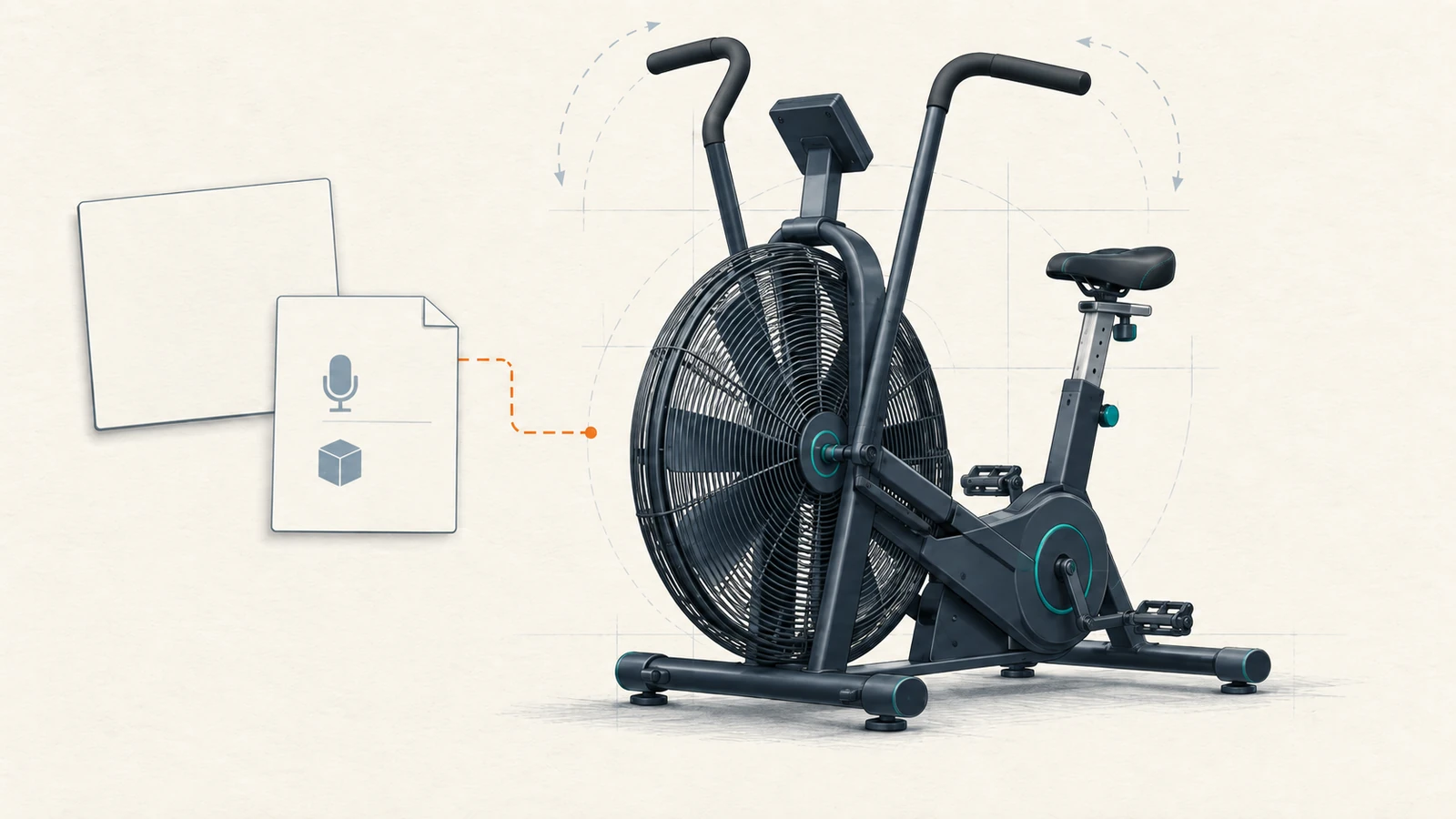
The current Schwinn AirDyne AD7 can remain on a home-cardio shortlist when a buyer has a permanent measured zone, accepts a fan-resistance bike with moving handles, and does not require a quietness verdict before direct measurement. It should not be called apartment-friendly from the product page alone.
The official U.S. product record gives a 53-by-26.5-by-53-inch product envelope, a 350-pound maximum user field, a minimum-ceiling formula of user height plus 17.6 inches, and an assembled mass listed as 113 pounds on the product page. The official comparison page lists 113.6 pounds. Neither rectangle nor weight resolves entry, arm sweep, pedal path, airflow, service access, floor response, or movement through the room.
The largest blockers are the absence of comparable sound and vibration measurements, an unapproved shared noise method, the difference between normal fan sound and possible mechanical noise, current official conflicts about drive wording and product mass, the dated promotion state, and unresolved buyer-specific delivery, return, floor, ceiling, and handling conditions.
Use the live FitFootprint space-measurement workflow and dimensions methodology to record the room, route, and field definitions. Do not use this article as a noise rating, rider-fit guarantee, structural assessment, medical recommendation, or purchase recommendation.
Key facts from current official records
| Field | Current official record | Evidence limit |
|---|---|---|
| U.S. identity | Schwinn AirDyne AD7 | Exact label, serial, production date, and hardware revision were not inspected |
| Parts identity lead | SCH AD7 (AD8i) BIKE, 2016; product code 100625 | Parts record does not prove every current retail unit has the same revision |
| Current direct listing | $999 with a crossed-out $1,299 reference field; the page showed a $300-off promotion ending September 12, 2026 | Dated listing input, not final checkout or evergreen normal price |
| Product envelope | 53 × 26.5 × 53 in | Does not include rider, moving handles, pedals, access, airflow, or service zones |
| Assembled mass | 113 lb on product page; 113.6 lb on comparison page | Official conflict; neither value proves one-person movement |
| Maximum user weight | 350 lb | Seller-stated limit, not an independent fit or safety finding |
| Minimum ceiling | User height + 17.6 in | Does not replace room-specific overhead and movement checks |
| Resistance | Infinite air resistance | Does not provide a cross-product intensity scale or noise result |
| Power | 2 D batteries; AC adapter ready | Battery inclusion, adapter inclusion, and console behavior need purchase-day verification |
| Heart rate | Telemetric support; compatible strap not included | Pairing and accuracy were not tested |
| Warranty headline | Frame 10 years; mechanical 2; electronics 2; labor 6 months | Coverage, exclusions, proof, freight, and remedy control the real outcome |
Best for and avoid if
Potential fit for further diligence: a buyer who has a permanent cardio zone, wants fan resistance and moving handles, accepts a large active-motion envelope, can tolerate unmeasured sound until a direct test is possible, and can manage a 113-to-113.6-pound machine plus delivery and return logistics.
Avoid or defer: a buyer who needs a verified quiet or low-vibration result, must move the bike after every session, has an unresolved ceiling or arm-sweep conflict, cannot retain packaging or extract the assembled bike for a return, needs a specific app ecosystem, or cannot distinguish normal fan airflow from abnormal mechanical noise.
This section routes diligence. It does not recommend the AD7.
Exact product identity and market
The checked direct product is the U.S. Schwinn AirDyne AD7 sold through Schwinn’s U.S. site. The July source snapshot for the accepted global AirDyne route recorded AD8 for 220-volt countries and AD7 for 110-volt countries. The September recheck redirected that route to the global AirDyne collection without exposing the same comparison text, so the regional relationship is retained as a qualified historical source record rather than a fresh current claim. It does not make AD7 and AD8 universally interchangeable across voltage, seller, warranty, included parts, labeling, or support. (Accepted global AirDyne route)
The official parts site has a record titled “SCH AD7 (AD8i) BIKE | 2016” with product code 100625, an owner’s manual, a service manual, parts list, and troubleshooting guides. This is a strong parts and documentation lead, not proof that a current retail unit is a 2016 revision or that record number 91080 is the retail SKU or serial. (Official AD7 parts record)
A used listing that says only “AD7,” “AD8,” or “AD8i” is not sufficiently identified for this analysis. Lock the exact label, voltage, seller market, serial or production information, included diverter, console, power arrangement, ownership history, and support eligibility.
Evidence and access
FitFootprint had no AD7, room, floor, rider, sound meter, vibration instrument, power adapter, chest strap, shipment, packaging, seller correspondence, support ticket, or checkout. The article separates:
- current official product and comparison records;
- current official shipping, return, warranty, contact, and parts routes;
- public-authority measurement guidance used only to define a future test boundary;
- unresolved official conflicts;
- direct observations that have not occurred.
No wording here means the AD7 was found quiet, loud, smooth, stable, comfortable, suitable for low-effort relocation, suitable for an apartment, or appropriate for a particular person.
Current purchase state
The current direct page displayed $999, a crossed-out $1,299 field, $300 Off + Free Shipping ending September 12, 2026, an Add to cart control, free FedEx Parcel delivery, and a $299 White Glove option. It also displayed a 48-by-36-inch equipment mat as a $99 add-on. (Current AD7 product page)
The current AD7 block on the official comparison page displayed $999, the $1,299 reference field, and $300 Off + Free Shipping; it did not show the earlier snapshot’s free-mat wording. The product page and accessories collection still list a 48-by-36-inch mat at $99, so exact checkout inclusion remains unverified and the earlier free-mat snapshot is not promoted as current. (Schwinn bike comparison)
An Add to cart control is not a completed transaction. Inventory, address acceptance, promotion eligibility, tax, financing, exact delivery selection, included mat, battery or adapter inclusion, and actual amount charged remain unverified.
Official conflicts at a glance
| Topic | Official record A | Official record B | Required treatment |
|---|---|---|---|
| Product mass | Product page: 113 lb | Comparison page: 113.6 lb | Preserve both; do not average |
| Drive wording | Product feature: single-stage direct drive | Comparison: single-stage belt drive / high-strength fan | Treat architecture wording as unresolved |
| Seat adjustment | Product feature: 4-way adjustable seat | Comparison: fore and aft adjustment | Do not claim a verified full adjustment range |
| Mat promotion | Product page and accessories collection: 48 × 36 in mat shown at $99 | Current comparison AD7 block: free shipping, with no free-mat field observed; earlier free-mat snapshot withdrawn | Recheck exact checkout inclusion |
These conflicts do not prove either source is wrong. They show why a current label, manual, checkout, and physical inspection matter.
Product envelope and complete room fit
The 53-by-26.5-inch product rectangle is about 9.75 square feet. That arithmetic describes only the published plan envelope. It excludes:
- entry and exit space;
- moving-handle sweep;
- knee, foot, pedal, and crank movement;
- seat adjustment and hand access;
- airflow in front of the fan;
- bottle and console access;
- floor mat and cord or adapter placement;
- transport-wheel tilt and turning path;
- cleaning, inspection, belt, linkage, crank, and fan service access;
- preserved doorway, household, and emergency routes.
Measure the room and delivery path with the FitFootprint measurement workflow and interpret the fields with the equipment-dimensions methodology. Product envelope is not operating clearance and is not proof of apartment fit.
Ceiling height and active motion
The product page gives a minimum-ceiling formula of user height plus 17.6 inches. For a hypothetical 72-inch user, the arithmetic result is 89.6 inches, or 7 feet 5.6 inches. This is a seller formula applied to a synthetic input—not a universal clearance rule or a verified pass.
A complete overhead check still needs the rider’s actual shoes, mounted posture, upper-body motion, moving handles, ceiling fan, light fixture, beam, sprinkler, shelf, and any platform or mat height. A seller formula cannot resolve these room-specific conditions.
Rider fit and missing inputs
The reviewed U.S. AD7 product and comparison pages publish seat adjustment descriptions and a 350-pound maximum-user field, but they did not close a rider-height or inseam range in the checked public records. A maximum user weight is not a rider-fit range.
The buyer still needs seat-height range, fore-aft range, pedal reach, handle reach, mounting ability, hand position, shoe and pedal interface, and any accessibility or clinical constraints. Those are not inferred from the product’s height or the user limit. Seek current seller clarification or qualified guidance when a claim depends on anatomy, rehabilitation, disability, pain, or medical conditions.
Air resistance and drive architecture
The official comparison page describes infinite levels of air resistance and a single-stage belt drive / high-strength fan. The product page calls the system a single-stage direct drive. (Schwinn bike comparison) (Current AD7 product page)
This package does not reconcile those terms. It records that resistance increases through fan interaction and that the source architecture wording conflicts. It does not convert “infinite” into comparable numbered levels, a power-accuracy claim, a maintenance interval, or a noise result.
Fan airflow and the included diverter
The current product page says an air diverter is included to block the rush of air generated by wheel movement. The separate official diverter page says it is designed for AD Pro and AD7 and included with the AD7 at purchase. (AirDyne air diverter)
The diverter addresses airflow direction. It is not documented here as a sound-control device, vibration treatment, cooling guarantee, safety guard, or complete enclosure. “Air diverter included” does not prove the exact unit, fasteners, or installation state at delivery.
Why no noise verdict is available
A fan bike intentionally moves air, and the accepted parts snapshot has separate troubleshooting routes for fan assembly, belt, crank, linkage, pulleys, and other noise locations. The September parts-route recheck returned HTTP 403, so that earlier record is retained as a transport-limited source snapshot rather than refreshed current support text. It establishes multiple potential sound sources, not a measured loudness value. (Accepted AD7 parts record)
No official reviewed source supplied a controlled AD7 dBA result for a defined resistance, cadence, room, distance, microphone, floor, or neighboring room. FitFootprint did not measure any of those conditions. The correct current output is:
noise_result = unknown_pending_direct_measurement
apartment_noise_suitability = not_established
Do not substitute “fan bike,” “high-strength fan,” customer reviews, or a phone recording for a comparable measurement.
Normal operating sound versus diagnostic noise
A useful owner record needs to separate repeatable fan/air sound from a new click, scrape, squeak, knock, rub, belt symptom, crank symptom, linkage symptom, or fan-cage contact. The parts catalog’s troubleshooting branches show why “the bike makes noise” is not a sufficient diagnosis. (Official AD7 parts record)
This article does not tell an owner to open guarded components or attempt a repair. Stop use when the exact manual or support process requires it, when a component appears damaged or loose, when movement is uncontrolled, or when the source of a new sound cannot be safely identified. Use the official support route rather than improvising a repair. (Schwinn contact and support)
What a useful direct noise test would require
A future FitFootprint test must lock the exact bike, revision, room, floor, mat, rider or controlled load, cadence or workload states, measurement location, microphone distance and height, background level, duration, weighting, instrument, calibration, and repeat count.
NIOSH guidance for sound-level-meter work emphasizes calibration, instrument settings, source and worker location, measurement duration, and recordkeeping. The NIOSH Sound Level Meter app is validated for iOS within stated limits; Type 2 performance requires a calibrated external microphone, and NIOSH does not represent equivalent Android validation. These occupational resources are used only for measurement discipline, not to classify AD7 home use or predict a neighbor’s experience. (NIOSH noise-measurement guidance) (NIOSH Sound Level Meter app)
At minimum, a product comparison would need the same method across all bikes. A single uncalibrated phone reading cannot support “quiet,” “loud,” “quieter than,” or apartment suitability.
Floor vibration and neighboring-room uncertainty
Airborne sound and structure-borne vibration are different evidence questions. A sound-level reading beside the bike does not determine what a downstairs neighbor, adjacent room, or lightweight floor receives.
A floor-vibration record needs floor construction, levelers, mat, bike state, rider input, measurement position, neighboring-room position, background state, and repeatable instrument or observation protocol. The product’s four levelers and optional mat do not prove isolation. Floor, structural, landlord, building, or neighbor requirements remain outside the seller footprint.
Controls, console, and power
The current pages document a multi-display LCD with time, distance, calories, RPM, watts, pulse, and speed readouts. The console power field says 2 D batteries, AC adapter ready. (Current AD7 product page)
“AC adapter ready” does not prove the adapter is included. The reviewed page did not clearly state whether D batteries are included. Do not conclude that every console function works without batteries, that external power is unnecessary, or that an adapter is compatible without exact model and voltage confirmation.
A buyer who wants no outlet near the bike should verify battery inclusion, expected battery life, replacement access, console behavior, and whether the exact intended features require any other powered device.
Heart-rate support
The official comparison says telemetric heart-rate support works with a compatible Polar 4.5–5.5 kHz chest-strap transmitter, not included. (Schwinn bike comparison)
This is a receiver-compatibility statement. It is not evidence of strap fit, sensor accuracy, successful pairing, data persistence, medical suitability, or inclusion. Add the exact strap and battery as separate objects and costs if heart-rate display is required.
App and subscription boundary
The reviewed AD7 records did not establish that an app or paid subscription is required for fan resistance or the local console. They also did not establish Peloton, Zwift, JRNY, Bluetooth FTMS, account, cloud history, data export, or automatic-control support for the AD7.
Do not copy IC4 compatibility into the AD7 because both are Schwinn bikes. A buyer who requires an app, training platform, data export, wearable, or account-free workflow needs a separate exact compatibility record.
Moving arms, pedals, and household access
The AD7 uses moving hand grips and pedals. The complete active envelope therefore extends beyond the frame. A setup record must include the rider’s arm and leg paths, mounting side, dismount route, hand-off position, nearby furniture, wall projections, children, pets, cords, bottles, and anyone crossing the room.
No generic number is invented here. Use the exact manual, room measurements, and a controlled powered-off layout rehearsal before actual use. A layout rehearsal can reveal a conflict; it cannot certify operating safety.
Transport wheels and movement burden
Transport wheels are documented. Product mass is documented as either 113 or 113.6 pounds depending on the official page. Wheels do not prove one-person control through carpet, thresholds, turns, slopes, doors, stairs, or tight storage.
A move-after-every-session plan needs the tilt state, hand positions, route width, turning radius, floor transitions, helper requirement, temporary set-down, storage orientation, and retrieval process. If those fields are unknown, the correct result is to choose a permanent zone or defer the purchase.
Mat and floor-protection boundary
The product page displays a 48-by-36-inch mat at $99; the accessories collection also lists that mat. The bike’s published length is 53 inches, so the mat’s 48-inch length is shorter than the product length. Mat area is 12 square feet, but area alone does not prove coverage or orientation. (Schwinn accessories)
A mat listing does not prove floor compatibility, vibration isolation, moisture protection, indentation resistance, static control, structural capacity, landlord permission, or adequate coverage for the exact bike and movement. Keep floor and mat questions separate.
Delivery and assembly choices
The current product page displayed FedEx Parcel: Free and White Glove: $299. White Glove includes delivery to the room of choice, one flight of stairs, unpacking, full assembly, and packaging removal; multiple flights require seller contact. (Current AD7 product page)
The general shipping page says orders leave the warehouse within five days and treats “all other products” differently from the named treadmill and elliptical freight section. Therefore, the $155 return-shipping field in the treadmill/elliptical subsection is not transferred to the AD7. (Schwinn shipping and delivery)
A buyer still needs package dimensions, package count, doorway and stair route, appointment or signature conditions, assembly location, access for installers, packaging-retention plan, and confirmation of the exact checkout delivery option.
Return logistics and packaging burden
The current return policy provides a 30-day period from delivery, requires authorization, deducts return freight in applicable cases, requires like-new condition and original packaging, and allows a restocking fee up to 20 percent. It also states that the customer must disassemble the machine and place it beyond the threshold or door for pickup. (Schwinn return policy)
At the current $999 listing field, 20 percent is $199.80. That is synthetic arithmetic illustrating potential scale, not a fee quote. Exact return freight, restocking applicability, packaging replacement, disassembly, moving, pickup, and refund outcome remain conditional or unknown.
Retain packaging until the purchase-day return window and exact policy have been reviewed. White Glove packaging removal may conflict with a buyer’s desire to retain original packaging; confirm the workflow before choosing that service.
Warranty boundary
The current headline is:
Frame: 10 years
Mechanical parts: 2 years
Electronics: 2 years
Labor: 6 months
Those periods do not state that every failure is covered or that service is free at the buyer’s location. Exact proof of purchase, original-owner requirements, household-use scope, exclusions, diagnosis, parts, labor after coverage, travel, freight, and remedy remain controlling. (Current AD7 product page)
Parts and service
The accepted parts snapshot exposed a parts list, service manual, owner’s manual, maintenance tooling, and troubleshooting routes for belt, fan assembly, pulleys, linkage, crank, pedal, speed, power, and heart-rate issues. Because the September parts route returned HTTP 403, this remains a transport-limited documentation lead; it does not prove every part is currently stocked, affordable, revision-compatible, or successfully installed. (Accepted AD7 parts record)
The official support page provides sales and in-warranty/out-of-warranty contact paths. A contact channel is not a service-time guarantee or successful repair outcome. (Schwinn contact and support)
Maintenance and abnormal-noise escalation
Before use, bind the exact current manual to the exact bike. Record required inspection, hardware checks, cleaning, belt or linkage guidance, console power, and prohibited repair work. Do not transfer a maintenance interval from AD6, AD Pro, AD8, another revision, or a third-party guide.
If a new sound, looseness, rubbing, damaged guard, unstable movement, console error, or speed-reading issue appears, stop and follow the exact manual and official support path. This article does not authorize opening the fan cage, adjusting internal drive components, or performing a repair.
Recall and regulator diligence
A checked CPSC search did not identify an exact AD7 notice in the records reviewed for this package. That search result is not a safety certificate and can become stale. (CPSC recalls)
Before purchase—especially used—verify the exact label, product code, regional variant, voltage, serial or production information, warnings, recalls, remedy status, ownership transfer, manual, and support eligibility. Do not transfer a recall from a Schwinn outdoor bicycle, another exercise machine, or an unrelated fan bike to the AD7.
Documented strengths
Within the current documentation boundary, the AD7 has:
- one current U.S. direct product route with dimensions, maximum user field, ceiling formula, power field, warranty headlines, delivery options, and an Add to cart control;
- official regional AD7/AD8 identity guidance;
- fan resistance and moving handles for the named format;
- an included air diverter according to official records;
- a local multi-display console and telemetric heart-rate receiver support;
- an official parts catalog with manuals, service material, troubleshooting categories, and named parts;
- current direct support contacts.
These are documented attributes, not performance scores.
Material burdens
The main burdens are:
- a fixed 53-by-26.5-inch frame before rider and moving-handle zones;
- a 113-versus-113.6-pound official mass conflict;
- deliberate fan airflow and no controlled sound or vibration result;
- product-page and comparison-page drive wording that does not match;
- no checked public rider-height or inseam range;
- moving arms, pedals, and a large household access envelope;
- unclear battery and AC-adapter inclusion;
- return freight, packaging, disassembly, threshold extraction, and possible restocking exposure;
- no direct evidence for fit, noise, vibration, stability, movement burden, durability, comfort, or service outcome.
Current unknown register
Material unknowns include:
- exact current hardware revision and physical label;
- exact current manual binding at the delivered unit;
- package dimensions and package count;
- complete active-motion and service envelope;
- rider-height, inseam, and reach range;
- measured sound at defined operating states;
- structure-borne vibration and neighboring-room response;
- normal fan signature for the exact unit;
- adapter and battery inclusion;
- battery life and replacement cost;
- chest-strap choice and successful connection;
- final inventory, tax, financing, promotion, and mat inclusion;
- exact return freight and service freight;
- parts availability, repair time, resale, disposal, and complete ownership cost.
Unknown does not mean zero, pass, quiet, fit, safe, or not applicable.
Buyer scenario: sound-sensitive apartment
The buyer shares walls or has a downstairs neighbor and requires a defensible sound and vibration result before purchase.
Disposition: no_purchase_or_deferOfficial fan and troubleshooting documentation does not replace a room- and floor-specific measurement. A future direct test would need the measurement controls described above.
Buyer scenario: garage or detached room
The buyer has a measured permanent zone, adequate ceiling and household route, no shared floor concern, and accepts that sound has not been independently measured.
Disposition: eligible_for_further_diligenceThe buyer still needs identity, rider fit, delivery, assembly, floor, power, return, warranty, and service checks.
Buyer scenario: low ceiling
The buyer has a 72-inch height and an 88-inch ceiling. The seller formula produces 89.6 inches before considering motion, fixtures, or mat height.
Disposition: eliminated_by_documented_constraintDo not override the seller formula with a smaller invented margin.
Buyer scenario: no outlet near the bike
The console field says two D batteries and AC-adapter ready.
Disposition: unknown_pending_evidenceVerify whether batteries are included, which functions operate on batteries, expected battery life, and whether any intended accessory requires power. “Battery capable” is not a complete no-outlet proof.
Buyer scenario: move after every session
The buyer must roll the bike through a threshold and turn into a storage alcove after every use.
Disposition: no_purchase_or_deferTransport wheels and seller mass do not prove the route or one-person control. Direct route and handling evidence are required.
Buyer scenario: no app or subscription
The buyer wants a local console and manual fan resistance without an account.
Disposition: eligible_with_named_conditionsThe checked documentation does not show a mandatory app or subscription for resistance and local metrics, but battery or adapter inclusion and the exact desired console functions still require verification.
When the AD7 remains eligible for further diligence
The AD7 can remain eligible when all required conditions are documented:
- exact U.S. AD7 identity and current manual;
- measured delivery and operating route;
- seller ceiling formula and complete moving-handle envelope pass;
- rider fit is verified without relying on an absent range;
- sound and vibration uncertainty is acceptable or direct testing is available;
- floor, household, power, delivery, return, warranty, and service plans are acceptable;
- the buyer does not require undocumented app or automatic-control functions.
This is not a recommendation.
When to defer or avoid purchase
Defer or avoid when:
- a quiet or low-vibration result is mandatory before direct evidence exists;
- identity, voltage, manual, product code, or revision is ambiguous;
- ceiling, arm sweep, pedal path, or preserved route fails;
- the bike must be moved daily without a proven handling path;
- packaging cannot be retained or the return extraction cannot be managed;
- a specific app, account, strap, adapter, or data function is required but unverified;
- the decision depends on a temporary price or free-mat state not confirmed at checkout.
“No purchase” is a valid evidence-first result.
Comparison and next-page boundary
Article 32 is an exact AD7 product analysis. It is not the compact-bike buyer guide, a fan-bike-versus-indoor-cycle comparison, a noise protocol, or a subscription-cost page. Those intents belong to the live compact exercise-bike guide, separate fan-bike comparison, report-reading methodology, and subscription-cost guides. For the live noise-evidence context, use the apartment noise and vibration guide; neither page supplies a direct AD7 test here.
For field-by-field report review, see How to Read Fitness Equipment Noise and Vibration Reports for separate sound and vibration evidence and interpretation limits; it does not provide a direct AD7 test or recommendation. The current internal next steps are the verified-live space-measurement workflow and dimensions methodology.
Recommendation boundary
The documentation supports conditional diligence, not an overall recommendation. The AD7 may fit a buyer with a permanent measured zone, acceptable fan-bike format, manageable delivery and return plan, and tolerance for unresolved sound until testing. It may fail a buyer who needs low-noise evidence, low movement burden, a smaller active envelope, a known rider range, or a closed ownership total.
Recommendation remains withheld. FitFootprint withholds “best,” “worth it,” “apartment-friendly,” “quiet,” “stable,” “comfortable,” “durable,” “low-effort relocation,” and “safe” conclusions until the relevant evidence exists.
Next step
Create a buyer record with the exact product route, seller, checked date, model label, product code, room and delivery measurements, user height and fit inputs, ceiling and fixture map, sound/vibration requirement, floor and household conditions, power plan, delivery option, packaging plan, return workflow, and unresolved conflicts.
Recheck the price, promotion, mat inclusion, shipping, tax, warranty, return terms, manuals, parts, and regulator records immediately before checkout. Save permitted transaction records.
Methodology
The Article 32 canonical transaction applies FitFootprint’s current dimension, room-fit, safety-source, product-analysis, conflict-preservation, and unknown-handling boundaries. It uses the exact accepted official Schwinn U.S. and global product, comparison, accessory, shipping, return, support, and parts routes; public NIOSH measurement guidance; the verified-live FitFootprint Articles 1, 2, 7, and 9 routes; and a CPSC recall-search route.
The accepted routes were rechecked on September 12, 2026. The AD7 direct and comparison pages showed a date-bound $999 listing and $300 Off + Free Shipping promotion; the global route redirected, the parts route returned HTTP 403, and no new claim was promoted from either transport-limited route. No direct measurement, product access, assembly, ride, movement, service, checkout, return, or regulator-remedy event occurred. Articles 1, 2, 7, and 9 are verified-live descriptive context; the shared noise method remains unassessed. This page remains documentation-only.
No conclusion here establishes exact label/serial/revision binding, a complete active-motion zone, rider fit, a direct noise/vibration result, service success, or a recommendation. Those limits remain binding through CMS and public QA.
For related decision paths, see Fan Bike vs Indoor Cycling Bike, Subscription vs No-Subscription Cardio Equipment, and Doorways, Stairs, Delivery, Assembly, and Returns.
Sources
- FitFootprint: How to Measure Your Space for Home Fitness Equipment
- Schwinn AirDyne AD7
- Schwinn Compare Bikes
- Schwinn Global AirDyne Comparison
- Schwinn AirDyne Air Diverter
- Schwinn Shipping and Delivery
- Schwinn Return Policy
- Schwinn Contact and Support
- Official AD7 Parts and Manuals Record
- Schwinn Accessories
- NIOSH: Understand Noise Exposure
- NIOSH Sound Level Meter App
- U.S. Consumer Product Safety Commission Recalls