
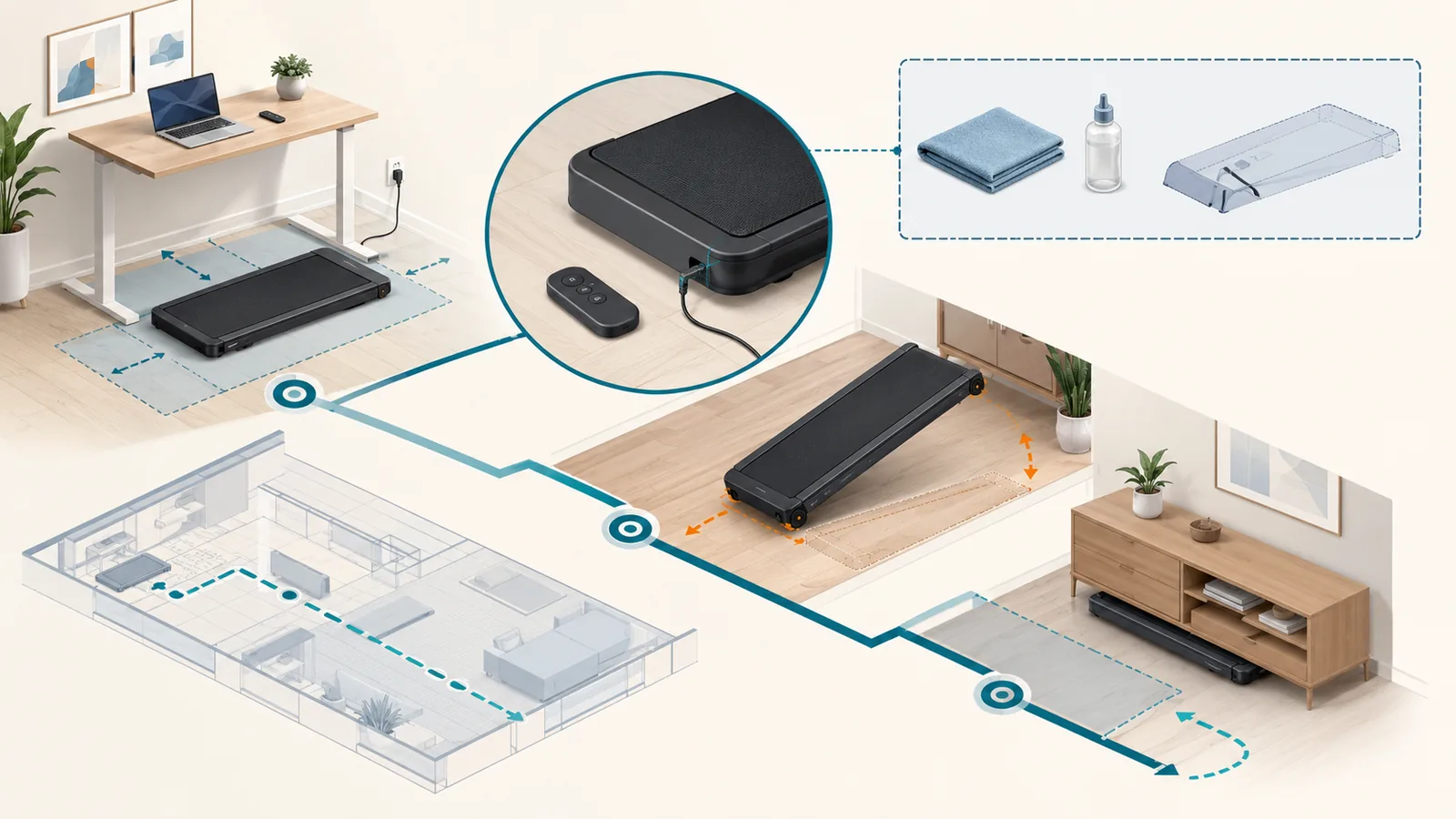
Quick answer
Do not begin with a “best walking pad” list. Begin with the exact buyer scenario, then eliminate every model that cannot document the required activity, user limit, room and route, walking area, control system, incline state, power path, maintenance plan, movement and storage workflow, and current support facts.
A foldable model is not automatically easier to live with. A short or light source-stated platform is not automatically easy to move. A higher maximum load, longer belt, incline feature, app, or quieter-sounding marketing line is not automatically better.
The correct result may be a short list, a category exit to another treadmill format, or no purchase until the missing evidence is resolved.
For cost fields beyond a product listing, use The Total Cost of Home Fitness Equipment: Beyond the Purchase Price as a separate cost framework.
Define the decision before looking at products
Article 5 starts only after the low-profile walking-platform format remains eligible. Use the treadmill-format comparison for that earlier format decision; a desk-treadmill base or an upright handrail treadmill does not belong in the same product shortlist.
Write one dated buyer record that states:
- intended use: desk walking, dedicated indoor walking, mixed use, or another defined mode;
- exact user-dependent limits named by each product source;
- real room, package route, operating area, access, retrieval, and storage route;
- desk height range, feet, crossbar, controller location, and cable path when relevant;
- required walking-area dimensions and why they matter to the scenario;
- whether incline is prohibited, optional, fixed, or required;
- whether the machine stays in place, moves occasionally, or must disappear after each session;
- who must fold, roll, lift, retrieve, align, lubricate, and service it;
- acceptable remote, app, account, FootSense, SmartControl, or desktop-console dependencies;
- outlet, voltage, cord, shutdown, and placement requirements;
- every material unknown.
Without that record, a product table can describe differences but cannot produce a defensible shortlist.
Build a current candidate universe
A candidate belongs in this canonical source universe only when its official brand site exposes an exact United States product identity and enough source-stated fields to compare the operating configuration.
The current reference set contains:
- WalkingPad A1 Pro;
- WalkingPad C2;
- WalkingPad Z1;
- UREVO SpaceWalk E1L;
- UREVO SpaceWalk 5L;
- Egofit ComfortDeck M2.
The set is intentionally bounded and non-exhaustive. It does not say these are the six best products. Marketplace-only listings, ambiguous private-label products, handrail hybrids, upright folding treadmills, and separate desk-treadmill bases are excluded from this version because they lack the required source parity or belong to another format decision.
Current source-state candidates
The table below records only fields stated on the checked official pages. It does not rank the candidates or prove that a product fits a buyer.
| Exact model | Product and walking-area dimensions | Fold-state record | Weight and stated maximum load | Speed and controls | Incline state |
|---|---|---|---|---|---|
| WalkingPad A1 Pro | Unfolded 56.5 × 21.5 × 5 in; walking area 47 × 16.5 in | Folded 32.5 × 21.5 × 5 in | 63 lb; page lists 230-lb and 300-lb options | 0.5–3.75 mph; app, FootSense, remote | None stated |
| WalkingPad C2 | Unfolded 56.9 × 20.4 × 4.9 in; walking area 47.2 × 15.7 in | Folded 32.5 × 20.4 × 5.4 in | 55 lb; 220 lb stated | 1–4 mph; app, FootSense, remote | None stated |
| WalkingPad Z1 | Unfolded 56.1 × 22 × 4.1 in; walking area 47.6 × 15.7 in | Folded 31.8 × 22 × 5.4 in | 51 lb; 242 lb stated | 1–4 mph; app, remote | None stated |
| UREVO SpaceWalk E1L | Product 42.1 × 19.3 × 4.2 in; running area 35.43 × 15 in | No folded dimensions stated on checked page | 36.59 lb; 265 lb stated | 0.6–4 mph; app and remote | None stated |
| UREVO SpaceWalk 5L | Product 48.8 × 20.3 × 6.1 in; running area 39.4 × 15.8 in | No folded dimensions stated on checked page | 50.7 lb; 400 lb stated | 0.6–4 mph; app and LED SmartControl | 0–9% automatic |
| Egofit ComfortDeck M2 | Product 41.5 × 22.8 × 7 in; walking area 36.2 × 17.7 in | No folded dimensions stated on checked page | 51.36 lb; 245 lb stated | 0.62–3.1 mph; desktop console | Fixed 3% |
The A1 Pro row contains a material variant issue: the checked page lists both 230-lb and 300-lb options. Bind the exact ordered option before using a limit.
The absence of folded dimensions for the E1L, 5L, or M2 does not prove that storage is impossible. It means the checked source does not supply a fold-state record, so the buyer must solve the full-length movement and storage workflow or obtain exact additional instructions.
Apply inclusion and exclusion rules
Include a candidate only when all of the following are true:
- The exact model, variant, market, and official source are resolved.
- The primary operating state is a low-profile walking platform.
- Product dimensions, walking area, source-stated maximum load, speed, and control information are available.
- Missing fold, move, storage, manual, support, or power fields remain visible.
- The product can be compared without marketplace-only specifications.
- Monetization and retailer access did not determine eligibility.
Exclude or hold a candidate when:
- the exact identity is ambiguous;
- the source has been removed or materially changed;
- a handrail or desk-base system changes the format;
- the product survives only through a generic category number;
- a required controller, desk, cord, route, storage, or maintenance input is missing;
- the buyer needs a noise, handling, health, or safety conclusion that the evidence cannot support.
Use one fixed shortlist criteria set
Apply the same criteria to every exact model.
| Criterion | Required record | Prohibited shortcut |
|---|---|---|
| Identity | Exact model, option, market, source, and checked date | Treating a family or marketplace title as the ordered product |
| Intended mode | Exact source-supported operating mode | Assuming every “walking pad” supports the same use |
| User limit | Exact source-stated maximum for the ordered option | Inventing a buffer or treating capacity as a quality score |
| Space and route | Package, room, route, operating, access, retrieval, and storage records | Using product footprint as the whole room requirement |
| Walking area | Exact component length and width | Turning belt size into a comfort, gait, or medical conclusion |
| Fold and storage | Fold instructions, moved state, route, stored orientation, and retrieval | Treating folded dimensions as storage permission |
| Handling | Weight, handles, wheels, orientation, turns, thresholds, and responsible person | Treating wheels or “lightweight” wording as easy movement |
| Controls | Remote, app, FootSense, SmartControl, console, account, display, and stop method | Assuming fewer controls is simpler |
| Incline | None, fixed, manual, or automatic, with full height and control effects | Treating incline as a universal benefit |
| Power | Voltage, outlet, cord, shutdown, and placement instructions | Assuming any nearby outlet is suitable |
| Ownership | Manual, lubrication, alignment, cleaning, service, app, and replacement dependencies | Ignoring tasks because the product arrives assembled |
| Evidence | Sources, dates, conflicts, and missing fields | Averaging conflicts or converting unknown to pass |
Compare preferences only after a candidate survives every relevant must-have.
Eliminate before comparing preferences
Apply hard constraints in this order:
- exact identity and current official source;
- Article 4 format eligibility;
- intended mode and source-stated user limit;
- package, room, route, operating, access, and retrieval;
- desk and controller system;
- fold, movement, storage, and handling;
- incline and full-height consequence;
- power and cord placement;
- maintenance, support, service, and purchase-day terms;
- evidence completeness and conflicts.
Only surviving candidates may be compared by color, display preference, app interest, or other optional features.
Scenario path: fold away after every session
Start with the whole storage workflow:
- operating position;
- shutdown and fold instructions;
- moved orientation;
- handles, wheels, latches, and support points;
- real route to the storage location;
- stored orientation and support condition;
- retrieval clearance;
- controller, cord, app device, and accessory location;
- person responsible for every reset.
The A1 Pro, C2, and Z1 pages state folded and unfolded dimensions. Those facts justify keeping them in a fold-state comparison. They do not prove that the folded unit clears a real bed, sofa, closet, doorway, turn, threshold, or lifting task.
The E1L, 5L, and M2 pages in this snapshot do not provide folded dimensions. They may remain eligible for an in-place or verified full-length storage scenario, but not through an invented fold state.
Scenario path: leave the platform in place
A non-folding or non-fold-documented platform may avoid a repeated fold/reset step, but it consumes its full envelope while stored in place.
Verify:
- desk and furniture geometry;
- walking and access area;
- controller or console location;
- outlet and cord path;
- chair transition;
- cleaning and maintenance access;
- whether the machine blocks circulation, doors, or another room use;
- whether the platform must still move for service or emergencies.
The E1L page states a 36.59-lb weight, which is lower than the other candidates in this snapshot. That comparison does not establish easy or safe movement. Real route, grip, wheel, posture, threshold, and responsible-person inputs still control the handling decision.
Scenario path: incline is required
Incline changes more than exercise intensity. It can change platform height, desk geometry, controls, power, and the user’s position relative to furniture.
The checked SpaceWalk 5L page states 0–9% automatic incline. The checked ComfortDeck M2 page states a fixed 3% incline. The other four checked pages do not state incline in the retained specification blocks.
Do not treat fixed and automatic incline as interchangeable. Do not use calorie, health, joint, or suitability marketing as shortlist evidence. Record the exact incline mechanism, height, controller, desk consequence, and operating instructions.
Scenario path: desk walking and controls
A walking pad is only one part of a desk-walking setup.
Verify:
- desk height after platform step-up;
- desk feet, crossbar, chair, monitor arm, and cable conflicts;
- controller or console placement;
- app, account, network, phone, watch, or Bluetooth dependency;
- the exact start, stop, speed-change, and emergency workflow;
- whether the display remains visible;
- where the remote, cord, and device are stored;
- the operating mode allowed by the exact source.
The WalkingPad pages list app and remote control, with FootSense on A1 Pro and C2. The UREVO pages list app plus remote on the E1L or LED SmartControl on the 5L. The Egofit M2 page presents a desktop console. These are different dependencies, not a quality ranking.
Complete purchase diligence
Before ordering, recheck the exact official page and current instructions. Then record:
- exact model, option, seller relationship, and US voltage;
- package and delivery route;
- assembly and first-use instructions;
- operating, fold, move, storage, and retrieval states;
- controller, app, account, connection, and stop behavior;
- lubrication, belt alignment, cleaning, maintenance, and reset tasks;
- current support, parts, service, shipping, return, warranty, and financing terms;
- exact-model search on the CPSC Recalls route;
- backup plan when a remote, controller, app, account, or service channel is unavailable.
A missing recall search result is not a safety certification. A current sale or in-stock badge is not a durable property of the product.
When no walking pad qualifies
Choose no purchase or defer, or leave the walking-pad category, when:
- the buyer needs running or an upright support configuration;
- no candidate satisfies the real room, route, desk, control, or storage workflow;
- the exact user limit or variant is unresolved;
- the intended mode is outside the exact source;
- a required app, remote, console, account, power, or maintenance dependency is unacceptable;
- noise or vibration is a decisive constraint but comparable evidence is unavailable; use the Apartment Noise and Vibration guide to record the source, path, receiver, event, and unresolved evidence before treating the shortlist as viable;
- the buyer cannot perform the required movement, retrieval, or upkeep;
- purchase-day support or policy terms are unacceptable;
- material source conflicts remain.
The guide should never force a product merely because six candidates were documented.
Handle missing or conflicting information
Keep every source record separate. Compare exact model, variant, market, state, object, axes, unit, date, and rounding before deciding whether two values describe the same thing.
Do not:
- average conflicting specifications;
- choose the smaller value to make a fit pass;
- choose the larger capacity to keep a candidate;
- replace missing clearance, storage, or route data with a generic number;
- convert marketing words such as “quiet,” “portable,” “compact,” “safe,” “comfortable,” or “apartment-friendly” into verified results;
- treat wheels as a handling conclusion;
- treat folded dimensions as stored-state permission;
- treat an app or safety feature as a site-specific safety conclusion.
Name the missing field and the exact shortlist conclusion it blocks.
Next step
Save one dated record for every surviving candidate and one reason for every elimination. Recheck volatile purchase terms only when a canonical shortlist is ready for a real purchase decision.
For a desk-walking scenario, continue to the standing-desk setup workflow to map desk states, controls, cable paths, and reset or storage constraints before treating any candidate as workable.
For the separate fold, movement-route, handler, stored-orientation, and retrieval record, use the treadmill and walking-pad fold–move–store workflow. It is a documentation route, not permission to move an exact unit.
For app, account, device, Apple Watch, Apple Health, control, and data-direction checks, use the WalkingPad app and KS Fit compatibility guide. It is documentation-only and does not replace an exact pairing and feature test.
Article 4 is now the live format-selection bridge. Articles 11–12 are live qualified exact-model analyses. For the separate WalkingPad alternatives guide, use the non-WalkingPad exit route only after recording why the WalkingPad lane no longer solves the buyer’s stated problem. For the separate user-limit, walking-area, and source-operator screen, use the walking-pad user-size and stated-limits guide. Before building the candidate record, use the room-and-route measurement workflow and the equipment-dimension interpretation method to keep local constraints separate from source-stated product fields.
Methodology
This guide uses FitFootprint’s reviewed dimension, room-fit, and safety-source-routing concepts as internal method inputs. It defines a current official-source candidate universe, applies fixed eligibility criteria, preserves source-state distinctions, withholds volatile and unsupported claims, and retains no-purchase/defer.
No listed product was tested. This page records the current intent and candidate-universe search, preserves source-state distinctions, withholds volatile and unsupported claims, and retains a no-purchase or defer path. It remains a documentation-only guide rather than a product recommendation.
Sources
- WalkingPad — WalkingPad A1 Pro Foldable Under Desk Treadmill — official United States product page checked August 1, 2026.
- WalkingPad — WalkingPad C2 Foldable Walking Treadmill — official United States product page checked August 1, 2026.
- WalkingPad — WalkingPad Z1 Folding Under Desk Treadmill — official United States product page checked August 1, 2026.
- UREVO — SpaceWalk E1L Smart Walking Pad — official United States product page and manual route checked August 1, 2026.
- UREVO — SpaceWalk 5L Smart Walking Pad — official United States product page and manual route checked August 1, 2026.
- Egofit — ComfortDeck M2 Walking Pad — official product page checked August 1, 2026.
- National Institute of Standards and Technology — NIST Guide to the SI, Appendix B: Conversion Factors — checked August 1, 2026.
- U.S. Consumer Product Safety Commission — Recalls & Product Safety Warnings — purchase-diligence route checked August 1, 2026.