
Quick answer
There is no universal substitute for a WalkingPad. The useful question is why you are leaving the WalkingPad lane. A buyer may need a different control system, no app dependency, automatic incline, a desktop console, a wider belt, a higher source-stated user limit, a different daily-use model, or a valid decision to leave the walking-pad category. Each need points to a different exact source-state record and creates a different room, desk, route, handling, power, maintenance, and support burden.
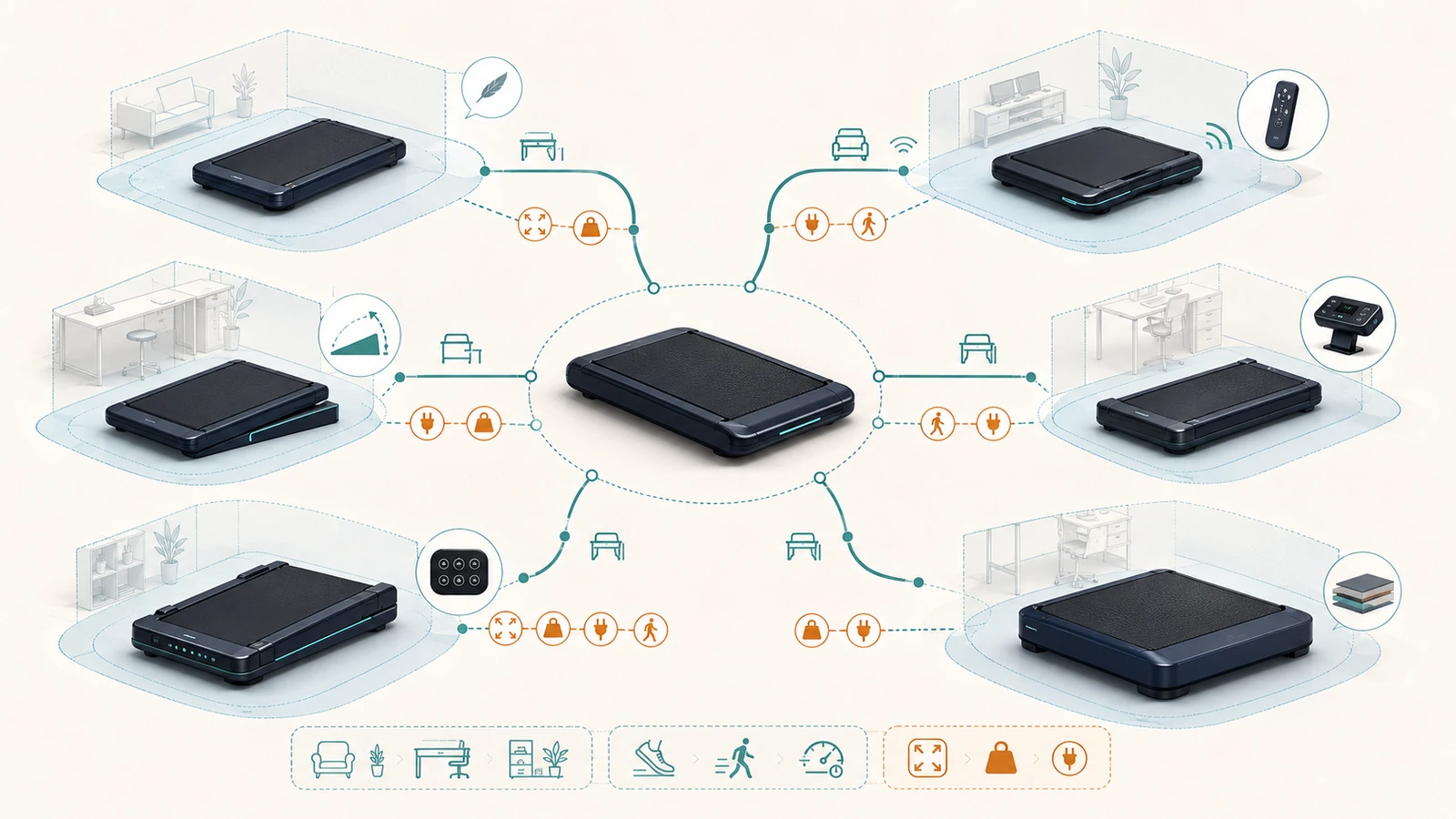
The current official-source sample contains five retained non-WalkingPad records: UREVO SpaceWalk E1L, UREVO SpaceWalk 3S, Egofit ComfortDeck M2, Sunny Pacer at the accepted SF-T722069 route, and LifeSpan TX6-GlowUp. The former Strol U1 route is retained only as an identity-drift record because it redirected to SpaceWalk 3S. The records are not ranked. A model remains only eligible for scenario comparison when its exact identity, route, operating envelope, stated limits, controls, support path, and purchase-day facts are complete enough for the buyer’s own constraints. If a must-have fails or a material unknown cannot be resolved, the valid result is no purchase or defer.
The controlled outcomes are eligible_for_scenario_comparison, eligible_with_named_conditions, eliminated_by_named_must_have, unknown_pending_evidence, no_purchase_or_defer, and category_exit. They describe the state of a documented verification path, not a product ranking.
Scope and standalone-page gate
The current candidate universe is a non-exhaustive source-state sample, not a complete market census. Article 5’s live page supplies the WalkingPad-category discovery boundary, while Article 20 owns the non-WalkingPad exit question. This guide keeps a standalone-page qualification visible: it has distinct exit intent, but the sample is not a complete market census and does not replace a general WalkingPad shortlist.
The accepted Strol U1 route was rechecked on September 5, 2026 and redirected to the SpaceWalk 3S page without Strol U1 identity. Its former U1 claims are withdrawn rather than copied to 3S. This guide preserves that correction and the five retained records; the public page remains a qualified evidence record rather than a complete market census.
Why look beyond WalkingPad?
A brand-exit page is useful only when it answers a decision that the general walking-pad buyer guide does not already own. This page is for a buyer who has accepted the low-profile walking-platform use case but needs a non-WalkingPad path because one or more of these conditions matters:
- a different control system or no app dependency;
- fixed or automatic incline;
- a wider source-stated belt or different speed range;
- a different source-stated user limit;
- a lighter or heavier-duty platform;
- a different maintenance, electrical, support, or daily-use model;
- a current safety warning or identity concern that removes a candidate;
- a valid decision to leave the walking-pad category entirely.
This page does not establish that another brand is better. It maps exact source-state differences so the buyer can identify which records deserve deeper verification. For the boundary between low-profile formats and other treadmill configurations, see the walking-pad, under-desk, and folding-treadmill format comparison. Exact WalkingPad context remains separate in the A1 Pro analysis, C2 analysis, and A1 Pro versus C2 comparison.
Current non-WalkingPad candidate universe
A candidate entered this exact sample only when an official US-facing manufacturer page exposed an identifiable current model and enough fields to discuss the same small-space decision: product envelope, walking surface, source-stated user limit, speed range, controls, and incline state. The retained records are:
- UREVO SpaceWalk E1L — flat, app-and-remote source-state example with the lowest source-stated product weight in this sample;
- UREVO SpaceWalk 3S — automatic-incline example with app and remote;
- Egofit ComfortDeck M2 — fixed-incline example with a desktop console;
- Sunny Pacer at the accepted SF-T722069 route — automatic-incline example with SunnyFit, remote control, and a source-stated minimum user weight;
- LifeSpan TX6-GlowUp — a wider, heavier under-desk treadmill base with a distinct daily-use and electrical profile.
The set includes multiple equipment and control patterns, but it does not prove that every relevant US alternative was found. Missing models are not rejected for quality, and included models are not endorsed. The accepted Strol U1 route remains a withdrawn identity record, not a sixth candidate.
Inclusion and exclusion rules
A model is included only when:
- the exact product has a current official manufacturer page available to the US market;
- the primary operating configuration is a low-profile walking platform or under-desk treadmill base without a permanently required upright console;
- the official page exposes enough comparable source-state fields;
- the model is not included because of commission, retailer access, review count, or a desired winner;
- no current reviewed regulator warning instructs consumers to stop using that exact model;
- current price, temporary promotion, stock, shipping, returns, and warranty are treated as volatile purchase-day facts rather than ranking inputs.
The following are excluded from this candidate universe:
- WalkingPad or KingSmith-branded products, because this page is the brand-exit lane;
- handrail hybrids and upright folding treadmills covered by the format comparison;
- marketplace-only, seller-only, private-label, or model-ambiguous listings;
- near-duplicate models added only to make the list longer;
- any exact model under a current stop-use warning;
- models selected because an affiliate program exists.
Non-affiliate eligibility and commercial boundary
Every candidate is eligible or ineligible on the same evidence rules regardless of commercial relationship. This guide contains no affiliate, merchant, paid, tracked, or product-recommendation link. No commission, approval status, payout, retailer relationship, review count, or sale price feeds the candidate set or scenario routing.
If a future commercial link is added, it must follow a separately verified program record, current destination, truthful disclosure, and the repository’s commercial-link rules. Commercial availability cannot repair missing fit, safety, identity, support, or evidence.
Source-state comparison table
The table below preserves exact source labels and current documentary limits. Product envelope is not an operating-clearance or storage result. Walking surface is not a comfort, stride, or medical-fit result. Maximum user weight is a seller-stated limit, not independent certification.
| Exact candidate | Product envelope | Source-stated walking surface | Product weight | Source-stated user limit | Speed | Incline | Controls |
|---|---|---|---|---|---|---|---|
| UREVO SpaceWalk E1L | 42.1 × 19.3 × 4.2 in | 35.43 × 15 in | 36.59 lb | 265 lb | 0.6–4.0 mph | None stated | UREVO app and remote |
| UREVO SpaceWalk 3S | 51.6 × 22.1 × 6.5 in | 42.5 × 16.54 in | 56.65 lb | 265 lb | 0.6–4.0 mph | 0–9% automatic | UREVO app and remote |
| Egofit ComfortDeck M2 | 41.5 × 22.8 × 7 in | 36.2 × 17.7 in | 51.36 lb | 245 lb | 0.62–3.1 mph | Fixed 3% | Desktop console |
| Sunny Pacer at SF-T722069 route | 58.2 × 24.9 × 5.9 in | 45.7 × 16 in | 69.5 lb | 99–265 lb | 0.5–3.7 mph | Six automatic levels; 1.67°–3.81° stated | SunnyFit app, Bluetooth, remote, emergency-stop brake |
| LifeSpan TX6-GlowUp | 60 × 28 × 5.8 in | 20 × 48 in belt | 98.5 lb | 400 lb | 0.4–6.0 mph | Not available | Remote and LED display |
The table does not produce a winner. The lighter and shorter examples generally expose smaller walking surfaces or different controls, while the wider and higher-capacity example creates a larger route, handling, electrical, and ownership burden. The buyer must apply the real room and use-case constraints before any preference comparison.
UREVO SpaceWalk E1L: lighter and shorter source-state example
The SpaceWalk E1L page states a 42.1 × 19.3 × 4.2-inch product envelope, a 35.43 × 15-inch running area, 36.59-pound product weight, 265-pound maximum load, 0.6–4.0 mph speed range, app support, remote control, and no incline. The page also lists a power cord, lubricating oil, remote with built-in coin battery, and user manual.
That makes the E1L a useful source-state path when lower product weight or a shorter envelope is the buyer’s reason for leaving WalkingPad. It does not prove the unit can be lifted, rolled over a threshold, stored under the buyer’s furniture, used comfortably, or controlled reliably. No folded dimensions or approved storage orientation were retained from the specification block. Marketing language about easy movement, quietness, comfort, safety, and joint protection is withheld.
UREVO Strol U1: accepted route withdrawn after current recheck
The accepted Strol U1 URL now redirects to the SpaceWalk 3S page. The current destination displays SpaceWalk 3S identity and does not establish a current Strol U1 page. Therefore the former U1 no-app, remote, speed, dimensions, weight, and limit claims are withdrawn from this current candidate set.
This is an identity and transport correction, not a finding that Strol U1 is unavailable, unsafe, or inferior. No substitute U1 route was searched for in this transaction. A future U1 record needs a new exact official route and a new review; the SpaceWalk 3S record cannot be reused as U1 evidence.
UREVO SpaceWalk 3S: automatic-incline source-state example
The SpaceWalk 3S page states a 51.6 × 22.1 × 6.5-inch product envelope, 42.5 × 16.54-inch running area, 56.65-pound product weight, 265-pound maximum load, 0.6–4.0 mph speed range, app support, remote control, and 0–9% automatic incline.
Automatic incline creates a different buyer problem. The buyer must verify the maximum deck height, desk range, step-on and step-off geometry, cable path, controller access, and whether incline is appropriate for the intended under-desk task. A 6.5-inch source-stated product height is not the complete height at maximum incline. The seller’s calorie, joint, quietness, stability, running, and easy-storage language is not retained as independent evidence.
Egofit ComfortDeck M2: fixed-incline and desktop-console source-state example
The ComfortDeck M2 page states a 41.5 × 22.8 × 7-inch product envelope, 36.2 × 17.7-inch walking area, 51.36-pound net weight, 245-pound maximum user weight, 0.62–3.1 mph speed range, fixed 3% incline, transport wheels, full assembly, and a desktop console that starts, stops, and adjusts speed.
This is the fixed-incline and desk-console branch. It may matter to a buyer who wants controls visible on the desktop rather than app dependence. It also creates a 7-inch source-stated step-up and fixed geometry that cannot be reduced to flat. The buyer must verify desk height, console cable routing, console placement, route, and storage. Product-page statements about noise, cushioning, joint impact, calories, portability, comfort, and user height are withheld.
Sunny Pacer at the SF-T722069 route: broader feature set with more route burden
The accepted Sunny route displays Pacer identity while its URL carries the SF-T722069 slug. It states a 58.2 × 24.9 × 5.9-inch product envelope, 45.7 × 16-inch running surface, 69.5-pound product weight, 0.5–3.7 mph speed range, six automatic incline levels, SunnyFit app support, Bluetooth, remote control, transportation wheels, and an emergency-stop brake. It also states a 99-pound minimum and 265-pound maximum user weight.
The page-label and URL qualification means the exact SKU binding must be rechecked before a purchase decision. The minimum user weight remains an exact source-stated constraint and must not be dropped. The product is larger and heavier than several records, so its feature set does not remove route or handling diligence. The public page’s dynamic purchase block exposes both sold out and add to cart template states, so current stock is unresolved and excluded from this durable article.
LifeSpan TX6-GlowUp: wider, heavier, dedicated under-desk base
The LifeSpan TX6-GlowUp page states a 20 × 48-inch belt, 60 × 28 × 5.8-inch product envelope, 98.5-pound product weight, 400-pound maximum user weight, 0.4–6.0 mph speed range, remote control, LED display, two front transport wheels, and seven-hour recommended daily use. It also specifies a 115V NEMA 5-15 non-GFI circuit requirement.
This is an adjacent higher-mass under-desk treadmill-base path, not a lightweight fold-away substitute. The wider belt and higher stated load may keep it in consideration for one scenario, while the 98.5-pound mass, larger route, exact electrical requirement, and storage burden may eliminate it in another. A 6.0 mph source-stated maximum does not by itself authorize running without the exact instructions, control, and support configuration.
Space, route, and storage differences
A product envelope is only one layer. For every candidate, record:
shipping_package
complete_delivery_path
assembly_area
powered_off_product_envelope
operating_and_access_zone
step_on_and_step_off_zone
desk_base_and_height_geometry
power_and_control_cable_path
movement_orientation
manufacturer_documented_handholds_or_wheels
stored_orientation
retrieval_and_reopening_path
handler_count_or_unknown
The current pages do not provide one comparable folded-state field for all five retained records. Wheels are stated for several products, but wheels do not prove easy movement, one-person handling, threshold suitability, stair movement, or approved vertical storage. A record that fits while operating may still fail the return route or daily reset path.
Control, app, and account differences
The retained records expose materially different control paths:
- E1L and SpaceWalk 3S: app plus remote;
- Egofit M2: desktop console;
- Sunny Pacer route: SunnyFit app, Bluetooth, remote, and emergency-stop brake;
- LifeSpan TX6: remote and LED display.
These are documentary control records, not observed behavior. App present does not establish account-free use, offline behavior, background reliability, subscription permanence, data export, or physical fallback. Remote present does not prove the remote is charged, paired, reachable, or an emergency-stop device. Desktop console does not prove the cable reaches the buyer’s desk without creating a hazard.
Incline and desk-height consequences
Incline is not a simple upgrade:
- E1L and TX6 state no incline;
- Egofit M2 states a fixed 3% incline;
- SpaceWalk 3S states 0–9% automatic incline;
- Sunny Pacer states six automatic incline levels and a source-stated deck-to-floor range.
A buyer who requires flat operation should eliminate a fixed-incline record. A buyer who requires adjustable incline should eliminate records with none and must still verify the exact maximum height and desk geometry of the automatic-incline survivors. Do not infer ergonomic, medical, calorie, or safety benefits from incline.
Walking-area and stated-limit differences
The source-state walking surfaces range from 35.43 × 15 inches for E1L to a 20 × 48-inch belt for TX6. The largest number does not automatically mean better fit. Surface labels, axes, side rails, step-up height, control position, and intended mode differ.
The source-stated user limits also differ. Sunny Pacer uniquely states both a minimum and maximum user weight. LifeSpan states the highest maximum in this sample. These are seller-stated limits attached to exact records, not independently certified safety thresholds. Do not invent a percentage buffer or transfer a limit to a related model.
Source conflicts and unknowns
Material unresolved items include:
- the Strol U1 accepted route redirect and resulting identity withdrawal;
- Sunny’s displayed Pacer identity versus the
SF-T722069URL slug; - Sunny Pacer’s dynamic stock template exposing both sold-out and add-to-cart states;
- LifeSpan’s marketing description of about 5 inches high versus its 5.8-inch technical dimension;
- non-comparable labels such as
running area,walking area, andbelt size; - missing comparable folded-state and storage-orientation records;
- exact manual revision, hardware revision, and model-label binding;
- app, account, offline, subscription, data, and fallback behavior;
- measured noise, vibration, stability, comfort, durability, and movement effort;
- current seller, price, tax, shipping, returns, warranty, parts, and service outcomes.
Unknown remains unknown. Do not average conflicts, restore the withdrawn U1 claims, or select the favorable value.
Excluded candidates and exact safety warnings
The CPSC April 16, 2026 Sperax warning instructs consumers to stop using affected Sperax Pro, Q1, RM-01, and RM-02 walking pads and treadmills because of fall, burn, and fire hazards. Those exact models are excluded from this candidate universe. This is not a finding about every Sperax product or every walking pad.
Every purchase-day review should also check the CPSC recall database using the exact model and, where relevant, serial or date range. No search result is a safety certificate. If a current stop-use warning, unresolved recall, missing identity, or unavailable remedy applies, the result is eliminated by a named must-have or no purchase or defer.
Scenario: avoid an app dependency
Buyer constraint:
app_or_account_required = unacceptable
physical_or_remote_or_desktop_control_required = yes
room_route_storage = not yet supplied
The M2 page describes a desktop-console path and keeps it eligible with named conditions for this documentary scenario. It does not pass route, storage, stop-control, cable, support, or reliability checks. The former U1 path is not used because its accepted URL now redirects to SpaceWalk 3S and does not establish U1 identity. E1L and SpaceWalk 3S remain unknown until app-free physical fallback is verified.
No product is recommended from this scenario alone.
Scenario: require adjustable incline
Buyer constraint:
adjustable_incline = required
flat_only_or_fixed_incline = reject
under_desk_geometry = must still pass
SpaceWalk 3S and the Sunny Pacer route remain eligible for scenario comparison because their pages state automatic incline. E1L, Egofit M2, and TX6 do not state adjustable incline in the retained records. The two survivors still lack one normalized maximum-height, desk-clearance, control, route, and tested-use record. The correct output is not a winner; it is a two-record verification queue.
Scenario: require a wider belt and higher stated load
Buyer constraint:
minimum_source_stated_belt_width = 18 in
minimum_source_stated_user_limit = 300 lb
route_and_electrical_burden = unresolved
Only the TX6 source-state record clears both numeric gates in this five-record sample. It remains eligible with named conditions because its 98.5-pound mass, 60 × 28-inch envelope, exact circuit requirement, desk geometry, storage path, and purchase terms are unresolved. Passing two source-stated fields does not make it suitable or safe.
Scenario: move the unit after every session
Buyer constraint:
must_move_after_each_session = yes
lifting_not_available = yes
thresholds_or_rugs_in_route = unknown
approved_storage_orientation = unknown
E1L has the lowest source-stated product weight in the sample and its page states transport wheels. That is not enough to pass. Wheel diameter, threshold behavior, approved grip, turning envelope, stored orientation, retrieval effort, and handler requirement remain unknown. The valid result is unknown pending evidence, and no purchase or defer remains available.
A heavier product with larger wheels could be easier on one flat route than a lighter product with poor wheel geometry. Product weight alone cannot decide the movement workflow.
When no current alternative fits
Use no purchase or defer when:
- every candidate fails a declared must-have;
- exact identity or current instructions cannot be resolved;
- room, desk, route, power, control, storage, or retrieval inputs are missing;
- a current warning or recall blocks the exact model;
- app-free, account-free, incline, belt, load, or handling requirements remain unsupported;
- the buyer cannot accept the remaining ownership and service unknowns.
Use category exit when the buyer needs a handrail, true running configuration, different equipment category, or a complete desk-treadmill system outside this low-profile candidate scope. Neither outcome is a failed article. Avoiding a mismatched purchase is a valid result.
Recommendation boundary
This guide does not name a recommended alternative. A future recommendation requires:
- an intentionally current and defensible candidate universe;
- exact model, market, manual, and availability verification;
- same-scope normalized fields;
- buyer scenarios fixed before evaluating products;
- evidence-parity disclosure;
- current safety and policy review;
- non-affiliate eligibility;
- a documented comparison review against these criteria;
- visible limitations and a no-purchase path.
Until those gates pass for a public recommendation, the strongest supported output is a scenario-specific verification queue.
Purchase-day recheck
Before ordering any surviving candidate, recheck:
- exact model, variant, color, hardware revision, and seller;
- current manual and included controls;
- current price separated from temporary promotion;
- stock and actual checkout state;
- shipping, delivery, package, tax, and return-freight exposure;
- warranty, labor, parts, service, and support route;
- app/account/subscription/fallback state;
- exact power instructions;
- current recall and warning results;
- representative media permission for any future page use.
A source-state alternative can become stale without changing its product name.
Next step
Write the buyer’s must-haves and reject conditions first. Then apply them to the exact current model records. Do not compare preferences until hard constraints, material unknowns, and current warnings are resolved. Keep a dated record of every source and the reason each candidate survived, failed, or remained unknown.
Methodology
This guide used the live Article 5 candidate/method boundary as a discovery lead and rechecked the exact nine accepted public routes on September 5, 2026 without source expansion. Five official product records remain in the current sample; the accepted Strol U1 route redirected to SpaceWalk 3S and its former U1 claims were withdrawn. The CPSC warning and recall database supplied the exact regulator boundary. Unit conversions, where needed, follow the NIST conversion reference.
No marketplace listing, affiliate page, copied review, forum, social post, user rating, or commission influenced inclusion. Marketing claims about quietness, health, joint protection, calories, comfort, stability, easy movement, durability, safety, productivity, or value were withheld. Conflicts remain separate, unknowns remain unknown, and no physical observation occurred.
For a cross-category format comparison, see the Compact Rower vs Exercise Bike vs Walking Pad for a Small Room.
Sources
- UREVO — SpaceWalk E1L official US product page — exact source-state identity and specifications — checked September 5, 2026.
- UREVO — Strol U1 accepted route — route/identity-drift record; it redirected to the SpaceWalk 3S page on September 5, 2026.
- UREVO — SpaceWalk 3S official US product page — exact source-state identity, automatic incline, controls, and specifications — checked September 5, 2026.
- Egofit — ComfortDeck M2 official product page — exact source-state identity, fixed incline, desktop console, and specifications — checked September 5, 2026.
- Sunny Health & Fitness — Pacer at the accepted SF-T722069 route — Pacer page identity, automatic incline, controls, stated limits, and specifications — checked September 5, 2026.
- LifeSpan — TX6-GlowUp official product page — exact source-state identity, belt, daily-use, electrical, handling, and warranty fields — checked September 5, 2026.
- U.S. Consumer Product Safety Commission — Sperax walking-pad and treadmill warning — exact affected models and stop-use action — warning dated April 16, 2026; checked September 5, 2026.
- U.S. Consumer Product Safety Commission — Recalls — exact-model purchase-day recall diligence — checked September 5, 2026.
- NIST — Guide to the SI, Appendix B — unit-conversion method only — checked September 5, 2026.