
Quick answer
A useful report-reading record answers four questions without rewriting the source:
- What exact document, object, configuration, and revision are being reviewed?
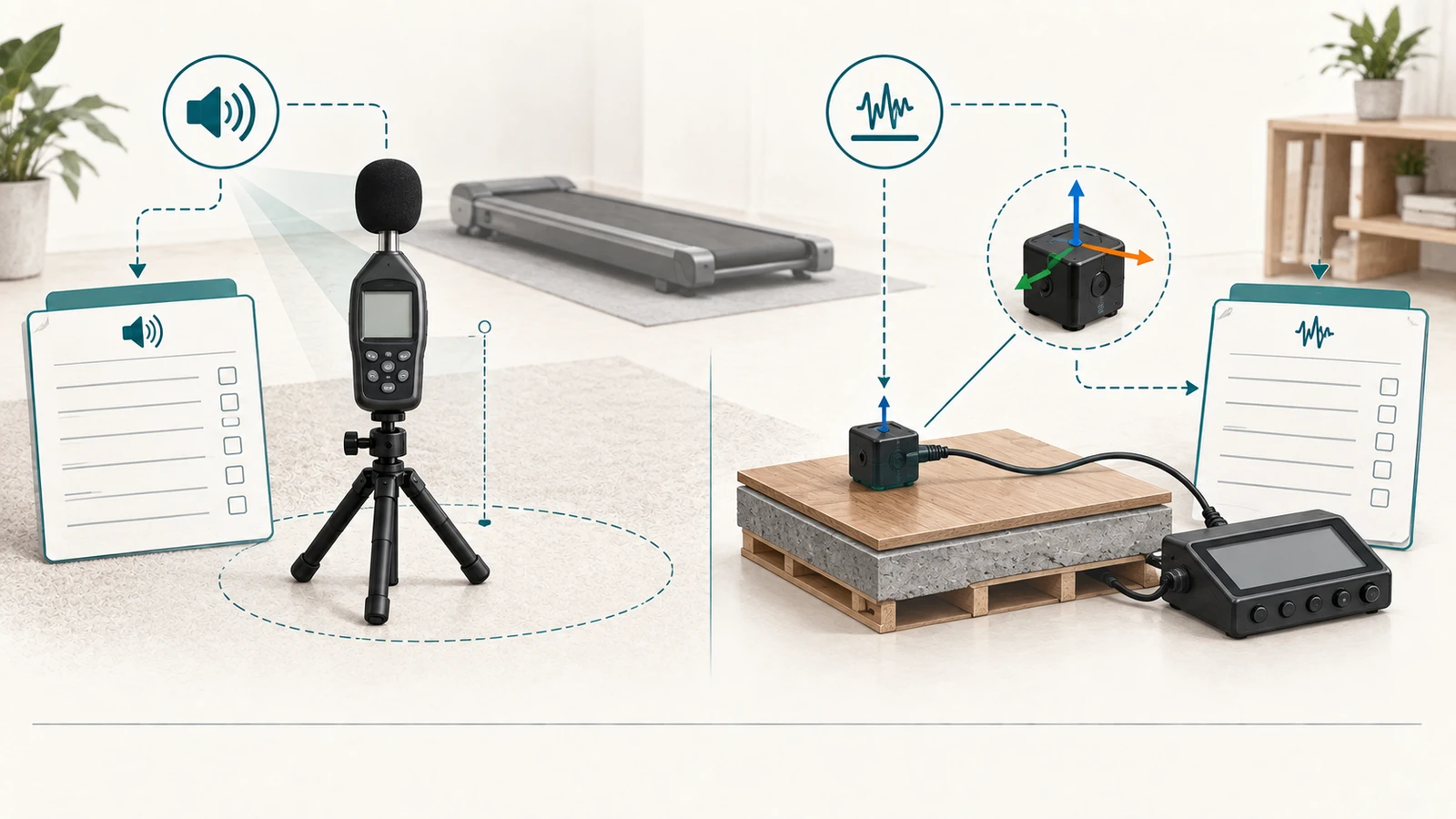
- Which evidence lane is present: sound, vibration, or both?
- What quantity, unit, instrument, position, condition, and traceability does each reported value have?
- Which fields are missing or conflicting, and what interpretation must stop?
The safest output is a field-by-field record with the source wording preserved. A sound number cannot fill an absent vibration lane. A report that lists every review field can be document-complete for the stated question while physical accuracy, actual execution, comparability, and residential acceptability remain unverified.
Scope and limitations
This page explains how to inspect a report before using it as one input to an equipment decision. It does not run a test, prescribe an operating sequence, produce a measured benchmark, or rank products.
The method covers:
- document identity, revision, date, authoring organization, and named object or configuration;
- separate sound and vibration evidence lanes;
- reported quantity, unit, weighting or filter, time basis, position, and stated precision or uncertainty;
- instrument, microphone or sensor, settings, and stated calibration or verification;
- equipment state, room, floor, mat, mounting, operating condition, receiver context, and source traceability;
- missing, conflicting, transport-limited, and out-of-scope fields; and
- the narrowest interpretation supported by the document.
It does not establish a universal home-fitness or neighbour threshold. Occupational guidance and standards metadata can explain why a field matters, but they do not decide whether equipment is quiet, safe, suitable for an apartment, acceptable to a neighbour, structurally suitable, legally compliant, or worth buying.
1. Purpose and version
This is Article 48, documentary report-reading methodology v02. Its output is a review record for one report or a clearly identified set of reports. The record states what the document says, under which declared conditions, what is absent or inconsistent, and which interpretations must stop.
The version boundary matters. A material change to a source, definition, required field, fictional-case expectation, downstream boundary, or interpretation rule requires a new reviewed version. Do not silently edit a frozen review or merge this method with the earlier unshipped measurement-protocol candidate.
2. Record the review output
Start with a compact record before interpreting any number. The following fields are the minimum review surface.
| Field group | What to record | If the field is absent or conflicts |
|---|---|---|
| Document identity | Title, report ID, revision/date, authoring organization, named equipment or object, variant and state | Keep identity unresolved; do not merge documents |
| Evidence lane | Sound, vibration, or both | Keep lanes separate; an absent lane stays unknown |
| Quantity | Metric, unit, weighting/filter, peak/average/dose or other stated quantity, duration, position, precision or uncertainty | Retain the number as reported; block any interpretation that needs the missing field |
| Instrument | Meter or analyzer, microphone/sensor, class or model, settings, calibration/verification statement and date | Record the omission; do not infer instrument quality |
| Configuration | Equipment state, operating condition, room/floor/mat, mounting, position and receiver context | Treat changed conditions as a separate configuration |
| Data trace | Source page/file, table or figure, report date/revision, raw/reduced-data statement and exclusions | Keep the value qualified and the traceability gap visible |
| Interpretation | Allowed documentary description, unknowns, stop condition and next owner | Never convert an unknown into a pass or recommendation |
The record should preserve source units and wording. Normalizing or rounding a number must not erase the original value, condition, or source location.
3. Keep sound and vibration as separate lanes
Sound and vibration are related topics, but they are not interchangeable evidence. A sound record describes the declared sound quantity and conditions. A vibration record describes the declared vibration quantity, sensor, mounting, orientation, and conditions. One lane cannot supply the other.
| Lane | Fields to keep together | What the review may say | What it must not say |
|---|---|---|---|
| Sound | Metric and unit, weighting/filter, time basis, microphone/meter, position, room or reflecting condition, equipment state and duration | The report states a sound value under the named conditions, if those fields are traceable | That the equipment is universally quiet or acceptable at home |
| Vibration | Quantity and unit, frequency/band or filter, accelerometer/sensor, mounting/orientation, floor or structure context, equipment state and duration | The report states a vibration value or context under the named conditions, if those fields are traceable | That absent sound evidence or a sound value describes vibration |
| Both | Separate sound and vibration records with their own sources and conditions | The document contains two declared lanes that can be reviewed separately | That the lanes are automatically comparable or complete for a residential decision |
The distinction also applies to standards context. A sound-power document and a specified-position emission sound-pressure document answer different documentary questions. A building-vibration reference is not a home-fitness acceptance limit. Keep the named method, quantity, position, frequency context, and conditions attached to the value instead of replacing them with a broad label such as “noise level” or “vibration result.”
4. Review sequence
Use the same sequence for each document or report set.
4.1 Freeze identity and source location
Record the title, report ID, revision or date, authoring organization, named equipment, variant, state, and the exact page, table, figure, or file location. If two documents name the equipment differently, preserve both identities until the difference is resolved.
4.2 Split the evidence lanes
Mark the document as sound, vibration, both, or lane-missing. Do not infer a missing lane from a related number. A sound report with no vibration section remains lane-missing for vibration.
4.3 Copy quantities without rewriting them
Record each value with its unit, metric name, weighting or filter, peak/average/dose or other time basis, duration, position, and stated precision or uncertainty. Keep the original source wording beside any reader-friendly description.
4.4 Attach instrument and configuration fields
Place the meter, analyzer, microphone, sensor, class/model, settings, calibration or verification statement, equipment state, room, floor, mat, mounting, position, operating condition, and receiver context next to the quantity they qualify. A number separated from those fields is not silently promoted to a comparable result.
4.5 Trace the material fields
Record the source page or file, report revision/date, table or figure, method name if stated, raw or reduced-data status, exclusions, and any transport limitation affecting the review. A standards publication page can identify a document and its scope; it is not automatically the full standard or a conformance certificate.
4.6 Compare only declared like-with-like conditions
Comparison is a separate decision from transcription. First check exact identity, lane, quantity, units, position, and material conditions. Different rooms, floors, mats, mounting, operating states, or receiver positions remain different configurations. Do not attribute a difference solely to the equipment when the declared conditions changed.
4.7 Classify the record
Use one or more of these labels and preserve the reason:
document-complete-for-review: required documentary fields for the stated question are present and traceable; this is not proof of accuracy or execution.incomplete: a field needed for the stated interpretation is missing.conflicted: material sources or configurations disagree and no approved reconciliation exists.lane-missing: sound or vibration is not documented, so the other lane cannot fill it.transport-limited: an accepted route could not be rechecked through the current access path; no substitute is silently introduced.outside-scope: the document does not answer the proposed question.
4.8 Write the narrowest interpretation
Describe only the field, condition, and limitation the document supports. Add a stop or defer outcome when a required field is absent or conditions differ. Do not turn completeness into a product verdict.
4.9 Record the correction trigger
Note what would require a new review: changed source, report revision, definition, configuration, case expectation, downstream use, interpretation rule, or material limitation. A factual transcription correction can stay within the current review only when the original record and correction reason remain traceable.
5. Preserve quantities, instruments, and conditions
Sound fields
Keep the named metric, unit, frequency or time weighting, time basis, duration, position, and room or reflecting condition together. The accepted sound-meter references distinguish time-weighted, integrating-averaging, and integrating instruments and identify Class 1 and Class 2 categories. That context helps a reader check which fields a report declares; it is not a FitFootprint conformance or accuracy finding.
The accepted NIOSH app route is iOS-specific and states that Android accuracy cannot currently be verified. A report that names an app or phone should therefore retain the platform, microphone or external-microphone setup, settings, and calibration statement. It should not be rewritten as cross-platform or Android-equivalent evidence.
Vibration fields
Keep the named quantity and unit, band or filter, frequency context, sensor, mounting, orientation, cable or attachment state when stated, floor or structure context, operating state, and duration together. Vibration-instrument and mounting references explain why sensor identity and mounting belong beside the value; they do not mean that FitFootprint performed or verified a calibration.
Method and context fields
Sound-power and specified-position sound-pressure documents should remain labeled by their own declared questions. Building-vibration context should remain separate from a household acceptance decision. Calibration or verification statements should be copied with their date and source, not converted into a claim that the complete test conforms to a standard.
Occupational noise guidance is also context, not a universal home-fitness limit. No number in this page should be read as a pass/fail threshold for a room, neighbour, lease, building, health, or legal question.
6. Four fictional review cases
| Case | Fictional input | Review output | Narrow interpretation |
|---|---|---|---|
| CASE-01 | One sound number is listed, but metric/weighting and duration are absent | incomplete |
Retain the number as reported; identify the missing fields and stop any interpretation that needs them |
| CASE-02 | The same named equipment appears in two records with different rooms and mats | conflicted |
Keep the configurations separate; do not attribute the difference solely to equipment |
| CASE-03 | A sound report has declared fields but no vibration lane | lane-missing |
Vibration remains unknown; sound cannot supply it |
| CASE-04 | A report states identity, lane, quantity, instrument, configuration, position, date, and traceability | document-complete-for-review |
Documentary fields are complete for the stated review; physical accuracy, execution, and residential acceptability remain unverified |
These cases test the review record, not a measurement method. Their expected labels are deliberately narrower than “pass,” “tested,” “quiet,” or “safe.”
7. Missing, conflicting, and transport-limited fields
Missing is not zero, typical, favorable, or equivalent. If a report omits duration, weighting, sensor identity, mounting, room, floor, mat, position, or source location, retain the number but block the interpretation that depends on the omission.
Conflicts must remain visible. If two records give different quantities, units, equipment states, rooms, mats, or positions, preserve both values and identify the identity, revision, condition, or source that needs reconciliation. Do not average conflicting fields into a third value that neither document supplied.
A transport-limited source is a limitation of the current access path, not proof that the source is false or unavailable to readers. The accepted OSHA route was transport-limited in the current recheck; no replacement source or new claim was added. The same rule applies to any later route that cannot be checked: record the limitation and do not silently substitute another source.
If only one lane is complete, keep the other lane explicitly unknown. If a document cannot answer the proposed question, label it outside-scope rather than stretching a related field into an answer.
8. What this review cannot prove
Even a document-complete record does not prove:
- that the equipment was operated as described;
- that a meter, microphone, sensor, calibrator, or mounting was accurate or compliant;
- that two reports are comparable when their identity, method, position, room, floor, mat, or operating conditions differ;
- that equipment is quiet, safe, apartment-friendly, neighbour-acceptable, structurally suitable, or suitable for a particular building;
- a health, medical, legal, lease, code, electrical, accessibility, or compliance conclusion;
- a product ranking, value judgment, purchase recommendation, or benchmark; or
- a validated noise method or measured input for Article 50.
Those questions need their own accepted evidence and gates. Permission to publish this documentary method does not convert the withheld conclusions into results.
Next step
Use the label and stop condition to decide what evidence is still needed:
- name the missing or conflicting field;
- identify the source or responsible party that can resolve it;
- preserve the response date and report revision;
- rerun only the affected documentary comparison; and
- keep the unresolved branch visible when the evidence cannot be obtained.
For broad buyer screening, return to Apartment Noise and Vibration: How to Evaluate Fitness Equipment Before Buying. For exact product context, inspect the Schwinn AirDyne AD7 analysis. For category context, use Fan Bike vs Indoor Cycling Bike for a Small Home or Compact Rower vs Bike vs Walking Pad. Equipment dimensions explained remains the related internal method for preserving object, state, unit, and provenance fields.
These links provide context only. Their own evidence, fit, safety, comparison, cost, and recommendation gates remain separate. The eight-product documentary evidence audit shows how missing report fields limit noise-related conclusions; it supplies no validated measurement input or product-noise ranking.
10. Methodology
This v02 method was reviewed against the accepted source boundary for documentary report reading. It keeps sound and vibration separate, retains source-specific quantities and conditions, classifies missing and conflicting fields, and uses four explicitly fictional document fixtures. The review is designed to make a report’s limits visible, not to recreate a test or certify a result.
The accepted source set includes public-authority guidance, official standards metadata, calibration and instrumentation context, and the existing FitFootprint dimensions method. Standards metadata is used for scope and field meaning only; it is not the full standard and does not establish conformance. The latest route review also records transport limitations where access could not be rechecked.
11. Corrections and change log
This is the first documentary v02 release for this title. The former v01-bound measurement candidate remains separate historical input and is not silently converted into this method. A later material change to the source set, report fields, fictional cases, interpretation labels, downstream boundary, or prohibited conclusions requires a new reviewed version. A transcription correction must retain the original value and its correction reason.
Sources
The following accepted routes are the complete source boundary for this review. A route limitation is stated where relevant; no replacement source was added.
- CDC/NIOSH: Understand Noise Exposure – occupational sound context and field discipline; not a residential threshold.
- CDC/NIOSH: Sound Level Meter App – iOS-specific app and stated platform limitation; not Android parity.
- OSHA Technical Manual, Section III, Chapter 5 – accepted route; transport-limited in the latest recheck, so no new claim is drawn from it.
- IEC 61672-1:2013 – sound-meter categories and time/integration context from publication metadata.
- ISO 3744:2025 – sound-power scope from official publication metadata.
- ISO 11201:2010 – specified-position emission sound-pressure scope from official publication metadata.
- ISO 11200:2014 – machinery emission sound-pressure guidance from official publication metadata.
- ISO 8041-1:2017 – general-purpose vibration-meter instrumentation context.
- ISO 16063-21:2003 – comparison calibration context for vibration/shock transducers.
- ISO 2631-2:2026 – building-vibration context; not a household acceptance result.
- NIST: Vibration Calibration of Accelerometers – calibration context; no FitFootprint calibration was performed.
- NIST: SI unit for acceleration – accepted unit reference; current route fetch was unavailable during recheck, so no new wording is added.
- FitFootprint: Equipment dimensions explained – existing internal object/state/provenance context; not a noise or vibration source.
- IEC 60942:2017 – sound-calibrator publication metadata.
- IEC 61260-1:2014 – octave and fractional-octave filter publication metadata.
- ISO 5348:2021 – mechanical mounting of accelerometers publication metadata.