
Main finding
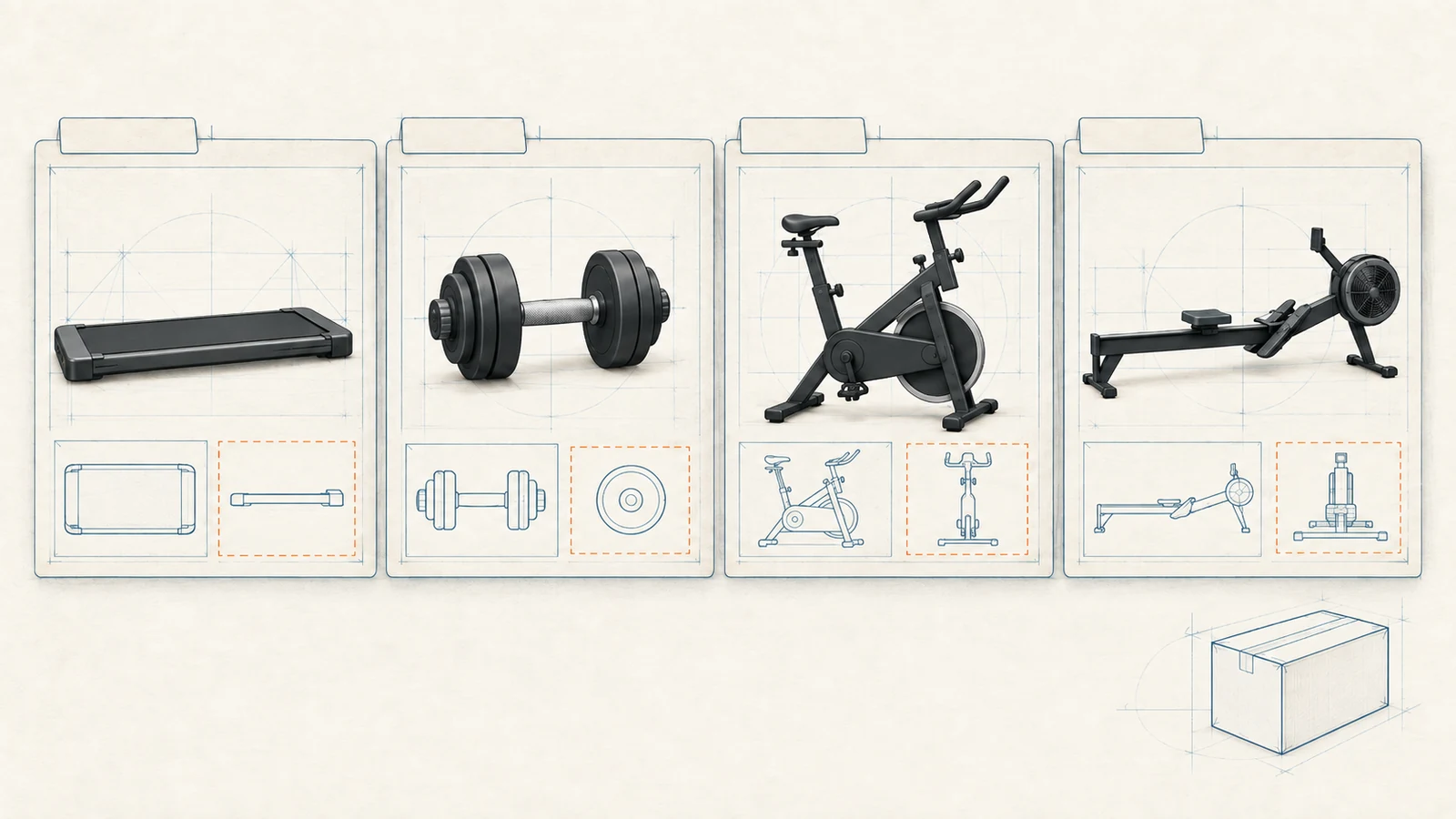
The central finding of fitfootprint-footprint-database-v0.1.0 is that “dimensions” is not one reusable field. Across 14 current United States product entities, the database contains 41 state-bound records: shipping packages, assembled or unfolded products, components, folded states, stored states, access clearances, and user-dependent formulas. Thirty-one records are documented numeric, formula, or conditional inputs; four are explicit conflict records; six are explicit unknowns.
Coverage is uneven. Only four products in this sample publish a shipping-package envelope on the checked route. Seven have a numeric folded or stored record, but C2’s folded records conflict and Concept2’s storage sequence lacks published axis labels. Two current adjustable-dumbbell pages publish one-dumbbell dimensions but not a complete pair-and-storage-system footprint. Only two products in the sample provide a dedicated access or installation-zone record broad enough to add more than a static product rectangle.
The useful output is therefore not a smallest-product ranking. It is a provenance-complete record that tells a buyer or downstream tool exactly which object and state a number describes—and which required state is still missing.
Coverage and dataset version
dataset version: fitfootprint-footprint-database-v0.1.0
market: United States
checked date: July 28, 2026
products: 14
dimension/state records: 41
documented or conditional records: 31
explicit conflicted records: 4
explicit unknown records: 6
selection: explicit, bounded, and non-exhaustive
ranking or score: prohibited
hands-on measurements: none
public export: not provided; source-attributed records are presented in this article only
Changing a product, variant, market, source scope, state label, axis meaning, or material value requires a new dataset version or a versioned correction. The versioned records are a dated snapshot, not a live API or an automatic Article 46 integration.
What this database contains
The database contains:
- an exact product entity with brand, market, category, and scope;
- a stable product ID and dimension-record ID;
- the physical object being described;
- the product state or access state;
- the orientation and axis meaning;
- the source value and source unit;
- normalized inches when a numeric conversion is supported;
- source ID, source class, URL, and checked date;
- an evidence state;
- conditions, missing reasons, and limitations; and
- a correction key that can identify one record without rewriting the entire dataset.
What this database does not contain
The database does not contain:
- a product ranking, footprint score, compactness score, or market census;
- buyer-specific room, doorway, stair, elevator, desk, outlet, or storage measurements;
- invented clearances, generic safety margins, or inferred package orientations;
- structural, electrical, accessibility, medical, legal, installation, handling, or safety approval;
- direct measurements or observations;
- delivery-route maneuverability;
- price, warranty, return, noise, durability, comfort, or recommendation fields; or
- automatic prefills for the room-fit calculator.
A smaller numeric rectangle does not establish a better product, easier delivery, safer handling, or better fit.
Inclusion criteria
A product enters version 0.1.0 only when:
- the current United States product or listing scope is sufficiently identifiable;
- the source is official and current enough for a dated record;
- at least one material dimension state is published;
- the record can preserve object, state, axes, orientation, units, and limitations;
- the product adds a distinct category or state-coverage example; and
- inclusion was not determined by affiliate availability, review count, popularity, price, or a desired conclusion.
Exclusion criteria
This version excludes:
- product families without an exact current record;
- marketplace, retailer-only, affiliate, forum, copied-review, and social-post measurements;
- dimensions borrowed from another region or model when the United States scope is unresolved;
- derived pair or system rectangles created by arranging components by assumption;
- marketing area claims when full source dimensions are available but do not reconcile to the claimed area;
- nominal category labels such as “folding bike” without an exact product; and
- any record that would require replacing an unknown with zero or a guessed value.
Exact product sample
The frozen sample is:
- WalkingPad A1 Pro;
- WalkingPad C2;
- UREVO SpaceWalk E1L;
- BowFlex Results Series 552, SKU ZMK4011008;
- PowerBlock Pro 50;
- FLYBIRD WP129;
- REP AB-4100;
- Schwinn IC4;
- Schwinn AirDyne AD7;
- XTERRA FB180;
- Sunny SF-B223011;
- Concept2 RowErg with standard legs;
- WalkingPad WR20; and
- Tonal 2.
This is an explicit, bounded, and non-exhaustive sample. It is designed to test dimension-state coverage across multiple equipment architectures, not to represent the entire market.
Source hierarchy
Use sources in this order:
- exact current official product page or manual for the stated market;
- exact official support, installation, or product-guide page;
- an official seller route that embeds the exact product specification;
- public-authority method sources for conversions and evidence boundaries; and
- no unsupported substitution from another model, generation, market, seller, or category.
Every record in version 0.1.0 has at least one source ID. An unknown record still cites the checked source that failed to publish the needed state.
Record schema
| Field | Meaning | What it cannot prove |
|---|---|---|
| Product ID | Stable exact entity within this dataset version | Universal model-family identity |
| Record ID | Stable state-bound record | That every other state is covered |
| Object | Package, product, component, access zone, or formula subject | Complete system by implication |
| State | Shipping, assembled, component, folded, stored, access, or user-dependent | Interchangeability with another state |
| Orientation | Source-defined axis order and configuration | Permission to rotate or store differently |
| Source value | Value exactly as published | Fit or measurement by FitFootprint |
| Normalized inches | Reproducible conversion when supported | Added source precision |
| Evidence state | Documented, conditional, unknown, conflicted, excluded, or not applicable | Quality, safety, or recommendation |
| Limitation | What the record cannot establish | A removable warning label |
Dimension-state taxonomy
Version 0.1.0 uses these states:
- Shipping package: the outside envelope of one identified package.
- Assembled: the product envelope in an identified setup, flat, unfolded, or assembled configuration.
- Component: one dumbbell, running area, wall unit, or other explicitly bounded sub-object.
- Folded: the envelope in a seller-labeled folded configuration.
- Stored: an explicitly labeled storage state; numeric values are not inferred from a fold claim.
- Access clearance: a documented use, installation, wall, floor, ceiling, or placement requirement.
- User-dependent: a formula whose result changes with an entered user value.
These states follow the project’s reviewed dimension method and must remain distinct.
Object identity and scope
A record must answer “what object?” before it answers “how large?”
For BowFlex and PowerBlock, the current official values describe one dumbbell, not the sold pair plus storage and adjustment access. For Tonal, the device envelope is separate from the wall span, active floor zone, ceiling guidance, and outlet-distance rule. For Concept2, the shipping box, assembled recommendation, clearance-for-use rectangle, and separated storage state are four different objects or states.
A database row that omits object scope is not reusable.
Axes, units, and orientation
The database preserves source axis order and labels. When an official source publishes only a number sequence without L/W/H labels, as Concept2 does for shipping and separated storage, the sequence is retained without assigning axes. The database does not assume that the first number may be rotated into any doorway, under-bed cavity, wall zone, or shipping orientation.
United States public display uses inches and feet first. Metric values may be shown second when useful. NIST defines one inch as exactly 2.54 centimeters; conversion does not justify more display precision than the source supports. (NIST Appendix B.8)
Evidence states
Every material record uses one of these meanings:
- Documented current input: exact current official source and scope recorded.
- Documented with named conditions: a formula or requirement applies only under stated conditions.
- Unknown: the field applies, but the checked source does not resolve it.
- Conflicted: exact official records differ materially.
- Not applicable: the field genuinely cannot occur for the record, with a reason.
- Excluded: the value was intentionally omitted because its scope would distort the dataset.
Unknown is not zero, not a pass, and not evidence that the state does not exist.
Missing-data policy
Missing data remain visible at both product and record level. The database does not:
- set a missing axis to zero;
- double one component dimension to create a pair footprint;
- copy a carton from another market;
- treat folded as stored;
- replace a missing clearance with a generic margin;
- use a marketing adjective such as compact as a dimension; or
- interpret “upright storage” as a numeric stored envelope.
A downstream consumer must display the missing value and name the decision it blocks.
Conflict policy
When current official sources conflict:
- preserve both records;
- verify exact model, variant, market, revision, state, axis, orientation, and checked date;
- identify whether one source is seller-specific or conditional;
- do not average the values;
- do not choose the value that makes a product appear smaller; and
- block the affected comparison or prefill until the conflict is resolved or explicitly qualified.
Version 0.1.0 excludes cross-market A1 Pro and C2 values, but it preserves a current within-market C2 conflict between the standalone U.S. route and a current U.S. bundle route. Four C2 records carry conflict ID CF47-001; no downstream comparison or prefill may choose one set by convenience.
Normalization and conversions
Normalization supports comparison of the same axis and state; it does not create evidence parity.
centimeters = inches × 2.54
millimeters = inches × 25.4
feet = inches ÷ 12
The JSON retains the source value and unit. Normalized inches are a convenience field. Formula records, unknowns, and partial-axis records remain formula, unknown, or partial rather than being forced into a complete three-axis rectangle.
Product dimensions are not room fit
The room-measurement guide separates room envelope, obstacles, delivery route, assembly, operating space, access, movement, storage, power, and preserved routes. Article 47 supplies none of the buyer’s local values.
product rectangle
!=
room-fit verdict
Even a provenance-complete product record can support only the state and axes it actually describes.
Folded is not stored
A folded record proves only the source-labeled folded envelope. It does not prove:
- long-term storage orientation;
- support points or lock state;
- whether water, batteries, or attachments may remain in place;
- insertion and retrieval clearance;
- one-person handling;
- child, pet, moisture, or traffic suitability; or
- that the product fits under a bed or beside a wall.
FLYBIRD explicitly publishes a stowed state. REP documents upright storage for the AB-4100 but does not publish a complete numeric stored envelope in the checked guide; that numeric record remains unknown.
Component dimensions are not system dimensions
The BowFlex Results Series 552 and PowerBlock Pro 50 records demonstrate the component boundary.
one dumbbell
!=
pair plus trays, stacks, selectors, hands, and re-racking path
The database does not double length or width, choose a gap, or arrange the pair. Those complete-system records remain unknown until an exact source or reviewed measurement supports them.
Access clearance is not product footprint
Concept2 publishes a separate clearance-for-use recommendation. Tonal publishes a wall span, active floor zone, ceiling guidance, and outlet-distance condition in addition to the device envelope.
These access records are not added to the device rectangle as if they were the same object. They answer different questions and retain their own orientation, conditions, and limitations.
Package dimensions and delivery route
Four sample products have documented package records on the checked route: A1 Pro, C2, Sunny SF-B223011, and Concept2 RowErg standard legs. UREVO E1L, IC4, and AD7 have explicit unknown package records because their checked product pages did not publish the needed carton envelope.
A package rectangle is still only a screen. It does not prove permitted orientation, turn geometry, stairs, elevator movement, center-of-mass control, flexible packaging, or safe handling.
User-dependent and formula records
IC4 and AirDyne AD7 each publish a minimum-ceiling relationship based on user height, but the current official formulas are not the same:
IC4 minimum ceiling height = user height + 20 inches
AirDyne AD7 minimum ceiling height = user height + 17.6 inches
The database keeps the formulas as separate product-bound records. It does not convert either formula into one fixed ceiling value. A buyer must supply a current user input and still consider posture, footwear, moving parts, fans, lights, beams, sprinklers, and other overhead constraints.
Cross-sample coverage finding
The sample shows why a database must publish coverage as well as values:
- 14 product entities;
- 41 state-bound records;
- 31 documented or conditional records;
- 4 explicit conflicted records;
- 6 explicit unknown records;
- 4 products with a documented shipping-package record;
- 7 products with a numeric folded or stored record; and
- 4 products with a documented access-clearance or user-dependent record family.
These counts describe version 0.1.0 only. They are not market statistics.
Shipping-package coverage
Package coverage is strongest where the seller explicitly separates carton and product states. A1 Pro, C2, Sunny SF-B223011, and Concept2 RowErg do so in the checked sources. The database does not infer package values for products that publish only assembled dimensions.
Package count also remains tied to exact configuration. Concept2 standard legs ship in one box; tall legs use a different multi-box configuration and are outside the frozen product scope.
Operational-state coverage
Most products publish an assembled, setup, unfolded, or component envelope. Those labels are preserved instead of being upgraded to “operating clearance.”
Schwinn IC4 and AD7 dimensions are assembled product dimensions. WalkingPad A1 Pro, C2, and WR20 publish unfolded sizes. XTERRA and Sunny publish setup/product dimensions. None of those labels automatically includes user movement, entry/exit, adjustment, power, desk, service, or household-route needs.
Folded and stored-state coverage
Numeric folded or stored records exist for A1 Pro, C2, FLYBIRD WP129, XTERRA FB180, Sunny SF-B223011, Concept2 RowErg, and WalkingPad WR20. C2’s two folded records conflict, and Concept2’s storage numbers remain a source-order sequence rather than an axis-bound envelope.
The records still differ:
- A1 Pro, C2, XTERRA, Sunny, and WR20 are labeled folded;
- FLYBIRD publishes stowed dimensions; and
- Concept2 publishes a separated storage sequence without explicit L/W/H labels.
The database does not treat these architectures as equivalent.
Access-clearance coverage
Concept2 and Tonal are the clearest examples of access or installation-zone records in this sample. Concept2 publishes a clearance-for-use rectangle. Tonal separates device dimensions from wall, floor, ceiling, and outlet requirements.
IC4 and AD7 add user-dependent ceiling formulas. Other products still need buyer-supplied access and route information or exact documentation before a complete room decision is possible.
WalkingPad A1 Pro records
The current U.S. A1 Pro route publishes:
shipping package: 35 × 24 × 7 in
unfolded product: 56.5 × 21.5 × 5 in
folded product: 32.5 × 21.5 × 5 in
The listing shows more than one weight-capacity option, while the dimension block is shared. Version 0.1.0 binds the dimensions to the current direct listing and does not claim option-specific geometry. (WalkingPad A1 Pro)
WalkingPad C2 records
Two current official United States routes agree on the shipping package but conflict on the unfolded and folded product envelopes:
shipping package on both routes: 35 × 23 × 7 in

standalone U.S. route:
unfolded product: 56.9 × 20.4 × 4.9 in
folded product: 32.5 × 20.4 × 5.4 in

current U.S. bundle route:
unfolded product: 57 × 20 × 5 in
folded product: 32 × 20 × 5.5 in
Version 0.1.0 keeps all four product-state values as conflicted records under CF47-001. It does not average them, choose the smaller values, or expose either set as an Article 46 prefill. Cross-market C2 dimensions remain excluded. (WalkingPad C2 standalone U.S. route, WalkingPad C2 bundle route)
UREVO SpaceWalk E1L records
The current U.S. E1L route publishes:
product: 42.1 × 19.3 × 4.2 in
running area: 35.43 × 15 in
The running area is a component record, not the product envelope. Shipping-package, folded, stored, and access-clearance values remain unknown in the checked scope. (UREVO SpaceWalk E1L)
BowFlex Results Series 552 records
The exact current SKU ZMK4011008 page publishes:
one dumbbell: 16.9 × 8.3 × 9 inThe complete pair-plus-trays envelope is not published in the checked record. Version 0.1.0 therefore contains one documented component record and one explicit unknown system-storage record. (BowFlex Results Series 552)
PowerBlock Pro 50 records
The current U.S. Pro 50 page publishes:
one dumbbell: 13 × 7 × 7.25 inThe complete pair/stack layout and selector-access envelope remain unknown. The database does not infer them from one-dumbbell dimensions. (PowerBlock Pro 50)
FLYBIRD WP129 records
The official indexed WP129 record provides:
assembled/flat: 42.3 × 15.1 × 16.5 in
stowed: 31.5 × 12.6 × 11.8 in
The accepted direct product route returned HTTP 404 after redirect during the 2026-09-20 source-status recheck. The dated values below therefore remain conditional historical records and are not current availability, fit, or public-prefill inputs. The seller-labeled stowed record also does not establish the fold path, lock state, under-bed insertion route, or every operating angle. (FLYBIRD WP129)
REP AB-4100 records
The current REP bench guide publishes:
assembled bench: 51.3 × 20.3 × 17 inIt also documents a built-in upright storage post. The checked source does not publish a complete numeric upright-stored envelope, so the stored record remains unknown rather than being calculated from the assembled dimensions. (REP Bench Guide)
Schwinn IC4 records
The current U.S. IC4 page publishes:
assembled bike: 54.6 × 30.7 × 51.8 in
minimum ceiling: user height + 20 in
The formula remains user-dependent. Shipping-package and complete access-clearance records remain unknown in this dataset version. (Schwinn IC4)
Schwinn AirDyne AD7 records
The current U.S. AD7 page publishes:
assembled bike: 53 × 26.5 × 53 in
minimum ceiling: user height + 17.6 in
The assembled envelope does not include moving-handle sweep, mount/dismount, airflow, leveling, or service access. Shipping-package dimensions remain unknown. (Schwinn AirDyne AD7)
XTERRA FB180 records
The current FB180 page publishes:
setup: 31.7 × 18.1 × 42.7 in
folded: 18 × 18 × 51 in
The folded state is taller than the setup state. The record does not imply under-bed storage, one-person handling, or an approved long-term location. (XTERRA FB180)
Sunny SF-B223011 records
The exact current Sunny model publishes:
shipping package: 45.1 × 15.8 × 8.1 in
assembled product: 33.5 × 21.7 × 52.6 in
folded product: 22.4 × 21.7 × 58.7 in
Again, the folded configuration is taller. Package, assembled, and folded values remain three separate records. (Sunny SF-B223011)
Concept2 RowErg records
For the standard-leg configuration, the current Concept2 page publishes:
shipping package source sequence: 15 × 21.5 × 57 in
assembled space recommendation: 8 × 2 ft
clearance for use: 9 × 4 ft
separated-storage source sequence: 25 × 33 × 54 in
The source labels the two horizontal space recommendations, but it does not label the axes of the three-number shipping and storage sequences. Version 0.1.0 therefore preserves those sequences without converting them into L × W × H. They are not eligible for an axis-bound doorway or Article 46 prefill until orientation is resolved. The tall-leg configuration uses different shipping and storage records and is excluded. (Concept2 RowErg)
WalkingPad WR20 records
The current U.S. WR20 page publishes:
unfolded: 81.50 × 18.90 × 22.83 in
folded: 28.94 × 18.90 × 22.83 in
Version 0.1.0 records the full three-axis values and excludes smaller marketing-area claims. Folded geometry does not resolve fold sequence, movement, water-filled storage, or operating clearance. (WalkingPad WR20)
Tonal 2 records
Current official records separate an unversioned FAQ device envelope from space and installation requirements:
device: 5.25 in deep × 21.5 in wide × 50.9 in high
unobstructed wall span: 7 ft
active floor zone: 7 × 7 ft
ideal ceiling guidance: 7 ft 10 in
outlet: grounded three-prong outlet within 6 ft
The FAQ provides the device dimensions plus recommended 7-foot wall and 7 × 7-foot floor space, but it does not explicitly bind that device envelope to the Tonal 2 generation. Those records therefore remain conditional. The installation page separately notes that Tonal can work with a 7-foot ceiling and requires a grounded three-prong outlet within 6 feet without extension cords, so the database preserves the 7-foot-10 ideal value as conditional rather than creating one universal ceiling pass. (Tonal dimensions, Tonal installation)
Current database summary
| Product | Documented state records | Material gap retained |
|---|---|---|
| A1 Pro | 3 | access and stored-orientation permission |
| C2 | 5 (4 conflicted) | official unfolded/folded conflict and access |
| UREVO E1L | 2 | package, folded, stored, access |
| BowFlex 552 | 1 | complete pair plus trays |
| PowerBlock Pro 50 | 1 | complete pair/selector layout |
| FLYBIRD WP129 | 2 conditional | direct-page recheck, fold route, and operating positions |
| REP AB-4100 | 1 | numeric upright-stored envelope |
| Schwinn IC4 | 2 | package and access |
| Schwinn AD7 | 2 | package and moving-handle access |
| XTERRA FB180 | 2 | package and fold route |
| Sunny SF-B223011 | 3 | fold route and stored access |
| Concept2 RowErg | 4 | source-order axis binding and route maneuverability |
| WalkingPad WR20 | 2 | package and fold/movement instructions |
| Tonal 2 | 5 conditional | FAQ generation binding, package, service, and installed-arm path |
The counts include numeric and formula/conditional records. Unknown records remain separate in the JSON.
Scenario: compare one-object envelopes
A buyer may compare the one-dumbbell envelopes of BowFlex 552 and PowerBlock Pro 50 because both records describe one dumbbell and use the same three axes.
The result is limited to that object state. It cannot be summarized as a smaller pair, smaller storage system, easier adjustment, better room fit, or overall recommendation.
Scenario: plan a folded storage screen
A buyer may use a documented folded or stowed envelope as one input in a proposed storage screen. The buyer still needs:
- manufacturer-approved orientation;
- support and lock state;
- insertion and retrieval path;
- handling method;
- household route;
- moisture and floor conditions; and
- any state-specific instruction.
A folded rectangle alone cannot produce a complete storage result.
Scenario: use Article 47 as a future Article 46 prefill
The baseline room-fit calculator is designed for manual inputs and does not require Article 47. A future prefill may use this database only after:
- Article 47 is live and versioned;
- the exact product and record are selected;
- the source, date, state, axes, orientation, and limitations remain visible;
- unknown values remain blank/unknown;
- the user can override the prefill without losing the original value; and
- the calculator records the database version and record ID.
No such integration exists in version 0.1.0.
Scenario: official sources conflict
When two official sources provide materially different values for the same exact scope, the database must create separate conflicted records or hold the record for a new version. It must not average them or choose the smaller value.
A calculator prefill or public comparison remains blocked for the affected axis until the conflict is resolved or explicitly qualified.
Scenario: required state is missing
Suppose a buyer needs a shipping-package envelope for a stair delivery, but the selected product publishes only assembled dimensions. The database output is:
shipping package: unknown
blocked decision: package-to-stair route screen
next action: obtain exact current package records from the seller/manufacturer
The database does not substitute assembled dimensions or a carton from another model.
When the database cannot support a decision
The database cannot support a complete decision when:
- the exact product or market is unresolved;
- the required state is missing;
- axes or orientation are ambiguous;
- official values conflict;
- the buyer needs delivery maneuverability rather than a rectangular screen;
- the buyer needs structural, electrical, accessibility, medical, legal, installation, handling, or safety judgment;
- the buyer needs a current price, warranty, return, noise, or support comparison; or
- the requested product is outside the frozen sample.
In these cases, no purchase or defer is a valid outcome.
Update and versioning policy
A material update requires a new dataset version when it changes:
- product identity, generation, market, or source owner;
- state taxonomy or field meaning;
- a dimension, formula, orientation, or evidence state;
- inclusion criteria or sample composition;
- normalization method;
- coverage findings; or
- the Article 46 prefill contract.
Minor typo corrections may be recorded without changing a numeric record only when the correction does not alter meaning. The change log must identify the prior version and affected record IDs.
Correction route
A correction report should identify:
dataset version
product ID
record ID
source ID
current source URL
claimed error
replacement evidence
checked date
FitFootprint should preserve the previous value and publish a versioned correction rather than silently rewriting the historical dataset.
Access and reuse
This article is not a public download, API, or licensed open dataset. Source facts remain attributable to their source owners, and the correction route below is part of this versioned publication boundary.
A future public export or downstream tool must state the dataset version, update date, missing-data policy, correction route, and access/license terms. Any downstream tool must preserve record-level provenance and must not remove limitations.
Recommendation boundary
The database does not recommend a product, category, storage method, or room layout. It does not identify the “most compact” product because the sample is non-exhaustive and the records describe different objects and states.
A buyer decision must start with the required activity, exact product, local room and route, access needs, ownership constraints, and acceptable unknowns.
Next step
For a real buyer scenario:
- select an exact product and state record;
- open the current source and recheck the value;
- collect the missing state records that the decision requires;
- measure the buyer’s room and complete route separately;
- use the equipment-dimension interpretation method to keep states and axes separate, then read the space-calculation workflow guide without treating a record as a fit result; and
- stop or defer when a material value, conflict, route, instruction, or professional question remains unresolved.
Article 46 remains a separate manual-input workflow guide; this publication does not create a prefill integration or replace its manual inputs.
For a cross-factor view, the eight-product documentary evidence audit connects selected dimension records with policy, cost, and noise-information gaps. Documentary coverage does not establish room fit or product quality.
Methodology
This versioned snapshot binds FitFootprint’s reviewed dimension-method v01 and room-fit-method v01. It applies a fixed schema to official United States product, support, installation, and product-guide records checked on July 28, 2026; the September 15, 2026 route recheck records transport and identity observations without silently refreshing the dated values.
The analysis counts records only after object, state, axes, scope, source, date, evidence state, and limitation are present. Unknown records are included in the record count because missing-data coverage is itself decision-relevant. No product score, rank, area-only winner, inferred system rectangle, or buyer-specific fit result is calculated.
Dataset: fitfootprint-footprint-database-v0.1.0. Material source, identity, state, or value changes require an append-only versioned correction before a later release.
Sources
- FitFootprint — How to Measure Your Space for Home Fitness Equipment
- FitFootprint — How Home Fitness Equipment Dimensions Work
- NIST — Appendix B.8, Factors for Units Listed Alphabetically
- WalkingPad — A1 Pro Foldable Treadmill
- WalkingPad — C2 standalone U.S. product route
- WalkingPad — C2 specifications in current U.S. bundle route
- UREVO — SpaceWalk E1L
- BowFlex — Results Series 552, SKU ZMK4011008
- PowerBlock — Pro 50
- FLYBIRD — WP129
- REP Fitness — REP Bench Guide
- Schwinn Fitness — IC4
- Schwinn Fitness — AirDyne AD7
- XTERRA Fitness — FB180
- Sunny Health & Fitness — SF-B223011
- Concept2 — RowErg
- WalkingPad — WR20
- Tonal — FAQ and device dimensions
- Tonal — Installation requirements