
Quick answer
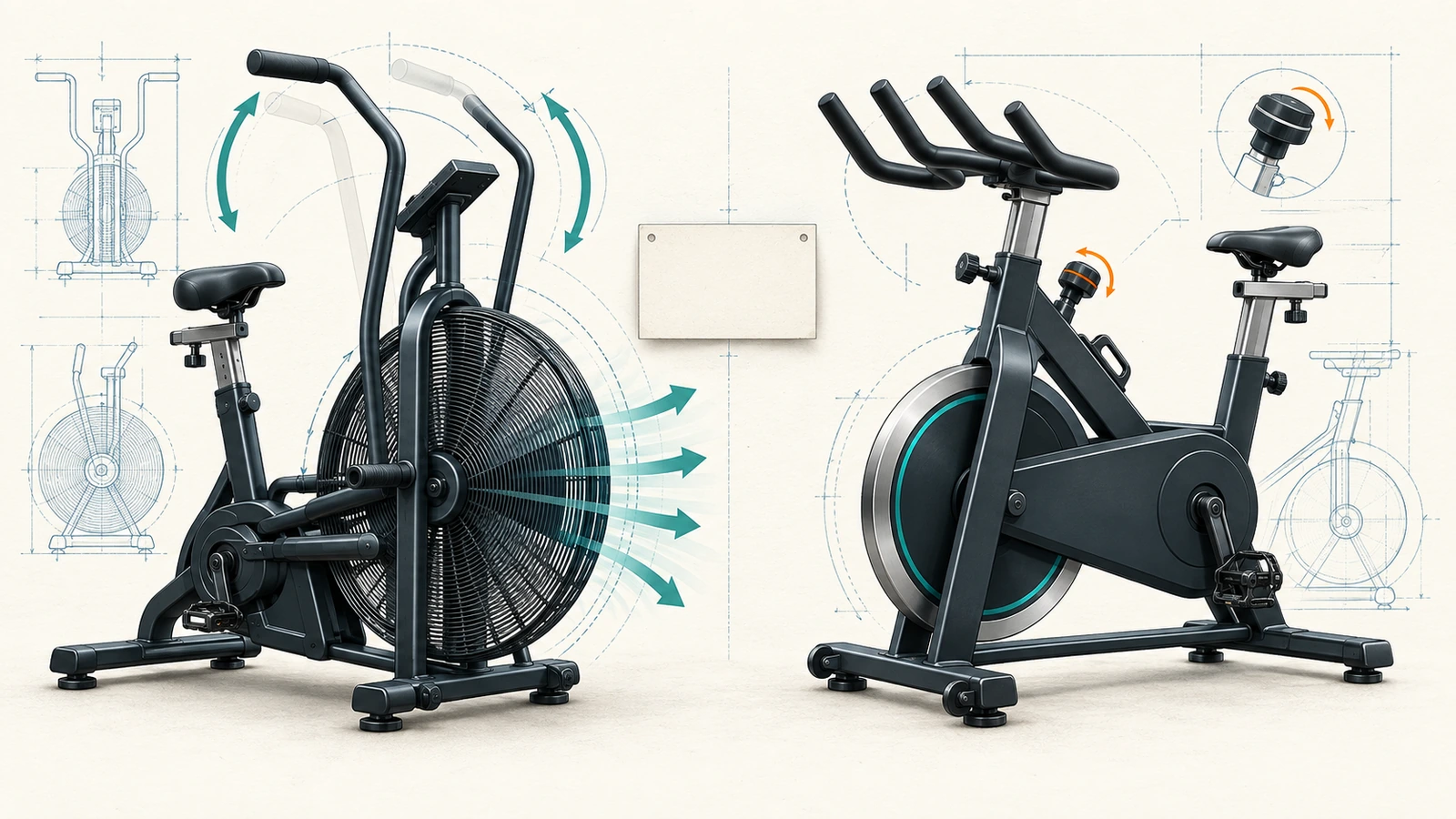
A fan bike and an indoor cycling bike solve different training and ownership problems. The AD7 remains a documentary candidate when moving handles, user-driven air resistance, combined arm-and-leg participation, and a console power path that does not require a permanent wall outlet are hard requirements. The IC4 remains a documentary candidate when a fixed cycling posture, dual SPD/toe-cage pedals, magnetic resistance, and documented Peloton cadence or Zwift power-source connections matter. Neither format wins in general. The exact room, rider, activity, outlet, app, airflow, sound, movement, maintenance, return, and ownership constraints can eliminate one format—or both.
Comparison scope and decision question
This page compares two equipment formats through two exact current anchors:
- the Schwinn AirDyne AD7, representing a fan bike with moving hand grips and air resistance; and
- the Schwinn IC4, representing a fixed indoor cycle with magnetic resistance, static cycling hand positions, and documented app-data paths.
The buyer question is not “Which bike is best?” It is: which format, if either, remains eligible after the buyer defines the intended movements, rider dimensions, user mass, pedals, app/data needs, outlet availability, operating zone, airflow tolerance, noise and vibration evidence requirement, move-and-store routine, maintenance preference, and ownership exposure?
Why the AD7 and IC4 are anchors
The roadmap connects this category comparison to exact-product research for the AD7 and IC4. This bounded anchor pair uses two current United States pages that expose enough comparable documentary fields to support a format decision: dimensions, product mass, maximum-user fields, resistance architecture, power, console, warranty, price, delivery, and return routes. The pair also reduces seller-policy noise because both are sold through Schwinn’s current direct storefront. For live context, use the compact exercise-bike buyer guide, apartment noise and vibration guide, Schwinn IC4 analysis, and Schwinn AirDyne AD7 analysis. These pages are descriptive context, not direct test evidence for this comparison.
They remain anchors rather than category definitions. Other fan bikes and indoor cycles can differ in handle motion, pedals, rider range, console power, app support, product mass, drive architecture, resistance controls, warranties, and price. Findings tied to the AD7 or IC4 may not be transferred to an unnamed product.
Format boundary: fan bike and indoor cycle
The AD7’s current official records describe a high-strength fan, air resistance, moving multi-position hand grips, and a seat. The IC4’s current records describe a magnetic eddy-current brake, a flywheel-based indoor-cycling platform, fixed cycling hand positions, and dual-sided pedals. (Schwinn bike comparison)
Those architecture labels do not establish a universal format rule for every product. “Fan bike” does not guarantee moving handles, battery power, a specific user limit, or a specific sound level. “Indoor cycle” does not guarantee magnetic resistance, app support, SPD pedals, or quietness. Exact model identity remains required.
Why two anchors are not a market census
Schwinn’s own comparison page shows variation inside each broad format. The AD6 differs from AD7 in dimensions, maximum-user field, console, power, warranty, and current listing. The IC3 differs from IC4 in resistance system, app connectivity, power, product mass, maximum-user field, and warranty. (Schwinn bike comparison)
The anchor pair therefore supports scenario routing, not a market-wide ranking. A buyer who eliminates both anchors may still need a new exact-model candidate set rather than a conclusion that the entire category fails.
Evidence parity and major gaps
Documentary parity is partial. Both anchors have current official dimensions, mass, maximum-user fields, resistance descriptions, power fields, console records, prices, delivery choices, return routes, and warranty headlines. IC4 has more detailed official app-direction documentation. AD7 has a seller-documented moving-handle and airflow-control path.
There is no evidence parity for actual rider fit, workload equivalence, sound level, floor vibration, movement control, maintenance time, parts availability, service outcome, long-term wear, comfort, stability, or complete ownership cost. An unknown is not a pass, zero, or reason to favor a format.
Fixed criteria used before comparing
The fixed criteria are:
- exact model and current United States source;
- intended movement and implement participation;
- resistance and workload-control architecture;
- product rectangle, complete operating zone, and overhead path;
- rider dimensions and exact user-limit operator;
- pedals, hand positions, and body position;
- console power, local use, app support, and data/control direction;
- airflow, sound, vibration, and evidence quality;
- product mass, wheels, movement, and storage routine;
- maintenance, parts, service, price, delivery, returns, and warranty; and
- valid outcomes when both, one, or neither format fits.
No criterion is weighted by affiliate availability, seller commission, popularity, or a desired winner.
Key facts from current official records
| Field | AirDyne AD7 fan-bike anchor | IC4 indoor-cycle anchor |
|---|---|---|
| Current product rectangle | 53 × 26.5 × 53 in | 54.6 × 30.7 × 51.8 in |
| Product mass | 113 lb on product page; 113.6 lb on comparison page | 113.6 lb |
| Maximum-user field | 350 lb | 330 lb |
| Minimum ceiling formula | User height + 17.6 in | User height + 20 in |
| Resistance | Infinite air resistance | 100 magnetic levels |
| Hand path | Moving multi-position hand grips | Cycling handlebars; no fan |
| Pedals | Weighted pedals with straps in comparison record | Dual SPD clips and toe cages |
| Console power | 2 D batteries; AC-adapter ready | Wall adapter |
| App direction | No equivalent training-app direction established in checked AD7 records | Peloton cadence and Zwift power-source paths documented |
| Current displayed listing field | $999; $1,299 reference | $799; $999 reference |
| Warranty headline | Frame 10 years; mechanical 2; electronics 2; labor 6 months | Frame 10 years; mechanical/electronics 3; labor 1 year |
This is a dated source-state summary, not a fit verdict, workload conversion, noise result, maintenance ranking, checkout quote, or recommendation. (AD7 product record) (IC4 product record) (Schwinn bike comparison)
Product rectangle and complete operating zone
The listed floor rectangles are approximately:
| Anchor | Arithmetic rectangle | Approximate area |
|---|---|---|
| AD7 | 53 × 26.5 in | 9.75 sq ft |
| IC4 | 54.6 × 30.7 in | 11.64 sq ft |
The arithmetic difference is about 1.89 square feet in favor of the AD7’s smaller listed rectangle. That does not prove the AD7 uses less usable room. The AD7 needs moving-handle sweep, fan airflow, rider mount/dismount space, pedal path, seat adjustment, and service access. The IC4 needs rider mount/dismount space, pedal and knee path, seat and handlebar adjustment, device and bottle access, power-cord routing, and service access.
A product rectangle is not a complete operating zone. Use the live FitFootprint room-measurement workflow to record the exact room, route, active movement, access, and household paths.
Moving-handle sweep and rider access
AD7’s moving hand grips create a dynamic front-and-side envelope that is not represented by the base rectangle. The exact handle arc, rider arm length, hand position, seat setting, and body movement were not measured. IC4 lacks that moving-handle path, but its riding position still requires access to the bars, pedals, resistance knob, seat, device holder, and both sides used for mounting and adjustments.
A smaller base rectangle can therefore fail when the active movement envelope or entry path is incomplete. Neither anchor receives a room-fit conclusion from listed dimensions alone.
Ceiling height and overhead constraints
Schwinn publishes different minimum-ceiling formulas:
AD7: user height + 17.6 in
IC4: user height + 20 in
For a hypothetical 72-inch rider, the arithmetic results are 89.6 in for AD7 and 92 in for IC4. These are applications of seller formulas, not independent clearance rules. The buyer must still account for footwear, posture, handle motion, lights, fans, beams, sprinklers, mats, and any overhead object. (AD7 product record) (IC4 product record)
Product mass and movement
AD7’s product page states 113 lb, while the current comparison page states 113.6 lb. The conflict remains separate. IC4 states 113.6 lb. Both official records mention transport wheels. (Schwinn bike comparison)
Transport wheels do not establish one-person handling, threshold control, turning radius, stair suitability, storage permission, or ease of repeated movement. A buyer who must move either bike after every session needs the exact manual, route, floor transitions, grips, handler capacity, and retrieval sequence.
Rider range and user-limit fields
IC4’s product page publishes 5 ft 1 in–6 ft 4 in or 29–39 in inseam, while the IC4 FAQ publishes 4 ft 6 in–6 ft 6 in and 30–39 in inseam. The two official records conflict and remain separate. (IC4 product record) (IC4 FAQ)
The checked AD7 public record publishes a 350 lb maximum-user field but does not expose a sufficiently complete rider-height or inseam range for a buyer-specific fit conclusion. IC4 publishes 330 lb. A buyer below either maximum does not automatically pass reach, posture, mounting, accessibility, stability, or safety checks.
Resistance architecture
AD7’s comparison record describes infinite air resistance through a high-strength fan and belt-drive wording. Its product page uses “single-stage direct drive.” The architecture wording conflict is preserved rather than silently reconciled. (AD7 product record) (Schwinn bike comparison)
IC4’s current comparison record describes 100 levels of magnetic eddy-current resistance. Those numeric levels are model-specific positions, not watts and not equivalents to air-resistance output.
Workload control and comparability
A fan bike’s user-driven fan resistance and an indoor cycle’s numbered magnetic setting are different control systems. “Infinite” and “100 levels” cannot be placed on one linear scale. Cadence, force, rider technique, device calibration, and the exact model all affect the workload record.
The public sources do not provide a validated conversion such as “AD7 cadence X equals IC4 level Y.” Article 35 does not create one.
Upper- and lower-body participation
AD7’s moving handles permit simultaneous arm-and-leg work, while IC4’s resistance task is based on pedaling with cycling hand positions. The accepted PubMed route returned HTTP 203 during the September 13 recheck and did not provide a usable current source body in that transport. The historical package identified a small arm-, leg-, and combined-ergometry study, but Article 35 does not promote its participant, workload, or outcome details as current evidence from this recheck. (Accepted PubMed route)
No study-specific conclusion is used here about which format is medically suitable, safer, better for weight loss, or more effective for an individual. The buyer’s activity requirement may select a movement pattern; it does not create a universal training winner.
Pedals, footwear, and body position
IC4 has documented dual-sided SPD clips and toe cages. AD7’s comparison record lists large weighted pedals with straps. These interfaces serve different footwear and foot-retention preferences. (Schwinn bike comparison)
Neither pedal record establishes shoe compatibility for every buyer, pedal security, joint suitability, technique, comfort, or accessibility. Exact assembly, tightening, footwear, and current manual instructions remain required.
Console and power requirements
AD7’s current field states 2 D batteries, AC adapter ready. The page does not establish that batteries or an adapter are included. IC4’s current field states wall adapter, and the product page shows a powered console and USB charging path. (AD7 product record) (IC4 product record)
“Adapter ready” is not “adapter included.” A battery-console path is not proof that every console function is available with missing or depleted batteries. Wall power availability is a buyer input, not a format-wide assumption.
App and connectivity scope
IC4 has current official instructions for connecting to Peloton and Zwift. The Peloton path sends cadence to the app. The Zwift path selects IC4 as a power source, with optional cadence and heart-rate connections. The instructions do not establish Peloton resistance control, automatic resistance, every device/OS combination, or observed pairing by FitFootprint. (IC4 app connection guide)
The checked AD7 records do not document an equivalent training-app connection path. That is not proof that no third-party device can ever interact with an AD7; it means app support was not established for this comparison scope.
Standalone use and subscription boundary
AD7’s local console and fan resistance are documented without a connected-training subscription. IC4 has a local console and physical resistance control, while connected apps may require separate accounts, devices, or subscriptions. (IC4 product record)
“Can operate without a subscription” does not mean every data, class, history, export, streaming, or integration feature remains available offline or account-free. Digital services and the physical bike are separate ownership layers.
Airflow is not a noise result
AD7 includes an air diverter intended to redirect the fan’s airflow away from the rider. The accessory page describes airflow direction, not sound reduction. (AirDyne air diverter)
air diverter present
!=
measured noise reduction
The presence of a fan identifies a sound source, not its level at the buyer’s ear, wall, floor, or neighboring room.
Noise evidence is incomplete
The IC4 product page uses seller language about a quiet ride, while AD7 has a fan and moving linkage. Neither statement is a controlled comparative sound test. No reviewed record locks the exact unit revision, rider, workload, cadence, room, floor, mat, microphone, distance, background sound, duration, weighting, calibration, and repeat count for both bikes.
The accepted NIOSH route returned HTTP 403 during the September 13 recheck. No current NIOSH page detail is promoted here, and the article does not claim an apartment pass/fail threshold. (Accepted NIOSH route)
Current result:
AD7 sound level: not verified
IC4 sound level: not verified
comparative quietness: not established
Vibration evidence is incomplete
Airborne sound and structure-borne vibration are different outputs. Product feet, levelers, mats, rider input, floor construction, room location, and neighboring-space observation all matter. Neither current anchor has a controlled floor-transfer record in this package.
A lower near-bike sound reading would not prove lower floor vibration. A mat would not certify structural or neighbor suitability. The current shared noise method remains unapproved, so Article 35 does not create a reusable threshold.
Maintenance and inspection points
The formats expose different documented systems. AD7 includes a fan, moving hand grips, pedal/crank components, a resistance drive described inconsistently as direct or belt drive, a console, and battery/adapter-ready power. IC4 includes pedals, a flywheel, magnetic resistance, seat and handlebar adjustment, a powered console, connectivity, and a wall adapter.
Those lists do not prove one format requires more maintenance. Exact inspection intervals, fastener checks, cleaning, calibration, belt or linkage service, and prohibited repairs belong to the exact current manual and hardware revision.
Parts and service boundary
Schwinn maintains an official parts and manuals route for current equipment. The existence of a parts catalog or support channel does not establish that a needed part is in stock, affordable, covered, transferable, available for every revision, or delivered within a particular time. (Schwinn parts and manuals)
No parts purchase, support request, diagnosis, repair, or warranty claim was performed for this package.
Current listing-price state
Current official direct records rechecked September 13, 2026 displayed:
AD7 displayed listing field: $999
AD7 reference field: $1,299
IC4 displayed listing field: $799
IC4 reference field: $999
The product-only listing difference is $200. This is not a complete cost or value conclusion. Both current pages also display promotional shipping and mat language that may change or depend on destination and checkout. (AD7 product record) (IC4 product record) (AirDyne collection) (Connected-products collection)
Shipping, tax, and checkout
Both current product pages display free parcel delivery and a $299 White Glove option, subject to the seller’s current conditions. The IC4 page and AD7 page also show a $99 equipment-mat field while current promotional language may show a free mat. Final inventory, address acceptance, tax, financing, promotion eligibility, delivery scope, stairs, assembly, and checkout amount remain purchase-day inputs. (AD7 product record) (IC4 product record)
Displayed product-plus-White-Glove arithmetic is $1,298 for AD7 and $1,098 for IC4 before tax and other unknowns. These are arithmetic scenarios, not quotes, and the displayed promotion banner showed an end date of September 12, 2026 at the time of the September 13 check; do not infer that the promotion remains available.
Return exposure
The accepted Schwinn direct return route returned HTTP 403 after resolving to https://help.schwinnfitness.com/hc/en-us/articles/31867579307405-Return-Policy during the September 13 recheck. Its current freight, packaging, threshold, and restocking details therefore are not asserted. The IC4 FAQ still displayed a 30-day RMA instruction, but that does not establish the complete return terms for either anchor. (Accepted Schwinn return route)
No current 20% return-fee arithmetic is reported because the accepted policy route was transport-limited. Return freight, packaging, disassembly, extraction, authorization, and any restocking exposure remain conditional or unknown.
Warranty boundary
Current warranty headlines differ:
AD7: frame 10 years; mechanical 2; electronics 2; labor 6 months
IC4: frame 10 years; mechanical 3; electronics 3; labor 1 year
A longer headline does not prove fewer failures, lower repair cost, faster service, free freight, parts availability, or coverage for a specific event. Exact warranty terms, original-owner conditions, exclusions, registration, service geography, and hardware revision still require purchase-day verification. (Schwinn bike comparison)
Exact-model recall diligence
A current regulator check must be exact-model scoped. The accepted CPSC MYX route returned HTTP 403 during the September 13 recheck, so earlier historical notice details are not promoted as a current notice result. The route is not evidence about AD7, IC4, all fan bikes, or all indoor cycles. (Accepted CPSC route)
not named in one recall
!=
safety certification
Exact model, serial, production scope, current manual, assembly, inspection, and current regulator search remain separate diligence steps.
Direct evidence not performed
FitFootprint did not:
- inspect labels, serials, production revisions, cartons, manuals, pedals, handles, belts, fans, flywheels, magnets, batteries, adapters, cords, levelers, or transport wheels;
- assemble, ride, move, store, level, clean, lubricate, calibrate, maintain, or repair either bike;
- measure dimensions, product mass, handle sweep, rider fit, workload, cadence, power, sound, vibration, airflow, stability, comfort, or console accuracy;
- pair Peloton, Zwift, JRNY, heart-rate devices, phones, tablets, or watches; or
- complete checkout, shipping, delivery, return, warranty, parts, or service transactions.
Any direct-use conclusion remains unavailable.
Scenario: low-noise apartment use is mandatory
The buyer requires a verified low-noise and low-vibration result for a specific room and neighboring space. Neither anchor passes because there is no controlled comparative measurement. Seller quietness language, fan presence, a diverter, levelers, or a mat cannot substitute for a protocol.
Result: no purchase or defer until comparable direct evidence exists.Scenario: combined arm-and-leg participation is required
The buyer requires moving handles that contribute to the exercise task. AD7 remains the documentary survivor because its current record includes moving multi-position grips and fan resistance. IC4 is eliminated from this exact requirement because its handlebars do not provide the same moving-arm task.
This is a movement-architecture result, not a medical, calorie, or superiority claim.
Scenario: cycling-app data and SPD pedals are required
The buyer requires dual SPD/toe-cage pedals, documented Peloton cadence, and a documented Zwift power-source path. IC4 remains the documentary survivor. AD7’s checked records do not establish these features. (IC4 app connection guide)
The result does not prove pairing success, data accuracy, automatic resistance, or future platform continuity.
Scenario: no wall outlet is available
IC4 is eliminated by its current wall-adapter requirement. AD7 remains eligible with named conditions because its power field lists 2 D batteries and adapter-ready status rather than mandatory wall power. The buyer must still confirm battery inclusion, console behavior, current manual, and all non-power constraints.
Scenario: a 340 lb user
AD7’s 350 lb maximum-user field survives the numeric screen. IC4’s 330 lb field is below the buyer input and is eliminated. The AD7 result is not a fit, accessibility, stability, durability, or safety pass.
Scenario: move the bike after every session
Both anchors are roughly 113–113.6 lb in current official records. Both list transport wheels, but neither receives an easy-movement conclusion. The buyer should defer until the exact route, turns, thresholds, floor, grip, handler capacity, storage position, and retrieval sequence are verified.
Scenario: a permanent training zone
The buyer has a permanent zone, no app requirement, acceptable power access, and no verified low-noise requirement. Both anchors can remain viable if their exact rider, user-limit, movement, and operating-zone gates pass. The next step is to select the required movement and pedal/app architecture rather than use listed footprint alone.
When both format paths remain viable
Both remain viable when the buyer has room for either complete operating zone, falls within all exact rider and limit fields, accepts the different power paths, has no unresolved hard requirement for moving handles or cycling-app data, and does not require a verified noise result. A format preference can then be based on the intended movement and control system, with all unknowns preserved.
When the fan-bike path remains eligible
The fan-bike path remains eligible when moving handles, combined arm-and-leg participation, user-driven air resistance, or the AD7’s battery-console path is a hard requirement. The buyer must still resolve airflow, sound, vibration, exact fit, movement, maintenance, return, and cost.
When the indoor-cycle path remains eligible
The indoor-cycle path remains eligible when cycling posture, dual SPD/toe-cage pedals, magnetic resistance, and documented Peloton cadence or Zwift power-source connections are hard requirements. The buyer must still resolve the rider-range conflict, power route, device/app conditions, complete operating zone, sound, maintenance, return, and cost.
When neither current option fits
Neither anchor fits when the buyer simultaneously requires verified low sound and vibration, foldable storage, a product mass below 80 lb, no wall outlet, dual SPD pedals, and documented Peloton cadence. AD7 fails the folding, mass, and app/pedal requirements; IC4 fails the folding, mass, outlet, and verified-noise requirements.
The evidence-safe outcome is no purchase or a new exact-model candidate search.
Conflicts and unknowns
Material unresolved items include:
- AD7
113 lbversus113.6 lbofficial mass records; - AD7 direct-drive versus belt-drive wording;
- IC4 rider-height and inseam conflicts between product page and FAQ;
- exact current hardware revisions and manual binding;
- complete operating zones, movement routes, and storage outcomes;
- comparative workload, sound, vibration, airflow, stability, comfort, and durability;
- battery and adapter inclusion for AD7;
- device, OS, account, subscription, and pairing results for IC4;
- final inventory, checkout, tax, financing, delivery, return freight, restocking, parts, service, and complete ownership cost; and
- direct maintenance burden and service outcomes.
An unknown is not a pass, zero, or reason to favor a format.
Recommendation boundary
This documentation-only comparison supports scenario filtering, not a purchase recommendation. AD7 has documentary advantages for a moving-arm task, air-resistance architecture, a higher stated user-limit field, and a battery-console path. IC4 has documentary advantages for dual-sided cycling pedals, magnetic resistance, and specific app-data directions. Those differences do not establish overall quality, safety, noise, comfort, durability, value, or long-term ownership outcome.
Next step
Record the buyer’s exact room, route, rider height, inseam, mass, movement requirement, pedals, outlet, app/data needs, airflow tolerance, noise-evidence threshold, move-and-store routine, and return tolerance. Eliminate any anchor that fails a hard requirement. For surviving products, verify exact current manual, label/revision, inventory, checkout, shipping, warranty, return, and support terms. Use the live FitFootprint measurement guide to keep product, active movement, access, route, and storage states separate.
Methodology
The two anchors were fixed before scenario analysis. Exactly the fourteen accepted United States product, comparison, app, return, parts, research, noise-method, regulator, and FitFootprint routes were rechecked September 13, 2026 without source expansion. S01–S08 and S10 returned HTTP 200; the accepted return route returned 403 after redirect, PubMed returned 203, NIOSH and CPSC returned 403, and the live FitFootprint route was verified in the authenticated Chrome session. The current AD7 and IC4 pages displayed $999/$1,299 and $799/$999 fields respectively. Each field retains its exact scope: model, object, state, market, source, and checked date. Arithmetic floor rectangles use length × width ÷ 144; ceiling examples apply the seller formula; cost examples use transparent addition only where current displayed inputs remain available. Conflicts remain separate, missing values remain unknown, and model-specific facts are not transferred to an entire format. No affiliate factor, user review, retailer listing, direct-use claim, invented threshold, or universal winner was used.
For adjacent format and storage decisions, see Subscription vs No-Subscription Cardio Equipment and Compact Rower vs Exercise Bike vs Walking Pad.
Sources
The following rows identify the exact accepted routes and the current recheck boundary. A transport-limited route is retained for traceability, not as proof that its content was available during this check.
- Schwinn Fitness — AirDyne AD7 — United States product, dimension, power, displayed price, delivery, and warranty record — checked September 13, 2026
- Schwinn Fitness — IC4 Indoor Cycling Bike — United States product, dimension, power, app, displayed price, delivery, and warranty record — checked September 13, 2026
- Schwinn Fitness — Compare Bikes — same-brand resistance, pedals, power, mass, user-limit, warranty, and family boundary — checked September 13, 2026
- Schwinn Fitness — AirDyne collection — current AD7 listing snapshot — checked September 13, 2026
- Schwinn Fitness — Connected Fitness Products — current IC4 listing snapshot — checked September 13, 2026
- Schwinn Fitness — IC4 Bike App Connect — Peloton cadence and Zwift power-source direction — checked September 13, 2026
- Schwinn Fitness — IC4 Bike FAQ — alternate rider-range and 30-day RMA record — checked September 13, 2026
- Schwinn Fitness — AirDyne Air Diverter — airflow-control scope — checked September 13, 2026
- Schwinn Support — Return Policy — accepted route; current transport-limited at HTTP 403 after redirect — checked September 13, 2026
- Schwinn Fitness — Replacement Parts and Manuals — support-path boundary — checked September 13, 2026
- Accepted PubMed route — transport-limited HTTP 203 during current recheck — checked September 13, 2026
- Accepted NIOSH route — transport-limited HTTP 403 during current recheck — checked September 13, 2026
- Accepted CPSC MYX route — transport-limited HTTP 403 during current recheck — checked September 13, 2026
- FitFootprint — How to Measure Your Space for Home Fitness Equipment — verified-live room and route workflow