
Quick answer
Do not begin with a “best compact exercise bike” list. Begin with the exact buyer scenario, then eliminate every format that cannot document the required riding position, rider range, mount and dismount path, whole operating area, ceiling height, controls, power, app workflow, movement or folding process, storage state, maintenance, and current recall status.
A folding frame is not automatically easier to live with. A small assembled footprint is not automatically a small operating or retrieval area. Magnetic resistance is not automatically quiet, air resistance is not automatically unsuitable for an apartment, and a Bluetooth logo does not prove that the buyer’s device, app version, region, subscription plan, or data path will work. For a defined fixed-versus-folding format comparison that keeps space, storage, power, app paths, and buyer-specific checks separate, see Schwinn IC4 or a Folding Exercise Bike for Small Spaces? A Format Decision Guide.
The correct result may be a short list, a different cardio category, or no purchase until the missing evidence is resolved. Until a real buyer record and exact-unit diligence exist, there is not enough evidence to judge any candidate for that buyer.
For cost fields beyond a product listing, use The Total Cost of Home Fitness Equipment: Beyond the Purchase Price as a separate cost framework.
Define the buyer problem before choosing a bike format
Write one dated buyer record before comparing products:
- intended use: steady cycling, intervals, general movement, desk-adjacent use, rehabilitation only under qualified guidance, or another defined mode;
- preferred riding position: forward indoor-cycle posture, upright, semi-recumbent, recumbent, or full-body fan-bike motion;
- exact rider-height, inseam, seat-to-pedal, and source-stated user-limit requirements;
- real room, package route, assembly area, operating area, access, mount, dismount, emergency-exit, movement, storage, and retrieval paths;
- ceiling height after platform, pedal, saddle, and rider position are considered;
- whether the bike stays assembled, folds after each session, or must move between rooms;
- who performs assembly, leveling, folding, rolling, lifting, battery replacement, belt or chain inspection, cleaning, and service;
- required monitor, device holder, heart-rate path, app, account, Bluetooth, ANT+, subscription, network, export, and offline behavior;
- acceptable outlet, battery, adapter, cord, and shutdown dependencies;
- whether sound or vibration is decisive and therefore requires comparable measured evidence rather than marketing language;
- exact model, option, market, seller relationship, serial or lot route, current instructions, recall status, and replacement-part path;
- every material unknown.
Without that record, a product table can describe bike formats but cannot produce a defensible shortlist.
Build a current bike-format universe
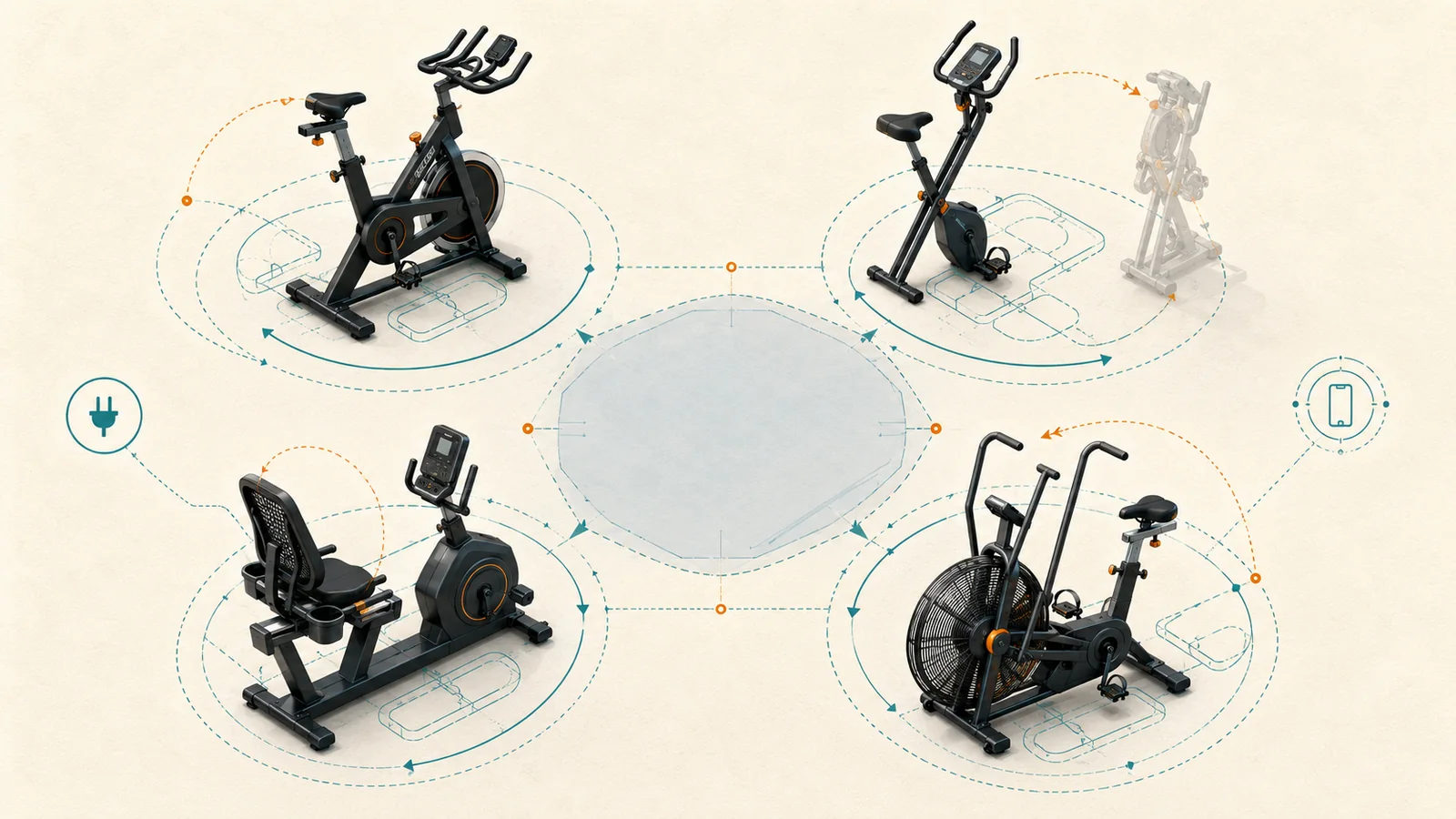
This bounded universe contains four exact official-source examples chosen to expose different space, control, power, and storage obligations:
- Concept2 BikeErg;
- XTERRA FB360 folding bike;
- Sunny Health & Fitness Foldable Magnetic Exercise X-Bike Pro, model SF-B223011;
- XTERRA SB150 recumbent bike.
The set is bounded and non-exhaustive. It does not say these are the four best bikes. Marketplace-only listings, ambiguous private-label products, discontinued identities, mini pedal exercisers, bicycle trainers, and bikes added only because an affiliate program or retailer exists are outside this guide. The Schwinn product links redirected away from the exact products, and the NIST conversion link led to a not-found page when rechecked on August 20, 2026; their product- or conversion-specific details are not used below.
This guide helps you narrow down bike formats; it does not assess an exact bike for your room or verify app compatibility. Use the room and delivery-path measurement workflow, the dimension definitions and evidence limits, and the cross-category compact-equipment guide when those earlier decisions are still open.
Apply inclusion and exclusion rules
Include a candidate only when all of the following are true:
- The exact product, option, market, count, source, and checked date are resolved.
- The official source identifies the primary riding configuration.
- Assembled dimensions, source-stated user limits, seat or inseam range, control method, and power path are available or explicitly unknown.
- Folded, moved, stored, and retrieval states remain separate when the bike folds or moves.
- Monitor, app, account, device, connection, and subscription dependencies remain exact and documentary.
- Noise, vibration, stability, comfort, and exercise-suitability claims are withheld unless separately supported.
- Current exact-model recall and remedy diligence can be completed.
- Eligibility is independent of affiliate access, retailer inventory, price, review score, and promotion.
Exclude or hold a candidate when:
- the ordered model, regional version, option, console, or app path is ambiguous;
- the primary source has been removed or materially changed;
- the buyer’s riding position or mount/dismount requirement is outside the documented configuration;
- package, route, ceiling, operating, access, folding, storage, or retrieval data are missing for a decisive constraint;
- the buyer requires a noise, vibration, comfort, medical, structural, electrical, accessibility, or safety conclusion that this evidence cannot support;
- an exact unit is covered by a recall and the remedy is unresolved;
- the product survives only through a generic room size, capacity buffer, “quiet,” “compact,” or “apartment-friendly” claim.
Use one fixed shortlist criteria set
Apply the same criteria to every exact bike.
| Criterion | Required record | Prohibited shortcut |
|---|---|---|
| Identity | Exact model, option, market, console, seller relationship, serial or lot route, and checked date | Treating a family or marketplace title as the ordered bike |
| Riding format | Indoor cycle, ergometer, fan bike, folding upright/X-bike, or recumbent state | Assuming every stationary bike supports the same posture or activity |
| Rider range | Exact user-height, inseam, seat-to-pedal, saddle, and source-stated user limit | Inventing a capacity buffer or treating maximum load as quality |
| Space system | Package, route, assembly, operating, access, mount, dismount, movement, storage, retrieval, and ceiling records | Treating assembled footprint as the whole room requirement |
| Fold and storage | Exact fold instructions, folded geometry, moved orientation, support condition, and retrieval path | Treating a folded dimension as storage permission |
| Controls | Console, resistance control, stop method, moving-arm or fixed-handlebar state, and visible metrics | Assuming fewer controls are simpler or safer |
| Power | Wall power, adapter, battery, self-powered monitor, cord route, shutdown, and replacement needs | Assuming any outlet or battery arrangement is acceptable |
| Apps and data | Exact official support, app/device/OS/region/version, account, subscription, direction, offline behavior, and export | Treating a logo or Bluetooth radio as verified compatibility |
| Sound and vibration | Reviewed comparable measurement protocol and environment when decisive | Ranking noise from resistance type or marketing words |
| Handling | Bike mass, wheels, grips, fold latch, route, thresholds, turns, and responsible person | Treating transport wheels or low weight as easy movement |
| Ownership | Assembly, leveling, inspection, cleaning, batteries, belts/chains, pedals, seat posts, parts, firmware, and service | Assuming low maintenance because the bike is compact |
| Recall | Exact CPSC and manufacturer search by model, serial, lot, and remedy status | Treating a clean brand search as safety certification |
| Evidence | Direct sources, dates, conflicts, missing fields, and prohibited inferences | Averaging conflicts or converting unknown to pass |
Compare preferences only after a candidate survives every relevant must-have.
Current source-state bike examples
The table records only fields stated on the checked official pages. It does not rank the candidates or prove fit.
| Exact model | Configuration and size record | User and ceiling record | Power and controls | Fold, storage, or app record |
|---|---|---|---|---|
| Concept2 BikeErg | Fixed ergometer; 48 × 24 in assembled; source recommends 60 × 48 in clearance for use; 68 lb | 350 lb maximum; seat-to-pedal range is source-stated | PM5 uses two D batteries and draws power from the flywheel during use | Must be stored fully assembled; ErgData documentation supports PM5 via Bluetooth, but device/version/account workflow remains a separate verification task |
| XTERRA FB360 | Folding X-bike; 37.4 × 22 × 44 in set up; 21.25 × 22 × 50 in folded | 250 lb maximum; recommended 4 ft 10 in–5 ft 10 in | Two AA batteries; eight resistance levels; LCD console | Folded dimensions and transport wheels are stated; real latch, route, stored support, and retrieval remain buyer-specific |
| Sunny SF-B223011 | Folding magnetic X-bike; 33.5 × 21.7 × 52.6 in; 22.4 × 21.7 × 58.7 in folded; 44 lb | 300 lb maximum; 28.3–33.5 in inseam range | Monitor power path remains unconfirmed pending the exact manual; 14 resistance levels | Product page states Bluetooth connection to SunnyFit; exact device, app version, account, and successful connection remain unverified |
| XTERRA SB150 | Fixed recumbent bike; 58.3 × 24.8 × 45.3 in; 72 lb | 265 lb maximum; recommended 5 ft 1 in–6 ft 2 in; seat-to-pedal 25.23–32.8 in | Wall power; 24 resistance levels; backlit console | No folded state is stated; recumbent seat and mount/dismount path create a different access record from upright formats |
The table exposes configuration differences. It does not establish quietness, stability, comfort, exercise suitability, safe use, or apartment fit.
Scenario path: fixed indoor cycle
A fixed indoor cycle may provide a familiar forward riding position and integrated resistance controls, but the buyer must evaluate the entire configuration:
- handlebar and saddle adjustment range;
- pedal and shoe interface;
- standing versus seated use;
- device-holder and screen position;
- wall outlet and cord route;
- mount, dismount, and emergency-exit path;
- sweat, cleaning, floor, and service access;
- whether the bike must move despite lacking a folded state;
- required ceiling height for the exact rider and use pattern;
- app and subscription behavior when connected features matter.
The sources retained in this guide do not supply a current fixed-indoor-cycle example. Treat the exact identity, rider range, ceiling, power, controls, and app fields as unresolved buyer-record requirements until a suitable source has been reviewed. Do not fill those fields with a family name, a redirect destination, or a generic category assumption.
Scenario path: folding bike stored after use
A folding bike requires a complete repeated workflow:
- finish and stop the session;
- exit the bike;
- reset the seat or controls if instructions require it;
- fold through the exact approved sequence;
- confirm the latch or support state;
- move the bike in the documented orientation;
- clear real turns, thresholds, furniture, and doors;
- place it in the approved stored orientation;
- store console, batteries, adapters, device, and accessories;
- retrieve, unfold, level, inspect, and reset it before the next session.
The XTERRA FB360 and Sunny SF-B223011 pages state set-up and folded dimensions. That supports a fold-state comparison, not a storage or handling verdict. Folded height can increase even when floor length decreases. Transport wheels do not prove that one person can move the bike through a real route.
Scenario path: recumbent access and seated geometry
A recumbent bike can change the seat, pedal, and access relationship:
- the frame may be longer than an upright or folding bike;
- the seat may require a wider side-access path;
- adjustment can be forward/back rather than only up/down;
- mount and dismount may be the decisive constraint;
- a backrest and lower seat do not establish medical suitability;
- the buyer must still verify ceiling, floor, outlet, route, and service access.
The XTERRA SB150 product page states a 58.3 in length, seat-to-pedal range, user-height range, and wall-power requirement. Those are configuration facts only. Any rehabilitation, joint, balance, accessibility, or medical conclusion requires qualified evidence outside this page.
Scenario path: fixed ergometer
A fixed ergometer introduces its own resistance, monitor, and motion records. For the BikeErg, record:
- fixed assembled storage;
- 60 × 48 in source-recommended use area;
- saddle and handlebar setup;
- PM5 battery and flywheel-generated monitor power;
- ErgData, PM5, phone, Bluetooth, account, and export workflow;
- any accessory or device-holder requirement.
Do not infer that one format is louder, quieter, harder, safer, or more effective from resistance type.
Scenario path: apps, accounts, and data
Documentary app support must be separated from a successful setup.
Before crediting an app or connected feature, record:
- exact bike model and console;
- official supported app;
- region;
- phone, tablet, watch, or computer;
- operating-system and app version;
- Bluetooth or ANT+ direction;
- account requirement;
- subscription requirement and which features remain without it;
- metrics sent from bike to app;
- controls sent from app to bike, if officially supported;
- offline behavior;
- export, deletion, cancellation, and shutdown fallback;
- what remains usable when the app, account, network, or service is unavailable.
This guide uses Concept2’s ErgData documentation, the Sunny X-bike page, and the SunnyFit page. These are official support statements, not pairing tests or guarantees that every feature works across every current device and subscription. No fixed-indoor-cycle app example remains in this guide after the Schwinn product links were withdrawn.
For a focused Peloton App compatibility verification guide, see the documentation-only Exercise Bikes Compatible With the Peloton App: Verification Guide; it keeps documented paths separate from observed pairing.
Eliminate before comparing preferences
Apply hard constraints in this order:
- exact identity, market, console, and current official source;
- riding position and intended use;
- rider height, inseam, seat-to-pedal range, and source-stated maximum;
- package, route, assembly, operating, access, mount, dismount, ceiling, and retrieval;
- folding, movement, stored orientation, and responsible person;
- power, batteries, adapter, cord, and shutdown;
- monitor, controls, app, device, account, subscription, and fallback;
- noise or vibration evidence when decisive;
- maintenance, parts, service, and recall remedy;
- evidence completeness and conflicts.
Only surviving candidates may be compared by appearance, display preference, app interest, resistance feel, or other optional preferences.
Check noise, floor, power, and recall evidence
Noise and vibration are environment-dependent. Manufacturer words such as “quiet,” “smooth,” or “apartment-friendly,” and resistance labels such as magnetic or air, do not create comparable measured evidence. When sound is decisive, leave the result unresolved or defer the purchase until a reviewed protocol covers the exact bike, floor, room, load, operating mode, instrument, duration, and background conditions.
Floor, outlet, and placement questions also exceed a simple product table. Preserve manufacturer instructions, but do not certify structural capacity, electrical suitability, accessibility, or safe placement.
Recall diligence is exact-unit work. The November 6, 2025 CPSC Peloton notice covers Original Series Bike+ model PL02 with specified serial scope. The CPSC MYX notice covers MYX I, MYX II, and MYX II Plus. These examples show why model, serial, affected component, remedy, and completion status must remain exact. They do not imply that another bike from the same brand or category is recalled, cleared, or safe.
When no exercise bike qualifies
Consider another equipment category, make no purchase, or defer the decision when:
- no bike format supports the required riding position or rider range;
- the real package, route, assembly, operating, access, mount, dismount, or storage workflow fails;
- ceiling height or moving-arm space remains unresolved;
- the buyer cannot accept the required outlet, battery, adapter, cord, app, account, or subscription dependency;
- a folding workflow cannot be performed and repeated;
- a recumbent seat or fixed frame cannot be accessed;
- noise or vibration is decisive but comparable evidence is unavailable;
- a recalled exact unit has no completed remedy;
- maintenance, parts, or service requirements are unacceptable;
- the buyer requires medical, rehabilitation, accessibility, structural, electrical, or safety conclusions that this page cannot provide;
- material source conflicts remain.
A walking pad, compact rower, pedal exerciser, outdoor bicycle and trainer, or no purchase may be a better category path. This page does not rank those alternatives.
Handle missing or conflicting information
Keep every source record separate. Compare exact model, option, market, state, object, axes, unit, date, app version, and rounding before deciding whether two values describe the same thing.
Do not:
- average conflicting dimensions, rider ranges, or user limits;
- choose the smaller dimension to make a room pass;
- choose the larger user limit to keep a candidate;
- convert folded dimensions into stored-state permission;
- treat transport wheels as a handling result;
- treat resistance type as a noise score;
- treat app branding as a successful connection or subscription-free result;
- treat source-stated user range as medical or ergonomic suitability;
- transfer a recall between models or clear an exact unit without identity and remedy evidence;
- replace missing route, ceiling, access, power, or storage data with a generic number;
- convert “compact,” “quiet,” “comfortable,” “safe,” or “apartment-friendly” into verified results.
Name the missing field and the exact shortlist conclusion it blocks.
Next step
Save one dated record for every surviving format and one reason for every elimination. Recheck exact product identity, manuals, app support, recalls, service, and volatile purchase terms when your shortlist is ready for a real buyer decision.
For an exact current indoor-cycling example, see the documentation-only Schwinn IC4 small-space analysis; its compatibility, fit, safety, cost, and recommendation limits remain explicit.
For the fan-bike versus indoor-cycle format question, see the documentation-only Fan Bike vs Indoor Cycling Bike for a Small Home; room, use, noise, maintenance, and recommendation limits remain explicit.
Methodology
This guide applies a fixed, monetization-independent eligibility process to a bounded set of current official-source examples. It separates riding format, rider range, assembled and operating states, folding and storage workflow, ceiling, controls, power, app support, sound-evidence limits, ownership, recall identity, and missing information.
No bike was tested and no buyer scenario was supplied. This is a research-based, documentation-only method. Changes to the sources, candidates, claims, or evidence limitations require a further evidence review.
For a cross-category format comparison, see the Compact Rower vs Exercise Bike vs Walking Pad for a Small Room.
Sources
- Concept2 — BikeErg — official product page checked July 24, 2026.
- Concept2 — ErgData — official app-support page checked July 24, 2026.
- XTERRA Fitness — FB360 Folding Bike — official United States product page checked July 24, 2026.
- Sunny Health & Fitness — Foldable Magnetic Exercise X-Bike Pro SF-B223011 — official product page checked July 24, 2026.
- XTERRA Fitness — SB150 Recumbent Bike — official United States product page checked July 24, 2026.
- Sunny Health & Fitness — SunnyFit App — official app page checked July 24, 2026.
- U.S. Consumer Product Safety Commission — Peloton Recalls Original Series Bike+ Exercise Bikes Due to Fall and Injury Hazards — recall dated November 6, 2025 and checked July 24, 2026.
- U.S. Consumer Product Safety Commission — MYX Recalls MYX I, MYX II and MYX II Plus Exercise Bicycles Due to Injury Hazard — checked July 24, 2026.
- U.S. Consumer Product Safety Commission — Recalls & Product Safety Warnings — exact-model search route checked July 24, 2026.