
Quick answer
Choose by configuration and intended use, not by retail label.
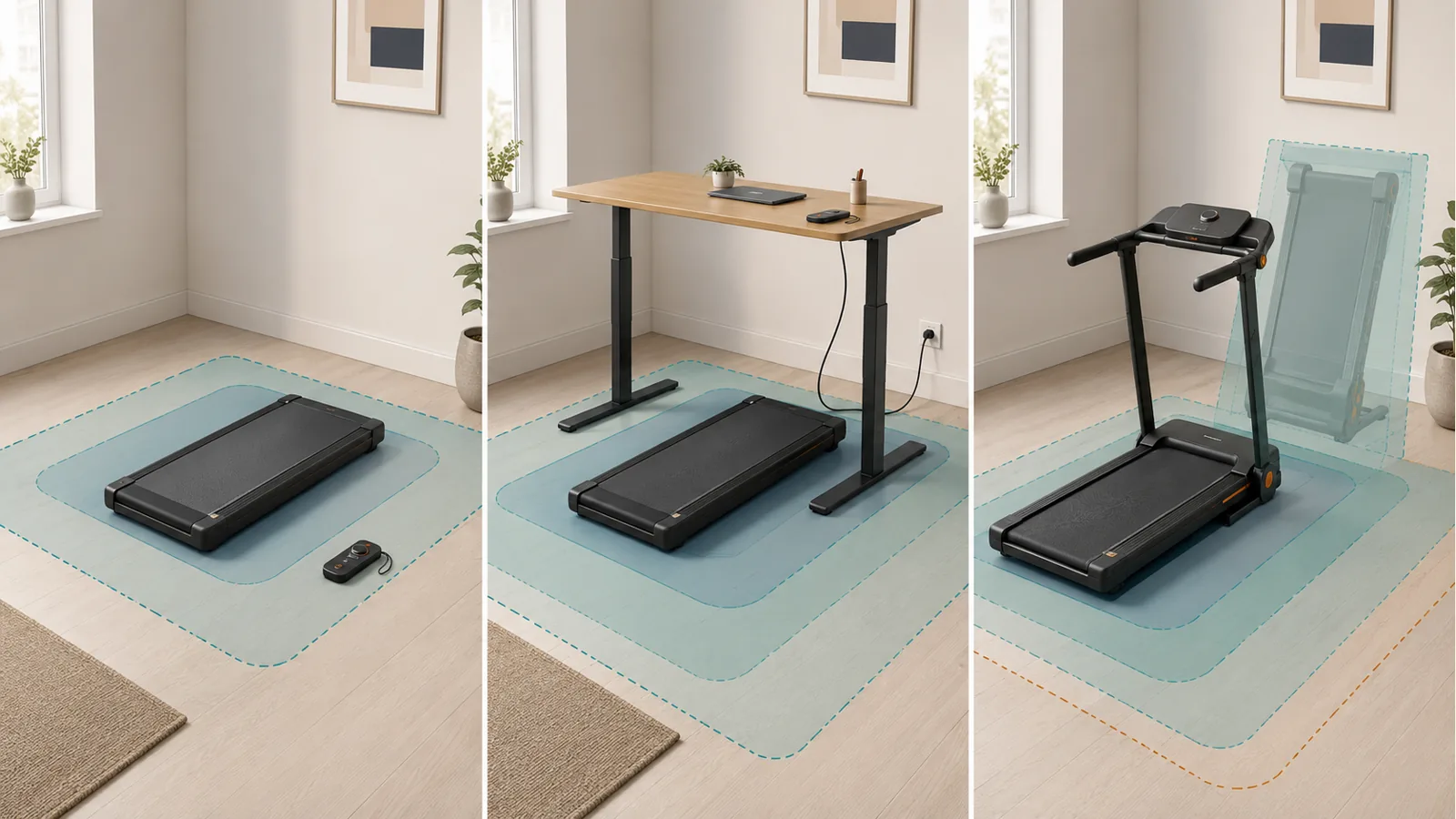
A low-profile walking platform can minimize the equipment envelope and may support desk walking, but the exact model may rely on a remote or app, may have no upright console, and may require a separate storage or movement plan. A desk-oriented treadmill base is designed around a standing-desk setup, but it may require a separate console, desk-height allowance, cable path, and a permanent floor position. An upright folding treadmill can provide integrated controls, handrails, a larger documented speed or incline envelope, and a fold-up state, but it still needs its full operating area, assembly route, power requirements, and a usable folded location.
No format wins universally. Eliminate any option whose exact documentation cannot satisfy the room, route, desk, control, activity, storage, power, and ownership constraints that matter in your scenario.
If the broader equipment category is still undecided, start with the compact-equipment buyer guide before comparing treadmill formats.
The labels overlap more than they clarify
“Walking pad” and “under-desk treadmill” are not clean, mutually exclusive technical classes. The current WalkingPad A1 Pro product page, for example, uses both the WalkingPad product name and the phrase “under desk treadmill.” A folding treadmill can also be marketed for walking, while some low-profile products fold through the deck and others do not fold at all.
Use three configuration records instead:
- Low-profile walking platform: a deck-focused configuration with no permanent upright console in the operating state.
- Desk-oriented treadmill base: a low-profile treadmill intended to work with a standing desk and an identified console or control device.
- Upright folding treadmill: a treadmill with an upright console or handrail structure and a documented deck-folding state.
These records describe configuration. They do not prove room fit, running suitability, quiet operation, easy movement, storage permission, durability, or safety.
Current source examples at a glance
| Example | Exact source state used here | What it illustrates | What it does not establish |
|---|---|---|---|
| WalkingPad A1 Pro/A1 Plus page state | Current United States page checked July 29, 2026; model/variant wording must be resolved before exact-value use | Product-page label overlap; low-profile foldable deck; remote/app/FootSense control types; separate unfolded, folded, and package records | A cross-variant value, category rule, storage permission, noise result, health benefit, fit, or recommendation |
| LifeSpan TR1200Pro-GlowUp page state | Current United States page checked July 29, 2026; body also uses TR1200B Pro wording | Desk-oriented base; separate wired console; desk/step-up dependency; full-length operating base; transport wheels | Exact identity without verification, desk fit, call suitability, quietness, durability, value, or a universal under-desk definition |
| Horizon T101 product/support family | Current product and dimensions-support pages checked July 29, 2026; official assembled-dimension records conflict and the former T101-06 instructions route is unavailable | Upright console/handrail configuration; product-page operating features; documented folded-state obligations | An exact operating or folding procedure, a selected assembled dimension, user suitability, apartment suitability, safety certification, quietness, or a universal folding-treadmill rule |
The examples are not ranked. They are used because their current official pages expose different configuration obligations.
Record the buyer scenario before comparing
Create one dated scenario and identify:
- the intended mode: work walking, dedicated exercise, mixed use, or another defined use;
- the exact room and complete delivery route;
- the standing desk, if any, including its usable height range and base geometry;
- the user-dependent limits named by each exact source;
- the required operating, access, folding, movement, and storage states;
- the available outlet and allowed cord path;
- the person or people who must assemble, move, retrieve, or reset the equipment;
- whether the setup must disappear after each session;
- maintenance, service, account, app, console, remote, and accessory dependencies;
- every material unknown or source conflict.
A category comparison without this scenario can describe tradeoffs, but it cannot produce a trustworthy shortlist.
Use the room-and-route measuring workflow to capture the scenario, then use the dimensions methodology to keep package, assembled, operating, access, folded, moved, and stored records separate.
Compare exact configurations with one fixed criteria set
Use the same criteria for every candidate.
| Criterion | Low-profile walking platform | Desk-oriented treadmill base | Upright folding treadmill |
|---|---|---|---|
| Intended mode | Verify the source permits the exact walking mode and duration being considered | Verify the base, console, desk, and work-walking configuration together | Verify the exact walking, jogging, or running mode documented for the model |
| Controls | Record remote, app, foot-sensing, onboard buttons, emergency stop, and account dependencies | Record the separate console or controller, its cable or wireless path, and where it sits | Record console, handrail controls, the documented stop method, programs, and any app dependency |
| Desk dependency | Confirm desk height, base clearance, monitor/keyboard position, and cable path if used under a desk | Treat the standing desk and console as required scenario inputs | Usually not an under-desk configuration; verify whether the upright frame conflicts with the desk or room |
| Operating envelope | Use exact unfolded/operational size plus documented access and user movement | Use exact treadmill, console, desk-base, step-up, and access geometry | Use exact assembled/operating size, deck movement, incline, entry/exit, and access requirements |
| Folded or stored state | Record whether the deck folds, how it is supported, and the allowed stored orientation | Do not infer storage from transport wheels or low profile; many bases remain full length | Record the exact fold procedure, latch, moved state, and usable folded location |
| Movement | Verify wheel location, permitted orientation, route, weight, and reset process | Verify whether the base can remain under the desk or must be moved, and where the console goes | Verify assembly, folding, wheel use, balance, route, and retrieval process |
| Power | Verify voltage, direct-wall or outlet requirements, adapter, cord location, and permitted routing | Verify treadmill and console power/communication requirements | Verify the exact circuit/outlet instructions, cord path, and console requirements |
| Activity envelope | Do not infer jogging or running from the category name | Work-walking intent does not establish dedicated-exercise suitability | A wider documented speed or incline range does not establish suitability for a particular person |
| Noise and vibration | Treat manufacturer noise language as a vendor claim unless a comparable test exists | Do not infer call suitability or neighbor acceptability | Do not infer apartment suitability from cushioning, motor, or marketing language |
| Ownership burden | Record assembly, reset frequency, maintenance, service access, app/console dependency, and storage handling | Add desk, console, cable, floor-position, and service dependencies | Add assembly, fold mechanism, larger route, service, maintenance, and relocation burden |
| Stop condition | Stop when exact control, use, storage, route, power, or user-limit evidence is missing | Stop when the desk/console/base combination is unresolved | Stop when the exact model, operating state, fold state, route, or power requirements are unresolved |
A compact envelope is only one criterion. An eligible configuration must survive every must-have check for the stated scenario.
Storage is a workflow, not a folded number
For every candidate, record:
- the operating position;
- the exact fold or shutdown sequence;
- the moved configuration;
- handles, wheels, latches, and permitted orientation;
- the route to the storage location;
- the approved stored orientation and support condition;
- retrieval and setup clearance;
- where the controller, cord, console, desk, or accessory goes.
The current WalkingPad A1 Pro product page lists separate unfolded, folded, and packaging sizes and states that the unit arrives assembled. It also lists remote, app, and FootSense controls. These facts make it a useful example of a low-profile platform with a deck-folding state. They do not establish that every walking pad folds, that the product may be stored in any orientation, or that one person can move it safely through a real room.
The current LifeSpan TR1200Pro-GlowUp example has front transport wheels but presents a full-length desk-treadmill base rather than a folded deck. Transport wheels do not automatically create a compact stored state.
The current Horizon example has a documented folded state. A fold-up state still requires floor area, height, route, latch, retrieval, and handling checks; exact folding and movement instructions remain required inputs.
Controls and dependencies can decide the format
A small footprint can be outweighed by a control or dependency mismatch.
Record whether the exact setup needs:
- a handheld remote;
- an app or account;
- foot-position sensing;
- a separate wired console;
- an upright console;
- a documented stop control or method;
- a standing desk;
- a phone, tablet, or network connection;
- an accessory, mat, anchor, or storage support;
- a specific outlet or direct-wall connection.
Do not assume a missing console is simpler. It may transfer control to a remote, app, desk-mounted device, or foot-sensing system. Do not assume an upright console is better. It may make under-desk use impossible and increase the operating or storage envelope.
Eliminate before you compare preferences
Apply hard constraints in this order:
- Identity: exact model, version, market, source, and current instructions are known.
- Activity: the exact source supports the intended operating mode.
- User limits: applicable source limits and user-dependent inputs are resolved.
- Room and route: package, delivery, assembly, operation, access, movement, and storage inputs are complete.
- Desk and controls: desk geometry, controller, console, app, account, cable, and stop method are workable.
- Power: the exact outlet, voltage, cord, and placement instructions can be followed.
- Handling: assembly, folding, movement, retrieval, and service questions are resolved.
- Ownership: maintenance, support, replacement, subscription, and return exposure are known enough for the decision.
- Evidence: material unknowns or source conflicts are visible.
Only after a candidate survives these checks should preferences such as appearance, programs, data display, or convenience influence the shortlist.
Work walking: start with the desk system
For work walking, begin with the complete workstation rather than the treadmill label.
Verify:
- the desk can reach a usable height after the treadmill’s step-up height is added;
- the desk feet, crossbar, cables, monitor arms, chair, and treadmill do not occupy the same space;
- the user can reach the controls and stop the belt as the exact instructions require;
- the console, remote, app, or control cable has an identified location;
- the operating mode and speed range are documented for the exact product;
- the room preserves required access and escape routes;
- calls, typing, balance, comfort, productivity, noise, and vibration remain untested unless separately observed under a reviewed protocol.
The current LifeSpan TR1200Pro-GlowUp product page illustrates a desk-oriented base with a separate Omni-Hub console that is added to the order, delivered separately, and connected by wire. The page also uses “TR1200B Pro Glow-Up” wording in its body, so exact model identity remains a required verification field. Its desk, console, cable, step-up, and floor-position records show why those inputs belong together. They do not prove that the system fits a particular desk or user, and values from this page must not be transferred to another model.
Dedicated exercise: verify the exact operating mode
An upright folding treadmill may be the more relevant format when the buyer needs integrated controls, handrails, incline, programs, or a wider documented speed range. That is still an exact-model question.
The current Horizon T101 product page presents an upright folding configuration with an integrated console/handrail structure and documented operating features. The previously reviewed T101-06 operating-instructions route now resolves to Horizon’s official not-found page, so this comparison does not claim an exact stop, folding, moving, leveling, or belt-adjustment procedure from that record.
Those records justify treating the T101 family as an example of an upright folding configuration. The current product page and Horizon’s current dimensions support page do not show the same assembled-dimension record, so this comparison does not select or average one. The sources do not prove that another folding treadmill has the same features, that the T101 suits a particular user, or that a higher maximum speed should control the purchase.
Mixed use: avoid the “does everything” shortcut
A mixed-use scenario might require work walking on some days and dedicated exercise on others. Do not assume one device can meet both needs because it is described as two-in-one, foldable, hybrid, or suitable for home and office.
Write separate must-haves for:
- work-walking controls and desk geometry;
- dedicated-exercise operating mode;
- transition time between modes;
- handrail or console position;
- storage and retrieval;
- power and cable reset;
- maintenance and service;
- each user’s limits and instructions.
A single configuration is eligible only when the exact documentation supports every required state. Two simpler configurations—or no purchase—may be more defensible than one unresolved hybrid.
When none of the formats qualifies
“No purchase” or “defer” is a valid result when:
- the standing desk or control system is incompatible;
- the operating or storage envelope cannot be verified;
- the delivery or movement route is unresolved;
- the intended activity is outside the exact instructions;
- power or cable placement cannot be resolved;
- the required equipment must be moved more often than the buyer can manage;
- the exact model or market identity is unclear;
- a material source conflict remains;
- specialist judgment is required and unavailable.
The comparison should not force a winner merely because three labels were placed in a table.
Handle missing or conflicting information
Keep each source record separate. When sources disagree, compare exact model, market, revision, object, state, axes, date, and rounding before deciding whether they describe the same thing.
Do not:
- average conflicting dimensions;
- choose the smaller value to make a fit pass;
- replace a missing clearance with a generic number;
- treat “compact,” “quiet,” “portable,” “office,” “walking,” or “running” as a verified measurement;
- turn folded dimensions into storage permission;
- turn transport wheels into an easy-movement claim;
- turn a stop control, handrail, or certification label into a site-specific safety conclusion.
Name the missing field and the exact conclusion it blocks.
The following source conflicts and gaps block unqualified conclusions:
- the WalkingPad page mixes A1 Pro/A1 Plus and variant wording;
- the LifeSpan title and body use TR1200Pro-GlowUp and TR1200B Pro wording;
- Horizon’s product and support pages currently disagree on assembled T101 dimensions.
- the formerly reviewed Horizon T101-06 operating-instructions route now resolves to an official not-found page, so affected procedure details remain unknown.
These conflicts do not create category averages. They block unqualified product-specific conclusions until the exact configuration and source state are resolved.
Next step
Save one comparison record per exact candidate. Bring the surviving configuration into the room-and-route workflow and interpret its fields with the dimensions methodology before treating it as eligible.
For a walking-pad shortlist, use the walking-pad buyer guide for apartments and small rooms after the format decision; it carries the same room, route, operating, control, storage, and evidence constraints into a bounded shortlist.
If the A1 Pro survives that category screen, continue with the WalkingPad A1 Pro exact-product analysis to inspect the current option, dimensions, ownership terms, source conflicts, and recommendation boundary without treating a product-page label as a verified fit result.
If the C2 is the exact candidate, use the WalkingPad C2 source-state analysis to inspect its current identity, dimensions, controls, ownership terms, official-source conflicts, direct-evidence gaps, and recommendation boundary under the same category-first discipline.
If both exact candidates remain, use the neutral WalkingPad A1 Pro versus C2 comparison to apply the same evidence-parity and buyer-scenario checks without assuming an overall winner.
Methodology
This comparison uses FitFootprint’s reviewed dimension, room-fit, and safety-source-routing concepts as bounded method inputs. Version 2 of the reviewed evidence supports a documentation-only comparison of treadmill formats and excludes the unavailable Horizon T101-06 instructions. The comparison classifies configurations, applies a fixed criteria set, preserves missing and conflicting inputs, and uses current official product pages only as examples of source states and dependencies.
No exact product, room, desk, route, noise level, vibration level, handling process, or user experience was tested. A material source, model identity, configuration, criteria, recommendation, or limitation change requires a new evidence review.
For a cross-category format comparison, see the Compact Rower vs Exercise Bike vs Walking Pad for a Small Room.
Sources
- WalkingPad — WalkingPad A1 Pro Foldable Under Desk Treadmill — United States page state, including visible A1 Pro/A1 Plus and variant wording, checked July 29, 2026.
- LifeSpan Fitness — TR1200Pro-GlowUp Under Desk Treadmill — United States page state, including TR1200B Pro wording in the body, checked July 29, 2026.
- Horizon Fitness — T101 Treadmill — current T101 product-family page checked July 29, 2026.
- Horizon Fitness — What are Dimensions and Weight of Treadmills? — support record updated March 9, 2026 and checked July 29, 2026; assembled T101 dimensions conflict with the current product page.
- National Institute of Standards and Technology — NIST Guide to the SI, Appendix B: Conversion Factors — updated August 18, 2025 and checked July 29, 2026.
- U.S. Consumer Product Safety Commission — Recalls — exact-model diligence route checked July 29, 2026.