
Quick answer
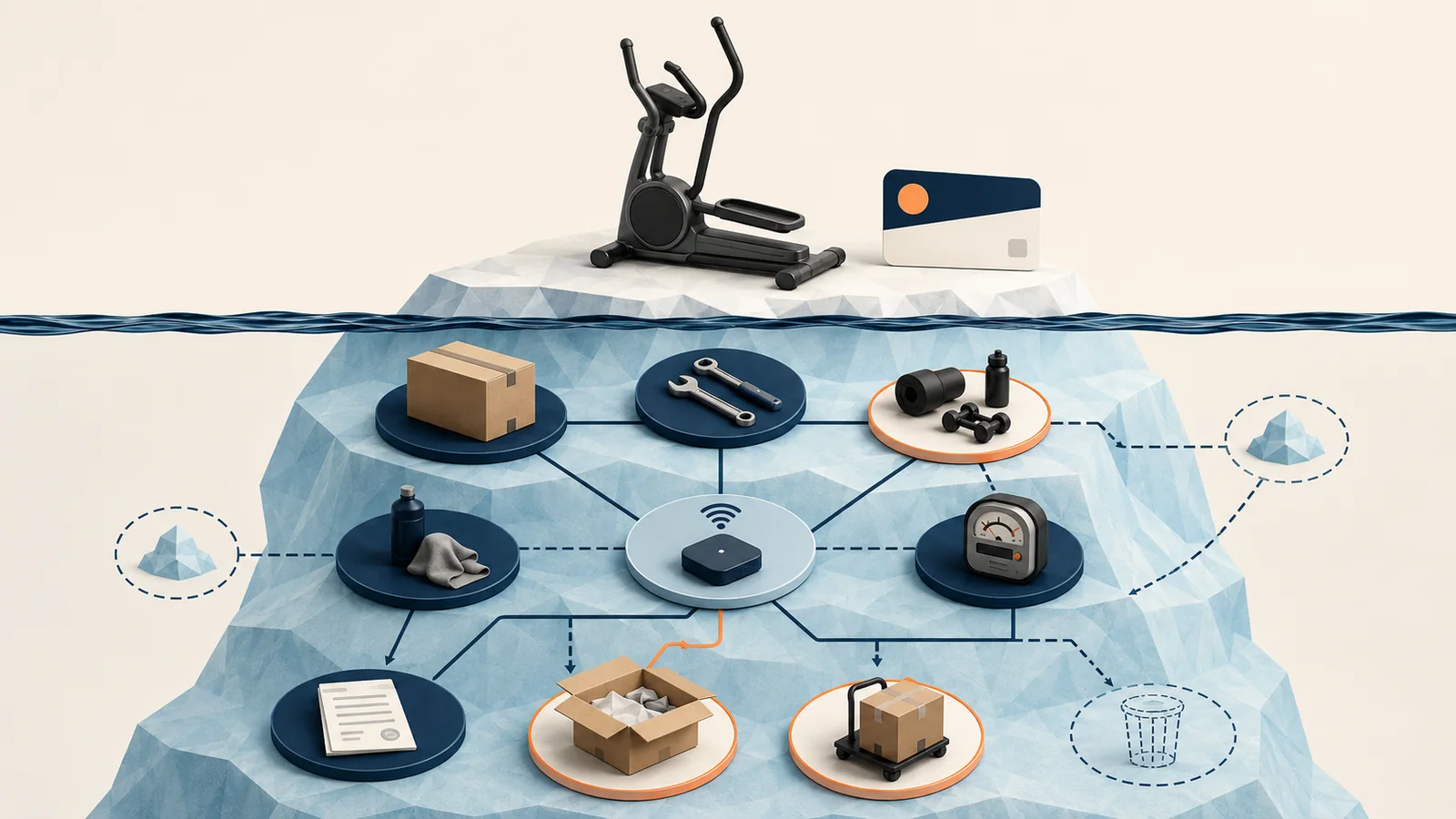
The purchase price is only one input. A defensible total-cost record separates:
- the exact normal price from a temporary promotion;
- one-time acquisition costs such as delivery, installation, required accessories, and scenario-specific taxes;
- recurring costs such as memberships, software, maintenance, consumables, electricity, and storage;
- financing costs from the cash price;
- return, pickup, de-installation, restocking, and other exit exposure;
- verified amounts from assumptions, excluded items, and unresolved unknowns.
Do not force a single total when a material cost is missing. Publish a known subtotal plus an explicit unknown register, a qualified scenario range, or a stop result. Do not call one option cheaper merely because its unverified costs were entered as zero.
Define the cost scenario before collecting numbers
Write one dated scenario record before opening a calculator. At minimum, identify:
- exact product, model, option, count, market, and seller;
- purchase, rental, refurbished, used, or financing path;
- currency and the date and time of every volatile price or policy check;
- normal price state and any promotion state;
- delivery location and whether remote-area, room-of-choice, stairs, pickup, or assembly services apply;
- required accessories, floor protection, installation, power, network, account, and subscription dependencies;
- intended ownership horizon and the number of recurring billing periods;
- expected usage only when an energy or per-use calculation requires it;
- maintenance, consumables, replacement parts, and service assumptions;
- return, cancellation, de-installation, pickup, disposal, and resale treatment;
- financing disclosures when credit is used;
- every cost that is known, assumed, excluded, conditional, or unknown.
Without that record, a total can mix different variants, sellers, terms, billing periods, and horizons while still looking precise.
Separate normal price from temporary promotion
Use the exact normal price as the durable baseline when the source identifies one. Record a promotion separately with its checked time, eligibility, end condition, coupon requirement, bundle requirement, and whether the discount changes return or refund treatment.
Do not:
- treat a crossed-out price as a verified normal price without source support;
- preserve a sale price as an evergreen baseline;
- combine a promotion from one seller with delivery or return terms from another;
- count a financing payment as the purchase price;
- count a rental payment as ownership unless the contract transfers ownership;
- subtract a rebate, trade-in, gift card, or tax benefit until eligibility and settlement are documented.
When only a promotional checkout amount is visible, label it as a time-bound purchase scenario. The normal-price field remains unresolved.
Classify every cost by timing and evidence state
Use two labels for every line item: when it occurs and how well it is supported.
| Timing class | Examples | Calculation treatment |
|---|---|---|
| One-time at acquisition | Hardware, delivery, installation, required accessories, setup service | Add once when verified for the exact order |
| Recurring | Membership, software, maintenance plan, electricity, storage | Multiply by explicit charged periods or usage units |
| Per event | Technician visit, belt lubricant, replacement part, moving service | Include only with a documented event or stated scenario frequency |
| Conditional exposure | Return freight, restocking, de-installation, damage fee, early cancellation | Keep separate until the trigger is part of the scenario |
| Terminal | Disposal, pickup, resale proceeds | Include only at the defined horizon with evidence or a labeled assumption |
Evidence states:
| Evidence state | Reader meaning | Allowed use |
|---|---|---|
| Verified current input | Exact current source, scope, currency, and checked date are recorded | May enter the known subtotal |
| Scenario assumption | The buyer deliberately supplies a value or frequency | May enter an assumption-dependent subtotal and sensitivity test |
| Conditional | The amount applies only if a named event occurs | Keep in an exposure table, not the base total |
| Unknown | A material input is missing, conflicting, or not recoverable | Never replace with zero |
| Excluded | Deliberately outside the approved scenario | State why the exclusion does not distort the decision |
| Not applicable | The cost class genuinely cannot occur in this scenario | May be zero only with the reason recorded |
A zero is a factual result, not a placeholder. “Free delivery” can be zero only for the exact destination and order after the source confirms it.
Map the one-time acquisition costs
The acquisition layer may include:
- normal hardware price;
- required bundles or accessories;
- delivery, freight, threshold, room-of-choice, or remote-area charges;
- assembly, installation, mounting, calibration, or setup;
- floor protection, mat, stand, bench, storage rack, adapter, cable, outlet, network, or device required for the intended configuration;
- sales or use tax only when the exact checkout or appropriate authority supports the amount;
- non-refundable service fees;
- approved disposal or removal of old equipment;
- financing fees that are not already included in a verified finance-charge figure.
Optional accessories stay outside the required subtotal unless the buyer scenario makes them necessary. Do not treat an accessory as optional when the product page says it is required to unlock the intended movements or features.
Map recurring ownership costs
Recurring cost records should identify the amount, billing period, start trigger, minimum commitment, renewal behavior, cancellation rule, and feature effect when the payment stops.
Possible classes include:
- required or optional equipment membership;
- app or software subscription;
- third-party streaming or connected-service subscription;
- maintenance plan or service contract;
- lubrication, batteries, filters, cleaning materials, or other consumables;
- replacement wear parts;
- electricity during use and, when evidenced, standby consumption;
- paid storage or recurring relocation service;
- account, network, device, or connectivity costs only when incremental to the buyer scenario.
Do not monetize maintenance frequency from generic advice. Use the exact manual, service record, or a clearly labeled scenario assumption. The FTC distinguishes a written warranty from a separately purchased service contract; do not assume either covers every repair or maintenance cost.
Treat financing as a separate cost layer
The monthly payment is not the equipment price and does not reveal the full cost of credit.
Record:
- cash price;
- down payment;
- amount financed;
- annual percentage rate, or APR;
- finance charge or total of payments when disclosed;
- term and number of payments;
- mandatory fees;
- promotional-rate conditions;
- whether taxes, accessories, membership, delivery, or installation are financed or separate;
- any contingent late, missed-payment, or early-payoff terms only when relevant to the scenario.
Use the lender or seller disclosure rather than reconstructing credit terms from a marketing payment alone. The CFPB explains that APR and interest rate are distinct credit-cost fields. A stated 0% APR does not prove that every cost is zero: the order can still have taxes, required services, membership, accessories, or a down payment. Do not provide tax, credit, or financial advice; show the disclosed inputs and transparent arithmetic.
Estimate electricity without inventing usage
Use energy cost only when the scenario has an evidence-backed or deliberately assumed consumption input.
A transparent estimate is:
energy_kWh = average_watts × operating_hours ÷ 1000energy_cost = energy_kWh × local_rate_per_kWh
For repeated use, multiply by the explicit number of sessions or days in the horizon. If the device remains connected, model standby energy separately only when a measured or authoritative standby value exists; the DOE standby-power guidance supplies the retained measurement boundary, not a product estimate.
Do not use nameplate maximum wattage as actual average consumption without labeling it as an upper-bound scenario. Use the buyer’s utility rate when available. EIA explains that electricity prices vary by locality and customer class, and its current state table can be a sensitivity input, not proof of the buyer’s bill.
If average power, operating time, standby use, or the applicable rate is missing, energy cost remains unknown. It may be immaterial, but materiality must be tested rather than assumed.
Model return, de-installation, and exit exposure
Return and exit costs belong in their own table because many apply only when the buyer returns, cancels, relocates, disposes of, or resells the equipment.
Record:
- return window and condition requirements;
- who pays outbound and return shipping;
- freight, pickup, stair, packaging, or restocking charges;
- non-refundable delivery, assembly, installation, or membership amounts;
- de-installation or wall-repair obligations;
- financing interest or fees that may not be refunded;
- cancellation, damage, or missing-component exposure;
- disposal or recycling route at the chosen horizon;
- resale proceeds only with a separately justified assumption or evidence.
A return policy is not a negative purchase price. Keep the base ownership scenario and return scenario separate, using the FTC online-shopping guidance only to define diligence fields rather than a seller-specific amount. A recall remedy can also change the exit path; use the CPSC exercise-equipment recall route, search by exact product identity, and record the remedy rather than estimating it.
Compare known totals without hiding unknowns
Use four outputs:
- Known subtotal: verified current amounts only.
- Assumption-dependent subtotal: known subtotal plus explicit scenario assumptions.
- Conditional exposure: costs that occur only after a named event.
- Unknown register: material missing or conflicting inputs that are not monetized.
Two options are comparable only when they share:
- equivalent buyer purpose and required functionality;
- the same currency and tax treatment;
- the same ownership horizon;
- equivalent purchase, rental, or financing basis;
- the same included and excluded cost classes;
- compatible billing-period and usage assumptions;
- similar evidence freshness and scope.
If one option includes installation and another has an unknown installation obligation, the known subtotals are not equivalent. The correct result is “not yet comparable,” not a winner.
Use one formula and one horizon
For a defined scenario:
known_total = verified_one_time_costs+ verified_recurring_costs_within_horizon+ verified_per_event_costs_in_scenario
assumption_total = known_total+ assumption_based_costs
conditional_exposure = sum(costs triggered only by named events)
Keep unknowns outside every numeric total. Show the horizon and period count next to the result.
Useful derived views may include:
- cost per month over the selected horizon;
- cost per year;
- cost per planned session only when session count is a visible assumption;
- difference between two otherwise comparable scenarios.
A derived figure does not become a quote, forecast, savings guarantee, or value judgment. Do not calculate a gym-membership break-even unless the services, travel, fees, taxes, horizon, usage, cancellation, and unknowns are genuinely comparable.
Run sensitivity on the largest uncertainty
Choose the one or two inputs most likely to change the decision, such as:
- membership duration;
- purchase versus rental duration;
- maintenance frequency;
- electricity usage;
- return freight;
- replacement part timing;
- promotion eligibility;
- financing charge;
- resale value, when the scenario deliberately includes it.
Run a low, base, and high assumption only within a credible, named range. Do not invent a range merely to fill a table. If no evidence supports a range, leave the input unknown and show how large it would need to be to change the decision.
Current source-state examples of cost packaging
The examples below show why a framework must read the exact current offer rather than assume every product bundles costs the same way. They are not recommendations and the page intentionally omits their volatile dollar amounts.
| Source-state example | Cost packaging visible on the checked page | What must be rechecked before a real calculation |
|---|---|---|
| Peloton Bike | New, refurbished, rental, financing, membership, delivery/setup, accessories, taxes, remote-delivery exposure, trial, and warranty are separate or differently bundled by path | Exact offer, destination, membership price, financing disclosure, accessories, tax, trial terms, and refund treatment |
| Tonal 2 | Purchase and rental paths package equipment, required accessories, membership, delivery/installation, warranty, and replacement obligations differently | Exact purchase or rental contract, membership commitment, installation quote, wall requirements, warranty, return/de-installation, and financing |
| Hydrow membership | The current membership page exposes monthly, prepaid, and machine-plus-membership bundle paths | Exact device, membership requirement, feature limits without membership, billing term, cancellation, and household scope |
These examples validate cost classes, not product quality or value.
Synthetic QA examples
The following numbers are fictional test data. They are not market estimates.
Case A — known subtotal with unresolved tax and return exposure
Normal equipment price: $900 verifiedDelivery: $80 verifiedRequired mat: $60 verifiedMaintenance assumption: $25 per year × 2 years = $50Tax: unknownReturn freight/restocking: unknown conditional exposure
Known subtotal: $1,040Assumption-dependent subtotal: $1,090Complete total: not available
The valid result is a $1,040 known subtotal, a $1,090 assumption-dependent subtotal, and two named unknowns. Entering zero for tax or return exposure would create false precision.
Case B — connected equipment over three years
Hardware: $2,000 verifiedDelivery/installation: $250 verifiedRequired accessory: $200 verifiedMembership assumption: $40 × 36 months = $1,440Energy assumption: $25 × 3 years = $75Verified finance charge: $120Return exposure: unknown
Known subtotal before assumptions: $2,570Assumption-dependent subtotal: $4,085Complete total: not available
Changing the membership duration is the primary sensitivity. The calculation does not claim that any current product has these prices.
Case C — not comparable
Option 1 includes delivery and installation but has an unknown required subscription after month 12. Option 2 has a verified subscription but an unknown freight and assembly obligation. Their known subtotals use different cost coverage. The result is not_comparable_pending_evidence, not “Option 1 is cheaper.”
Stop when the totals are not comparable
Stop and recheck when:
- exact model, seller, market, or offer path is unresolved;
- the normal price and promotion cannot be separated;
- one scenario is purchase and another is rental without a common outcome definition;
- billing periods or ownership horizons differ;
- tax treatment differs or is missing materially;
- required membership, accessories, installation, or maintenance is unknown;
- return or de-installation exposure could change the decision;
- financing disclosures are incomplete;
- electricity inputs are invented or borrowed from another product;
- an important policy or price is stale;
- a comparison depends on assumed resale, repair, or durability without evidence.
A known-cost subtotal can still be useful, but label it as incomplete.
Complete purchase-day diligence
Immediately before ordering, save a dated record of:
- exact product, option, count, seller, and destination;
- cart price, normal price, promotion, coupon, tax, delivery, assembly, and installation;
- required accessories and separate shipments;
- subscription tier, commitment, renewal, cancellation, and feature consequences;
- financing disclosure, amount financed, APR, finance charge, and total of payments;
- warranty and any separate service contract;
- maintenance instructions, consumables, parts, and service route;
- utility rate and energy assumption only when energy is modeled;
- return window, return freight, pickup, restocking, non-refundable services, and packaging;
- exact-model recall search and any remedy status;
- every unresolved amount and the decision it blocks.
Keep the evidence record even when the buyer chooses not to purchase.
Handle missing or conflicting information
Keep conflicting records separate by seller, product, option, region, date, and policy version.
Do not:
- average two prices from different sellers;
- use a promotional price from one date with a return policy from another;
- choose the lower delivery amount because it improves the total;
- treat “included” as zero without confirming the exact offer;
- use a monthly payment as the cash price;
- assume a subscription is optional because basic hardware still powers on;
- assume a warranty eliminates maintenance, labor, freight, or downtime costs;
- assume electricity is zero because no energy figure is published;
- subtract resale value without a defined method;
- convert buyer time or occupied floor area into dollars without an explicit valuation assumption.
Name the conflict, preserve both records, and block the affected total or comparison.
Next step
Use one worksheet per exact option. Save the formula version, source URLs, checked dates, cost-state labels, horizon, assumptions, conditional exposure, and unknown register. Recheck all volatile facts before a canonical pricing page, calculator, purchase decision, or public update.
For checked-date exact-product examples, use the WalkingPad A1 Pro total-cost analysis or the WalkingPad C2 total-cost analysis to see how a public-page subtotal stays separate from checkout, conditional exposure, and unresolved ownership inputs. The live adjustable dumbbell total-cost analysis applies this framework to pair, stand, delivery, warranty, return, service, storage, and replacement-risk fields without presenting a complete ownership total or recommendation. The live subscription versus no-subscription cardio equipment cost framework separates current-field arithmetic from complete ownership cost, conditional exposure, and unresolved buyer inputs. The live smart home gym versus modular equipment comparison keeps function parity, space, subscription, five-year scenario, and unresolved buyer checks separate from a recommendation.
For a category decision, use the live compact home fitness equipment guide, walking pad buyer guide, adjustable dumbbell buyer guide, or compact exercise bike buyer guide before applying this worksheet to an exact option.
Methodology
This framework uses the reviewed Article-specific article8-total-cost-framework-v01 method. The separately reviewed calculator has its own method version and limitations; this article does not establish a buyer-specific total. The method uses a category-neutral taxonomy, explicit cost timing, known-versus-unknown states, promotion separation, financing and energy boundaries, return exposure, one-horizon arithmetic, sensitivity tests, and fail-closed comparison rules.
The source-state examples and policy routes were rechecked on August 21, 2026. The exact offer, device, market, and date must still be rechecked before a real calculation or public update. This method is documentation-only and does not establish a buyer-specific total; a material source, method, claim, or conclusion change requires a fresh source and method review.
For a documented scenario, use the Home Fitness Equipment Total-Cost Calculator; it keeps known, assumed, conditional, terminal, and unknown amounts separate.
Sources
- Federal Trade Commission — Online Shopping — delivery, return, refund, return-shipping, and restocking diligence — checked August 21, 2026.
- Federal Trade Commission — Warranties — written-warranty and service-contract distinction — checked August 21, 2026.
- Consumer Financial Protection Bureau — What is the difference between a loan interest rate and the APR? — credit-cost field boundary — checked August 21, 2026.
- U.S. Energy Information Administration — Prices and factors affecting prices — electricity-rate locality and customer-class context — checked August 21, 2026.
- U.S. Energy Information Administration — Electric Power Monthly, Table 5.6.A — current state electricity-price reference, not a buyer-specific rate — checked August 21, 2026.
- U.S. Department of Energy — Measuring Standby Power — standby-power method boundary — checked August 21, 2026.
- U.S. Consumer Product Safety Commission — Exercise Equipment recalls — exact-product recall and remedy route; route access was limited in this environment — checked August 21, 2026.
- Peloton — Peloton Bike — current purchase, membership, financing, delivery/setup, and trial packaging example — checked August 21, 2026.
- Tonal — Tonal 2 — current equipment, accessories, membership, installation, purchase/rental, and warranty packaging example — checked August 21, 2026.
- Hydrow — Hydrow Memberships — current monthly, prepaid, and machine-plus-membership packaging example — checked August 21, 2026.